Haplogroup G2a1

– 6 min read


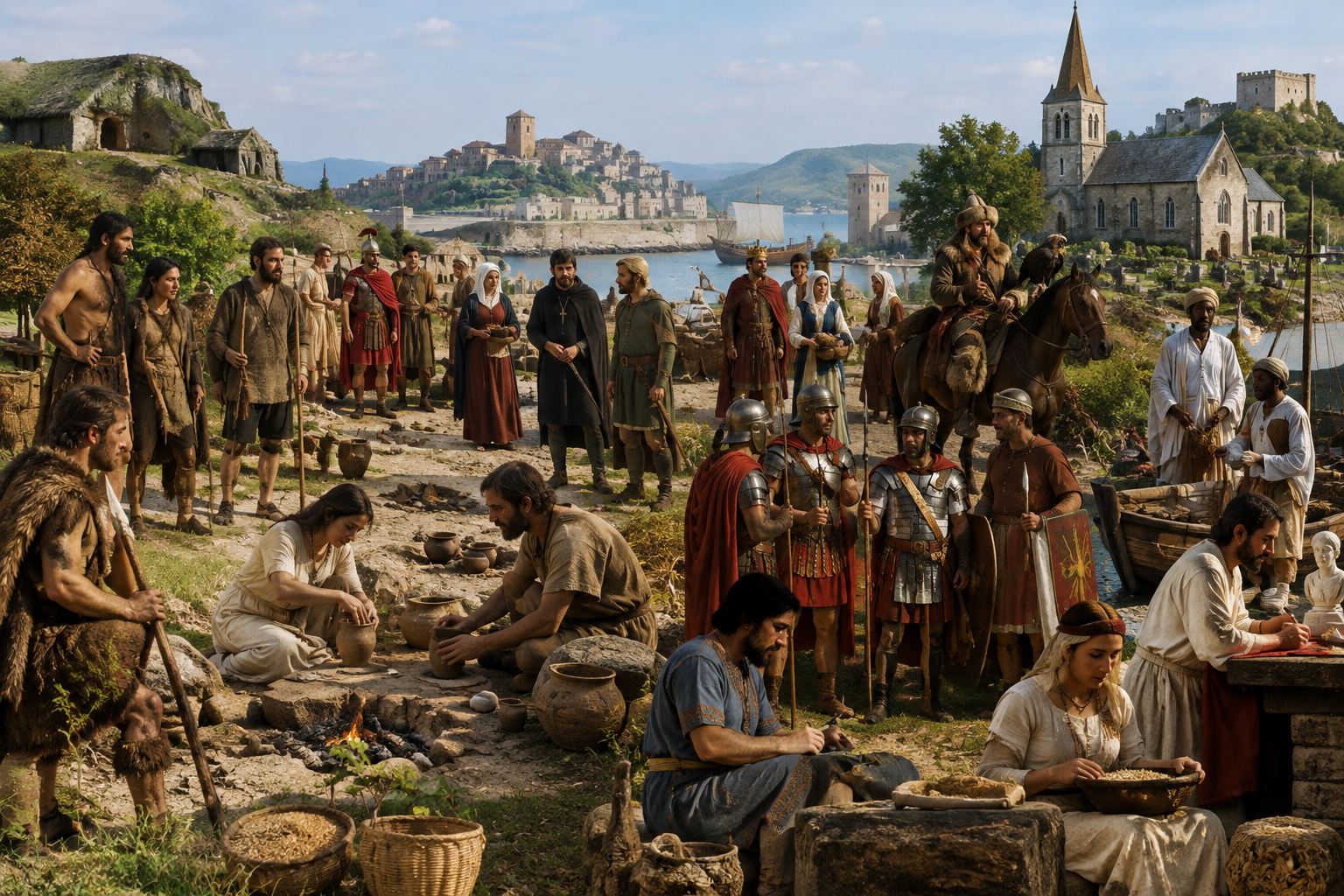
Some Y-chromosome lineages turn up in exactly the places one might expect. Others behave more like old archaeological gossip: appearing in an early farming settlement in Anatolia, reappearing in Neolithic central Europe, then turning up again in Roman, Lombard, Merovingian, and even early modern contexts far from any single obvious homeland. Haplogroup G2a1 belongs to that second category. It is historically interesting not because it can be reduced to one people, one kingdom, or one grand migration, but because it seems to sit at several important crossroads in the story of western Eurasia.
As a Y-DNA haplogroup, G2a1 traces a direct paternal line: father to son, back through time. That makes it a powerful tool for reconstructing ancient male ancestry, but it is only one narrow line among the many ancestors any person has. A man with G2a1 does not "come from" just one ancient population, and a shared haplogroup does not by itself prove close kinship. Still, when ancient DNA repeatedly finds related paternal branches across different places and periods, it gives us a valuable historical thread to follow.
Broadly speaking, haplogroup G is strongly associated in ancient DNA research with early farming populations of western Eurasia, especially those linked to the Neolithic expansion from the Near East into Europe. For G2a1 specifically, the most cautious reading of the evidence is that it belongs within that wider world of early agricultural societies and later regional survivals, dispersals, and mixtures. It should not be treated as the sole signature of Neolithic farmers, but it certainly appears in that company often enough to be historically important.
One of the striking things about the sample list for G2a1 is how early some appearances are. At Catalhoyuk in Late Neolithic Anatolia, sample cch097 dated to 5200 BC places this paternal line in one of the most famous landscapes of early settled life. Another early example comes from Seh Gabi, Kermanshah Province, Iran, where sample I1671 is dated to 5636 BC. Add to that I3882 from Shanidar, Iraq, dated to 7900 BC, and one begins to see G2a1 not as a purely European affair, but as part of a much broader Near Eastern and western Eurasian background.
That makes the later European finds all the more interesting. In the early farming world north and west of the Alps, FO130 from Fellbach-Oeffingen, Baden Wuerttemberg, dated to 5100 BC, places the lineage in an LBK context, one of the classic archaeological horizons of early Neolithic Europe. Another ancient Italian example, NEO834 from Mora Cavorso Cave, Jenne, Rome, dated to 5460 BC, reminds us that the spread of farming into Europe was not a single march but a set of regional processes by land and sea.
Explore the Neolithic Expansion
If this were only a Neolithic story, it would already be interesting. But G2a1 does not politely remain in one period. It appears again in later prehistoric and historic settings that suggest endurance, mobility, and local incorporation into very different societies.
Take I2111 from Verteba Cave, Ukraine, dated to 3500 BC in a Trypillian context. Then there is I7895 from Yamnaya Lesne Kosice, Slovakia, dated to 4500 BC. That combination is a useful warning against simplistic narratives. It suggests that paternal lines associated with earlier farming or Near Eastern-linked ancestry could also be present in regions later famous for steppe interaction and Bronze Age transformation. The point is not that G2a1 "was Yamnaya" in some blanket ethnic sense. The point is that paternal history in prehistoric Europe was more entangled than old textbook models allowed.
The western reach is visible too. Sample I0825 from Barcelona Paris Street, North-East Iberia, dated to 2346 BC, places the lineage in Bronze Age Spain. In southern Italy, NEO823 from Grotta Nisco, dated to 2715 BC, adds another Mediterranean setting. And on the Black Sea coast, IKI006 from Ikiztepe, Black Sea Anatolia, dated to 3300 BC, helps bridge Anatolia and later European appearances.
By the classical and Roman periods, the map becomes even more revealing. We find I3309 at Halikarnassos on the Aegean coast, dated to 177 BC; I11805 at Phoenician Achzib, Coastal Israel, Acre, dated to 650 BC; and in Sardinia, I22093 from Tharros, dated to 297 BC, as well as I12223 from La Palma, dated to 329 AD. This is less a tale of one marching tribe than of a paternal lineage moving through the busy circuits of Mediterranean history.
Discover Ancient Italian Islands DNA
The later samples are especially good at showing how ancient DNA unsettles tidy labels. Four Imperial Roman individuals from Karlovac, Pannonia Savia, Croatia - BBC033, BBC021, BBC024, and BBC031, each dated to 275 AD - show this paternal line in a Roman provincial setting on a frontier zone where soldiers, locals, migrants, traders, and administrators could all meet.
Then the same broad lineage appears in the post-Roman and Migration Period world: 2417_103 from Malles Burgusio Santo Stefano, South Tyrol, dated to 450 AD; GYS033 and GYS016 from Arrabona Szechenyi Square, Hungary, both dated to 425 AD; HMU002 from Scarbantia Hegyko Barbaricum, Hungary, dated to 525 AD; COL_112b from Collegno, Northern Italy, dated to 580 AD in a Lombard-era context; and G83PB from Lauchheim Mittelhofen, Germany, dated to 700 AD in Merovingian Germany.
What does that prove? Not a single ethnic identity, certainly. But it does show that G2a1 could persist within the social worlds of Roman provinces, post-Roman communities, and Germanic-associated archaeological contexts. In other words, paternal lineages do not obey the neat ethnic boxes historians sometimes inherit from chronicles.
That is also clear farther east. I4156 from Bustan, Bactria-Margiana, Uzbekistan, dated to 1450 BC, and DA117, a Medieval Turkic-Speaking Nomad from Kyrgyzstan, dated to 1250 AD, show how far-ranging the wider record can be. These are not proofs of one unbroken political community. They are reminders that ancient paternal lines can survive through repeated language shifts, cultural change, and migration.
Explore Post-Roman Hungary DNA
Two later samples are bound to catch the eye. One is AHPS91 from Visegrad Sibrik domb I Esperesi, Hungary, dated to 1050 AD in the Arpad Period. The other is the relic identified as LXVI, the Relic French King Louis XVI, dated to 1793 AD. There is also ATP_PSN_411 from Trinity Church, England, dated to 1844 AD. These later appearances are fascinating precisely because they tempt readers to jump too quickly from haplogroup to dynasty.
That temptation should be resisted. A haplogroup match or association does not make every member of a royal or noble house part of one confirmed paternal line, and it certainly does not turn an ancient sample into a documented ancestor. What it can do is place noble and royal histories into a much longer regional context. If a paternal lineage is present in Neolithic Anatolia, Roman Pannonia, Lombard Italy, Merovingian Germany, Arpad-period Hungary, and an early modern French royal relic, then the historical world of castles, courts, and dynasties was built on very old biological foundations indeed.
Unfortunately, the supplied noble family and castle field contains no usable family names or stronghold details to describe directly. So the honest course is not to invent them. Still, the historical settings themselves suggest the kinds of landscapes in which later families would have operated: fortified hilltops in Hungary, aristocratic estates in Lombard and Merovingian territories, and royal centers in France and England. Genetics does not replace genealogy here; it provides a deeper backdrop against which genealogy can be read.
Read About the Arpad Dynasty DNA
The real lesson of G2a1 is that paternal history is rarely straightforward. This lineage appears in some of the earliest farming worlds of Anatolia, Iran, Iraq, and Neolithic Europe. It also shows up in Bronze Age Spain and Italy, in Roman frontier provinces, in Lombard and Merovingian cemeteries, in medieval Hungary and Denmark through VK140 from Galgedil, Funen dated to 925 AD, and even in later historical remains as far afield as England, France, Kenya, and Nubia through samples such as I7941, I17482, and I17473.
That distribution does not tell us that all these men belonged to one people. It tells us something more interesting: paternal lines can outlast kingdoms, languages, and identities. They can be adopted into new cultural worlds, survive in local communities, and travel with migrants, soldiers, traders, or elites. Ancient DNA gives us that long view in a way written records alone cannot.
For readers interested in how such deep ancestry meets later historical identity, the wider MyTrueAncestry community has much more to explore, especially on steppe interactions, Roman mobility, and dynastic genetics.
Explore North Pontic Migrations
If your own Y-DNA falls within haplogroup G2a1, or near it, MyTrueAncestry can help place that paternal line in the company of ancient individuals like cch097, FO130, I7895, COL_112b, and AHPS91. That does not prove direct descent from any one burial or noble house. But it may show that your paternal line belongs to a story stretching from early farmers and Bronze Age communities to Roman frontiers and medieval kingdoms.
Upload your DNA to MyTrueAncestry and see which ancient populations and archaeological samples your results connect with.






Comments