Haplogroup G2a

– 6 min read


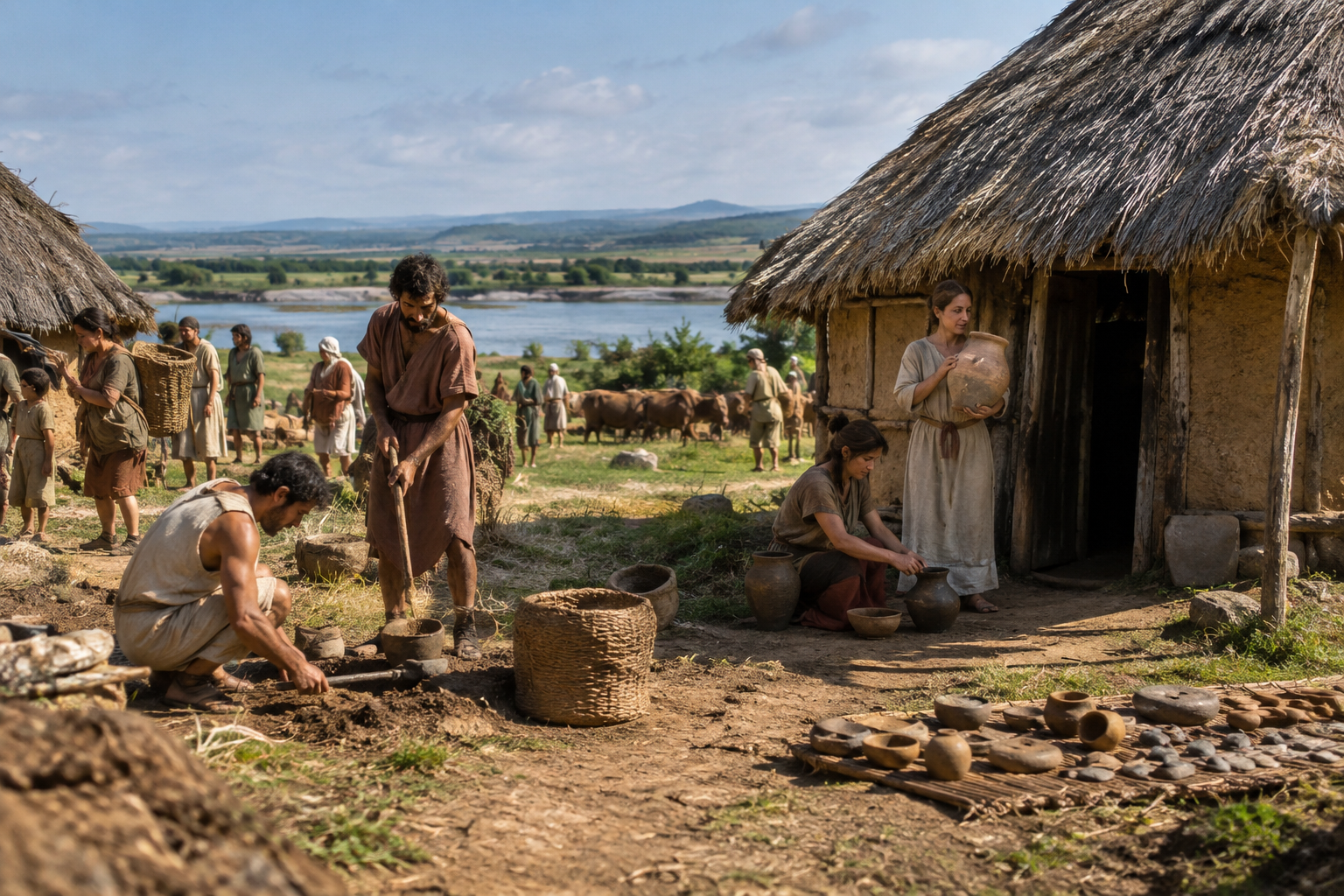
There are some Y-DNA haplogroups that stride into history wearing a crown. G2a does something more interesting. It turns up first in the houses, graves, and farming settlements of the early Old World, long before courts, heraldry, and royal palaces. If you want to understand how men moved with the first farmers into Europe, how older paternal lines survived the great demographic upheavals of later prehistory, and how ancient lineages could still be present in Roman, post-Roman, and medieval worlds, G2a is a fine place to begin.
As ever with Y-DNA, a caution first. A haplogroup traces one direct paternal line only: father to father to father. It does not describe a person's whole ancestry, culture, language, or identity. Nor does sharing a broad haplogroup prove close kinship. But used carefully, G2a is enormously revealing, because ancient DNA has found it again and again in early farming communities and in later historical settings across Europe and western Asia.
Within the wider Y-chromosome tree, G2a is one of the lineages strongly associated in ancient DNA research with early agricultural populations spreading from Anatolia into Europe. That does not mean every farmer carried G2a, nor that every G2a line belonged to the same migration wave. But the pattern is striking enough to be historically important.
Some of the most evocative evidence comes from Anatolia itself. At Catalhoyuk, one of the great Neolithic settlements, G2a appears in individuals such as cch173, dated to 6700 BC, and cch097, dated to 5200 BC. These are not mere abstractions in a genetic table. They belong to a world of tightly packed mudbrick houses, elaborate household ritual, and one of the earliest large settled communities on earth. G2a here sits close to the beginnings of village farming life.
Another early Anatolian sample, ART004 from Neolithic Anatolia Arslantepe dated to 4568 BC, helps show that this paternal lineage was not confined to a single famous site. Add to that I1671 from Seh Gabi, Kermanshah Province, Ancient Iran dated to 5636 BC, and I3882 from Shanidar, Ancient Iraq dated to 7900 BC, and the broader picture comes into view: G-related paternal lines were present across a wide zone of southwest Asia in deep prehistory.
Explore the Neolithic Expansion
When farming spread into Europe, G2a came with it often enough to leave a memorable trail. In Central Europe, the early Neolithic LBK horizon is especially important. At Fellbach-Oeffingen, Baden Wuerttemberg, several individuals dated to 5100 BC carry this haplogroup: FO146, FO47, FO127, FO130, and FO131. Nearby in time and space are NP410 from Niederpoering dated to 5200 BC, and I0056 and I0048 from Halberstadt-Sonntagsfeld dated to 5052 BC. This is exactly the sort of repeated archaeological pattern that makes population historians sit up.
Once in Europe, G2a does not vanish after the first farmers. It appears in a geographical spread broad enough to remind us that prehistory was never static. There is NEO128 from Neolithic Czech Vedrovice dated to 5191 BC, I11270 from Ancient Bulgaria Veliko Tarnovo dated to 5725 BC, and HBS004 from Neolithic France dated to 4300 BC. In Italy, NEO834 from Mora Cavorso Cave Jenne Rome dated to 5460 BC and BRC001 from Grottina dei Covoloni del Broion dated to 2934 BC show continuity of presence into later prehistoric periods.
Switzerland offers a remarkable cluster: Aesch7, Aesch22, Aesch12, Aesch1, Aesch21, Aesch20, Aesch19, Aesch13, Aesch23, Aesch17, Aesch4, and Aesch14, all from Late Neolithic Aesch around 3000 BC, together with MX219 from Oberbipp dated to 3300 BC. That concentration matters because it suggests not just stray individuals but local communities in which G2a paternal lines were well established.
Then comes the complication which makes European prehistory so fascinating. Later millennia saw major demographic changes, including the expansion of steppe-related ancestry. One supplied sample, I7895 from Early Bronze Age Slovakia Yamnaya Lesne Kosice dated to 4500 BC, places G2a in a context many readers would more readily associate with other paternal lineages. The lesson is not that G2a somehow becomes "the Yamnaya haplogroup" - that would be careless - but that real ancient populations were more varied than older textbook summaries implied.
By the Bronze and Iron Ages, G2a is found in settings that span the Mediterranean and continental Europe. There is NEO823 from Bronze Age Southern Italy Grotta Nisco dated to 2715 BC, GCP002 from Italic Tribe Grotta Regina Margherita Italy dated to 1550 BC, XAN051 from Minoan Period Crete Chania dated to 1575 BC, and I13510 from the Mycenaean Palace of Nestor, Pylos dated to 1330 BC. There are also Aegean and Anatolian appearances such as I13428 and I13580 from Phokis, I3309 from Halikarnassos, and I5249 from the Black Sea coast at Samsun.
The western Mediterranean is no less interesting. I0825 from Bronze Age Spain North-East Iberia Barcelona Paris Street dated to 2346 BC, I21987 from Phoenician Era Tharros Italy Sardinia dated to 500 BC, and I22093 from Roman Era Sardinia Tharros dated to 297 BC show G2a in maritime zones shaped by trade, colonization, and imperial contact.
And then Rome does what Rome so often does in the data: it scatters people. In Britain, DUX006 from Roman Era Cambridgeshire Duxford dated to 112 AD shows this paternal line on the empire's northwestern edge. In the Danubian provinces and borderlands there is a dense cluster: BBC033, BBC021, BBC022, BBC024, BBC031, and BBC014 from Imperial Roman Croatia Karlovac Pannonia Savia dated to 275 AD; GYS037, GYS033, and GYS016 from Late Roman and Late Antique Pannonia Arrabona Szechenyi Square Hungary dated to 425 AD; and later SZL056, MFC019, HMU002, and MFC001 in post-Roman and Longobard-period contexts.
What this suggests is not one simple ethnic label, but persistence and mobility. G2a paternal lines could belong to men living under Roman rule, on its frontiers, or in the successor societies that followed.
The early medieval evidence is especially good at puncturing modern assumptions. G2a appears in COL_112b from Lombard Era Collegno Northern Italy dated to 580 AD, 2417_103 from Dark Ages Italy South Tyrol Malles Burgusio Santo Stefano dated to 450 AD, G83PB from Early Medieval Merovingian Germany Lauchheim Mittelhofen dated to 700 AD, and RTW013 from Migration Period Germany Rathewitz Saxony-Anhalt dated to 500 AD. It also turns up in later contexts such as AHPS91 from Arpad Period Hungary Visegrad Sibrik domb I Esperesi dated to 1050 AD and even VK140 from Viking Age Galgedil Funen Denmark dated to 925 AD.
That matters because it shows how a paternal lineage rooted so strongly in Neolithic archaeology could remain present in societies that medieval chroniclers would have described in entirely different terms: Merovingian, Lombard, Avar-age, Arpad-period, Viking-age. Genetics and written history are asking different questions, and that is precisely why they are so useful together.
The noble association supplied here is French Royalty, centered on Chateau de Saint-Germain-en-Laye. The chateau began as a royal residence founded by Louis VI in the 12th century and was rebuilt and enlarged by later kings, especially Charles V, Francis I, and Henry II. It became a favored court outside Paris and the birthplace of several monarchs, including Louis XIV, who spent part of his childhood there before power shifted to Versailles.
Now, one must be careful. The existence of G2a in ancient France, and even the supplied relic sample LXVI from Relic French King Louis XVI dated to 1793 AD, does not allow us to claim that all French royals belonged to G2a, still less that a Neolithic farmer from France was a direct ancestor of the Bourbons or earlier dynasties. That would be bad history and worse genetics. What we can say is more subtle and more interesting: French monarchy stood on land whose human story runs far deeper than monarchy itself.
Saint-Germain-en-Laye is a particularly apt symbol of that depth because since 1867 it has housed the National Archaeology Museum. In other words, the palace of kings became a house of older memories: prehistoric burials, Roman lives, ancient tools, and the material remains of men whose paternal lines included haplogroups like G2a. That is the real connection - not a simplistic dynastic claim, but a geographical and historical continuity between the royal landscape of France and the far older populations who lived there.
Read About the Royal House of Capet
G2a reminds us that the deep past does not disappear just because later history gets louder. This haplogroup is one of the clearest markers of the early farming world in ancient DNA, yet it also survives into Bronze Age, Iron Age, Roman, and medieval contexts across an astonishing geographical range: Anatolia, Iran, Iraq, Central Europe, Italy, France, Iberia, the Balkans, the Aegean, Britain, Hungary, and beyond.
That breadth does not make every G2a man part of one people. It tells us something better: paternal lineages can persist through language shifts, migrations, conquests, and the rise and fall of kingdoms. A medieval man in Merovingian Germany, a Roman-era individual in Cambridgeshire, and a Neolithic farmer at Catalhoyuk may share a broad paternal marker without sharing any documented genealogy. But together they show how ancient DNA lets us trace continuity and change on a timescale no family tree can manage on its own.
If you would like to explore related discoveries, you might also enjoy how G2a appears in French prehistory in Ancient DNA and Cerny Culture Ancestry in Neolithic France.
Upload your DNA to MyTrueAncestry to explore whether your own results show similarities to ancient individuals such as cch173, FO146, DUX006, COL_112b, or AHPS91, and to place your ancestry against the wider backdrop of archaeology and history. These matches do not by themselves prove direct descent from a particular ancient person or noble house, but they can offer a remarkable new perspective on where your deep past may fit into the human story.






Comments