Haplogroup E1b1b1a1b1a16a

– 6 min read


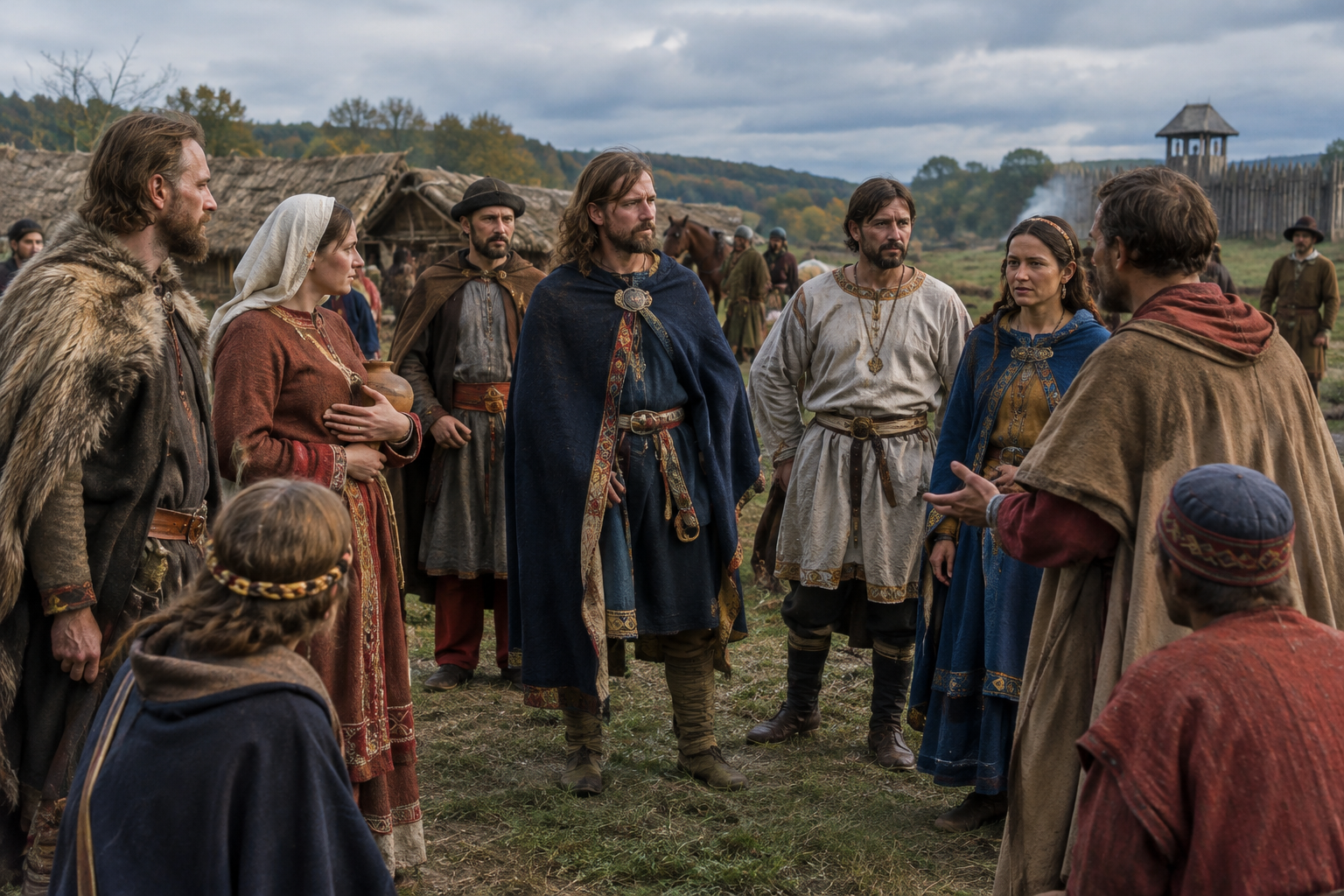
Some Y-DNA haplogroups announce themselves with famous royal pedigrees or with a single dramatic archaeological find. E1b1b1a1b1a16a is more interesting for a different reason. It appears in places that remind us how untidy real history is: post-Roman Bavaria, the Byzantine Black Sea coast, medieval Poland, Slovakia, and Islamic Iberia. Rather than pointing neatly to one kingdom or one people, it opens a window onto movement, contact, settlement, and the long survival of paternal lines across very different historical worlds.
That is worth pausing over. Y-DNA haplogroups trace a direct paternal line only: father to father to father, along one very narrow thread of ancestry. They do not describe a person's whole family tree, ethnicity, or identity. For a specific and narrow branch like E1b1b1a1b1a16a, we also need to be especially careful. Its broader parent haplogroup, E1b1b1a, has a deep and complicated history across parts of Africa, the Mediterranean, and Europe, but the full story of that wider branch cannot simply be pasted onto this much smaller subclade. What ancient DNA gives us instead is something better: actual sightings of related paternal lines in real graves, in real landscapes, at specific moments in time.
In the larger Y-chromosome tree, E1b1b belongs to one of the major paternal lineages found around the Mediterranean world and beyond. Different branches of E1b1b are well known in southeastern Europe, the Balkans, parts of Italy, the eastern Mediterranean, and North Africa. For a narrower branch such as E1b1b1a1b1a16a, the safest approach is not to invent a single grand origin story, but to note where ancient evidence places it or closely related lines.
The supplied samples suggest a pattern that is strikingly medieval and late antique in its visibility. We see related paternal signatures in Bavaria around 600 AD, in Byzantine-period Romania around 575 AD, in a medieval Slav-Avar context in Slovakia, in Piast-era Greater Poland, and in Al-Andalus at Alhama de Granada around 1200 AD. That spread does not prove one simple migration. It does, however, fit a world in which late Roman, post-Roman, Byzantine, Slavic, and Islamic-era societies were far more connected than older textbook maps once implied.
Explore Ancient DNA and Human History
The most eye-catching part of the evidence is the cluster from Altheim, Bavaria, Germany. There, a remarkable series of samples appears in the Merovingian period: Alh_232, Alh_234, Alh_122, Alh_123, Alh_147, Alh_162, Alh_219, Alh_152, and Alh_153, all dated to 600 AD. Alongside them stand Alh_126, described as a Merovingian Period Post-Roman Outlier from 590 AD, and Alh_137 from the Late Merovingian Period, dated 640 AD.
This is precisely the sort of evidence that makes archaeogenetics so useful. One isolated sample might be a curiosity. A whole cluster suggests that a paternal line, or closely related set of paternal lines, was not merely passing through but had become part of a local community. Merovingian Bavaria was no sealed ethnic box. It sat in the aftermath of Roman power, in a zone shaped by mobility, military service, marriage alliances, and the reorganization of communities after empire. A lineage like this one appearing repeatedly there hints at settlement and continuity within that changing world.
Alh_126 is especially intriguing because it is labeled a post-Roman outlier. That does not automatically tell us who he was in ethnic or linguistic terms, and it certainly does not let us assign him a tidy identity badge. But it does remind us that post-Roman cemeteries often held people whose ancestry and family histories did not fit a single local template. In other words, the Merovingian world was peopled by individuals with mixed backgrounds, not cartoon Franks on one side and cartoon Romans on the other.
Discover Post-Roman Central Europe
If Bavaria gives us density, the other samples give us range. Arg3, from Late Antique Early Byzantine Argamum Orgame, Romania, dated 575 AD, places this paternal thread on the western Black Sea frontier of the Byzantine world. That region was a meeting ground: imperial administration, old Greek colonial sites, Balkan populations, and the pressures of steppe and frontier politics all collided there. A sample like Arg3 fits a borderland where lineages and loyalties were often more layered than later national histories prefer.
Further inland, CGG018923 from Medieval Slav Avar Slovakia Cifer-Pac, dated 950 AD, brings the lineage into a central European setting shaped by the legacies of Avar power and the formation of early medieval Slavic societies. Then PCA0255, from the Piast Dynasty context at Greater Poland Poznan Srodka Lad, dated 1100 AD, shows it in the orbit of one of medieval Europe's rising Christian polities. That does not prove dynastic descent from any ruling Piast line, but it does place the haplogroup in the same historical landscape as the early Polish state.
And then there is I7457, from Carthago Al-Andalus Alhama de Granada, dated 1200 AD. Here the story stretches into Islamic Iberia, a society linked to the wider Mediterranean, North Africa, and older Iberian populations. Again, caution first: one sample is not a census. But taken with the others, I7457 suggests that this paternal branch or very close relatives belonged to the broad web of medieval Mediterranean and European mobility rather than to one isolated corner.
The noble connection supplied here is the House Gage and Firle Place in East Sussex. Firle Place began as a manor with medieval roots and became the seat of the Gage family after Sir John Gage acquired it in the sixteenth century. Over time it was rebuilt and enlarged into the substantial house known today, while still preserving traces of its earlier fabric. As with so many country houses, it is not merely architecture; it is a record of landed power, agricultural management, taste, inheritance, and social ambition over centuries.
There is something rather pleasing in placing a house like Firle Place beside a haplogroup such as E1b1b1a1b1a16a. Not because the building can prove anything genetically - it cannot - but because noble houses preserve the historical memory that DNA alone does not. Firle Place anchors the Gages in a particular English landscape of Tudor acquisition, estate continuity, and later cultural life, including its associations with nearby Charleston and the Bloomsbury world. Genetics, by contrast, works on a very different scale: it can show how paternal lines move through populations over centuries, often long before a family appears in written records.
So any association between this haplogroup and the Gage family must be handled carefully. A historical link in a haplogroup context does not prove that every Gage male carried this lineage, nor that the family can be directly tied to any of the ancient men listed above. What we can say is that families like the Gages belonged to a later Europe built upon many older layers of migration and continuity. The manor house in Sussex and the graves in Bavaria or Romania are part of the same long human story, but not the same documented pedigree.
Explore the Noble House of Gage
E1b1b1a1b1a16a is historically interesting precisely because it resists the lazy habit of equating one lineage with one people. The ancient evidence supplied here places related paternal lines in Merovingian Bavaria, Byzantine Romania, medieval Slovakia, Piast Poland, and Al-Andalus. That is a map of contact zones: frontiers, successor kingdoms, imperial margins, and mixed communities. It reminds us that paternal ancestry can persist through many changes of language, religion, and political allegiance.
It also shows why ancient DNA is such a useful partner to history and archaeology. Written sources usually spotlight elites, chroniclers, and institutions. Genetics can illuminate communities that left few words behind. Yet genetics has limits too. Shared haplogroups do not prove close kinship, still less direct descent from an excavated individual to a later noble house. The value lies in context: graves, dates, landscapes, and patterns of recurrence.
For anyone carrying this haplogroup today, the real fascination may be that your direct paternal line belongs to a branch that turns up in some of the most connected and complicated societies of medieval Europe. Not a single tribe on the march, then, but a lineage present in the thick of post-Roman transformation.
If you want to see whether your own DNA shows links to ancient individuals such as Alh_232, Arg3, PCA0255, CGG018923, or I7457, MyTrueAncestry can help you explore those comparisons. They may offer a powerful perspective on your past, even though they do not by themselves prove direct descent from any ancient person or noble family.






Comments