Haplogroup E1b1b1a1b1a14a

– 6 min read


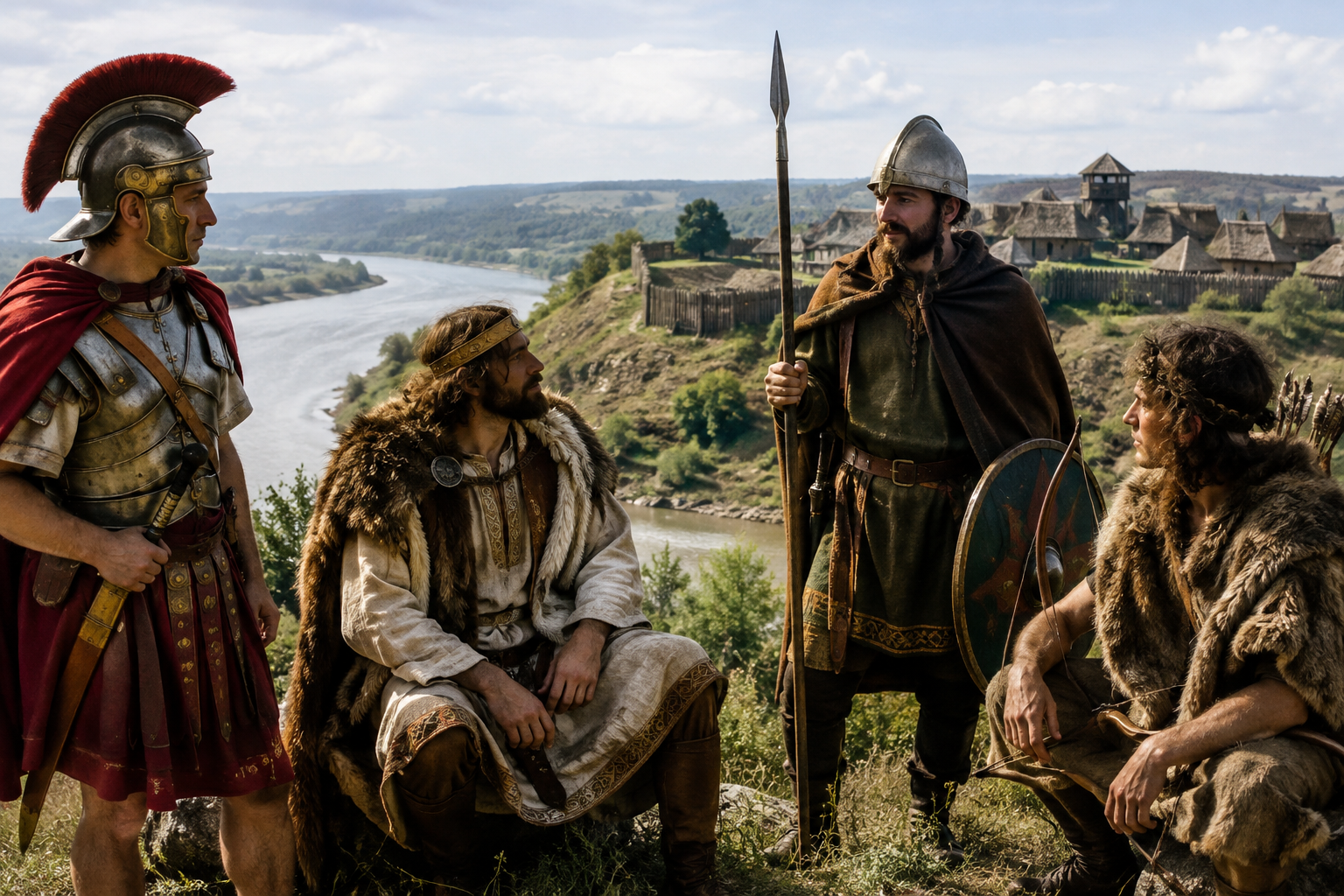
Some Y-DNA haplogroups arrive in the historical record with fanfare. Others creep in by side doors: an Iron Age burial in Croatia, a Roman-era man on the Dalmatian coast, a medieval burial in Slovakia, and then, unexpectedly, a member of the Piast world in Greater Poland. Haplogroup E1b1b1a1b1a14a belongs to that second category. It is historically interesting not because it can be reduced to one people, one kingdom, or one grand migration, but because it hints at a long paternal story crossing the Balkans, the Roman world, and medieval east-central Europe.
As ever with Y-DNA, a small note of method matters. A Y-chromosome haplogroup traces one direct paternal line only: father to father to father. It does not describe a person's whole ancestry, culture, language, or identity. Nor does the presence of a haplogroup in an ancient cemetery prove direct descent from any named historical family. What it does offer is something more precise and more modest: a way of following one thread of male-line ancestry through time, and setting that thread beside archaeology and written history.
E1b1b1a1b1a14a is a very specific downstream branch within the wider E1b1b family, a major Y-chromosome lineage with deep roots outside northern Europe and a long history around the Mediterranean, the Balkans, and parts of Africa and western Eurasia. For broad historical purposes, the important point is that a narrow subclade like this should not simply be treated as if it carries the entire history of all E1b1b men. The parent tree is broad; this branch is narrow.
That said, the ancient samples supplied here make one thing immediately striking. This lineage, or a very close paternal neighborhood around it, appears in contexts stretching from the Iron Age Sava Valley to Roman Dalmatia, then into the medieval Slavic and dynastic world farther north. That pattern does not prove a single unbroken corridor of descent from one named tribe or polity. But it does suggest that the branch was part of the population mosaic of southeastern and central Europe over many centuries.
For readers interested in the deeper background of the region where several of these samples appear, the Balkans are crucial terrain in European population history. A useful companion piece is this look at long-term regional ancestry: Balkan populations did not appear overnight, and paternal lineages like this one make more sense when set against that larger backdrop.
The earliest supplied anchor for this haplogroup is I5724, from an Iron Age Hillfort Croatia Kriz Brdovecki Sava Valley, dated 290 BC. Hillforts are not just dramatic places to excavate; they are reminders that later national borders tell us very little about ancient movement. The Sava Valley was a corridor: military, commercial, and human. A paternal line found there in the late Iron Age belongs to a world of fortified uplands, local communities, and wider regional connections between the Balkans and central Europe.
Several centuries later we meet I26702, an Imperial Roman Trogir Dragulin Croatia individual dated 100 AD. Here the setting has changed completely. Instead of an Iron Age hillfort inland, we are on the Dalmatian coast in the Roman imperial world. Trogir sat in a landscape tied into shipping routes, garrisons, trade, and the intense social mobility of empire. A Y-line present in both an Iron Age Croatian context and a Roman Croatian context does not prove simple local continuity, but it does raise the possibility that some paternal lines endured through major cultural change while others arrived through imperial movement.
That is one of the best lessons of ancient DNA: Rome did not erase local ancestry, nor did local ancestry prevent new arrivals. Both things can be true at once. If you want a broader sense of how paternal and other lineages behave in this region over long stretches of time, this related article on Croatia is especially relevant.
Discover Ancient Croatia's DNA History
The medieval evidence pushes the story northward. CGG018923, described as Medieval Slav Avar Slovakia Cifer-Pac and dated 950 AD, belongs to a landscape shaped by the aftermath of the Avar world, the rise of Slavic-speaking populations, and the formation of new Christian polities in central Europe. This is exactly the sort of sample that warns us not to equate haplogroups too neatly with ethnicity. The label itself already tells us we are looking at a mixed historical zone: "Slav" and "Avar" are not interchangeable categories, and neither can be read directly from a Y-chromosome alone.
Still, the geography matters. A paternal line seen in Croatia in earlier periods and then in Slovakia in the 10th century fits a plausible broad pattern of movement and survival across the middle Danube and neighboring regions. The route from the Balkans into central Europe was never a single migration arrow on a textbook map. It was a long sequence of contacts, settlements, conquests, marriages, and local continuities.
For that reason, the late first millennium and early second millennium are especially revealing. Ancient DNA is steadily showing that central and eastern Europe were populated not by sealed ethnic blocks but by communities with layered ancestry and complex histories.
The most tantalizing sample here is PCA0255, from the Piast Dynasty Greater Poland Poznan Srodka Lad, dated 1100 AD. That places this paternal line, or a very close related branch, in one of the most politically significant settings in medieval eastern Europe. The Piasts were foundational rulers in the history of Poland, and any Y-DNA result associated with their world naturally attracts attention.
But this is where scientific responsibility matters most. A Piast-era sample is not the same thing as proof that every Piast ruler, every cadet branch, or every later noble house carried this exact haplogroup. Medieval burial grounds can include relatives, retainers, clergy, local elites, and others connected to a dynastic center without belonging to a single simple paternal chain.
What PCA0255 does show is that this paternal lineage had reached, or was present within, the political orbit of Greater Poland by around 1100 AD. That is historically fascinating in itself. Readers who want to look more closely at the genetic and dynastic questions around the Piasts should follow this related study.
At first glance, not much. And that is precisely the point worth making. The supplied noble associations, Clan Colquhoun and Clan Kirkpatrick, belong to a much later medieval and early modern Scotland, far from the Adriatic and the Sava Valley. They should not be turned into crude genetic conclusions. We are not entitled to say that these clans were definitively of haplogroup E1b1b1a1b1a14a merely because they are associated here, still less that every man bearing those surnames shared one paternal origin.
What we can say is that clans and castles preserve regional memory in the same way burials preserve biological evidence. They are different archives of the past. Together they help us think about how lineages, identities, and power become attached to landscapes.
Dunglass Castle in East Lothian, associated here with Clan Colquhoun, stands dramatically above the Firth of Forth. Its story reaches back before the surviving ruins, into an early medieval setting linked to Northumbria and Saint Balthere. Later it became a strategic fortified site in a zone where war between Scotland and England repeatedly shaped lordship. The estate passed through noble hands including the Homes, and in 1640 a catastrophic explosion in the powder magazine wrecked much of the fortress. The remains visible today are largely those of a 15th-century tower house and later rebuilding. In other words, Dunglass is not one moment frozen in stone but many centuries layered on top of one another.
Closeburn Castle in Dumfries and Galloway, associated with Clan Kirkpatrick, offers a sterner border story. With origins in the late 12th century and enlargement in the 13th and 14th, it became the long seat of a family deeply involved in the hard politics of medieval Scotland. Tradition links Roger Kirkpatrick to the killing of John Comyn in 1306 after Robert the Bruce struck the first blow. Whether one approaches that tale as legend, memory, or history polished by repetition, it captures the world of frontier loyalties in which families like the Kirkpatricks rose.
These castles do not prove genetic descent from any ancient Croatian or Polish sample, of course. But they remind us that paternal ancestry survives history in uneven ways. Sometimes in bone. Sometimes in documents. Sometimes in a ruined tower over a river or sea cliff.
Readers interested in the historical setting of one of these families can continue with the dedicated clan feature below.
E1b1b1a1b1a14a is a good example of why narrow Y-DNA branches are so compelling. Not because they hand us a ready-made ethnic label, but because they force us to think historically. Here we have evidence tied to an Iron Age hillfort in Croatia, a Roman-period coastal individual, a medieval burial in Slovakia, and a Piast-era context in Greater Poland. That spread suggests endurance, movement, and reappearance across very different political worlds.
It also shows how ancient DNA and traditional history do different jobs. Written genealogies may take us into the age of castles, clans, and dynasties. Ancient DNA reaches much farther back, into periods where surnames did not exist and chronicles are silent. Put the two together carefully, and the past becomes both stranger and more interesting.
If your own paternal line falls within a rare or highly specific branch, that does not make you Roman, Piast, Avar, Croatian, or Scottish by itself. But it may place one line of your ancestry into the same broad historical landscapes where these ancient men once lived.
Upload your DNA to MyTrueAncestry to explore whether your results show connections to ancient individuals, archaeological cultures, and historical populations. Those matches may open remarkable perspectives on your past, even when they do not prove direct descent from a particular ancient person or noble family.






Comments