Haplogroup E1b1b1a1b1a10c

– 6 min read


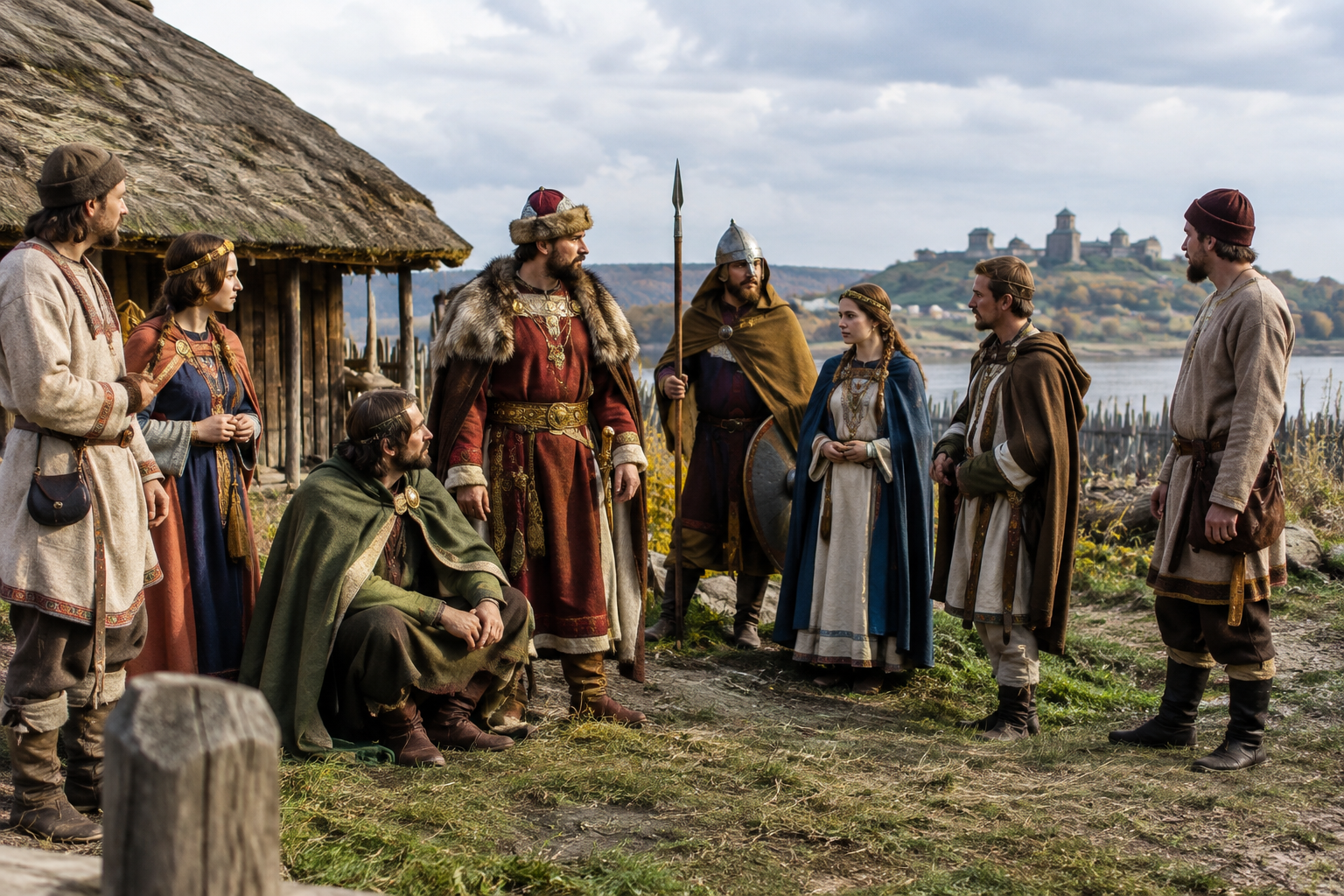
Some Y-chromosome lineages appear in the historical record like a sudden flash: one tomb, one dynasty, one region. Others are more intriguing because they turn up in very different settings, forcing us to think less in terms of neat ethnic boxes and more in terms of movement, mixture, and long-lived paternal lines. Haplogroup E1b1b1a1b1a10c belongs to that second category.
This is a very specific branch within the wider E1b1b family, a major Y-DNA lineage with deep importance in the history of parts of Africa, the Mediterranean, the Balkans, and Europe. With such a narrow subclade, caution matters. We should not simply pour the whole history of broad E1b1b into this one downstream branch. Still, the ancient samples connected with this lineage offer a striking picture: men buried in Migration Period Germany, in Avar-period Austria and Hungary, in medieval Slovakia, in Piast-era Poland, and in the Principality of Halych-Volhynia in Ukraine.
That is worth pausing over. Y-DNA traces one direct paternal line only: father to son to son across generations. It does not describe a person's full ancestry, culture, language, or identity. But when the same paternal branch appears across centuries and across the middle of Europe, it gives us a useful thread. Not a complete map, but a thread.
The larger E1b1b haplogroup is historically associated with a wide arc stretching through North Africa, the Near East, the Mediterranean world, and southeastern Europe. In prehistoric and historic studies, branches of E1b1b have often been discussed in connection with movements around the Balkans and Mediterranean, and later with the many population shifts that made Europe what it is.
For a highly specific branch such as E1b1b1a1b1a10c, the safest thing to say is that ancient DNA places it firmly in the story of early medieval and medieval Central-Eastern Europe. Rather than belonging to one simple "people," it appears in zones where Roman frontiers had collapsed, new kingdoms were forming, steppe powers pressed westward, and Slavic-speaking communities, Germanic groups, and mobile elites all interacted.
That is one of the most useful lessons of Y-DNA. A paternal lineage can persist while political labels change repeatedly around it. A man buried as Avar-period elite, another in a Thuringian context, and another in a Piast dynasty setting may share a distant paternal branch without belonging to the same ethnicity, language group, or ruling house in any straightforward sense.
If you want a broader grounding in how ancient DNA changed the way historians tell these stories, MyTrueAncestry's article on archaeogenetics is a good companion.
The oldest supplied evidence for this haplogroup in our set comes from the unstable centuries after Rome's western empire fractured. In Germany, OBM013 from Obermoellern, dated to 500 AD, is described as belonging to the Thuringii Tribe. Not far away in the wider historical sense, RTW003 from Rathewitz, Saxony-Anhalt, also dated to 500 AD, belongs to the Migration Period.
These are revealing finds. They place the lineage in central German lands at a time when tribal federations, post-Roman polities, and shifting military networks shaped daily life. The point is not that E1b1b1a1b1a10c was "a Thuringian haplogroup." That would be far too crude. The point is that this paternal line was present among real men living in the political churn of early medieval Germania.
Then the record moves southeast into the old frontier belt around the Vienna Basin and the Carpathian world. CSK016, from Csokorgasse, Vienna Basin, dated to 650 AD, and MGS006, from Moedling-An der Goldenen Stiege, Vienna Basin, also dated to 650 AD, both sit in an Avar-period setting. So does RKC041, an Avar Elite burial from Rakoczifalva, Hungary, likewise dated to 650 AD.
Now the story becomes especially interesting. The Avar world was not a sealed ethnic package; it was a political formation on the steppe-to-Europe frontier, drawing in different ancestries and local populations. The appearance of this paternal line in both ordinary Avar-period graves and an elite context suggests that E1b1b-related male lines were part of the social fabric of the Carpathian Basin in the seventh century. That does not prove a single origin for all these men, but it does show how widely such lineages could circulate within military and regional hierarchies.
For readers interested in this wider setting, the MyTrueAncestry article on post-Roman society in the Little Hungarian Plain offers a useful parallel view of the same world of mixed communities and new identities.
By the tenth century, the lineage is still there. CGG018923, from Cifer-Pac, Slovakia, dated to 950 AD, is described as Medieval Slav Avar. That label alone is a reminder that historians and archaeologists are dealing with blended frontier societies, not tidy replacement narratives. Here we may be looking at continuity, assimilation, or the survival of paternal lines through profound cultural change.
By 1100 AD, the branch appears in a still more politically defined setting: PCA0255 from Greater Poland, Poznan Srodka Lad, identified with the Piast Dynasty. This does not mean that the entire Piast house can simply be assigned to this haplogroup from one mention in a sample list, nor that everyone linked to Piast rule shared the same paternal ancestry. But it does place this lineage in the orbit of one of medieval Europe's formative ruling environments, where state formation, Christianization, and elite burial culture were all transforming the landscape.
The story continues eastward with KRW002 from Korolivka, Ukraine, dated to 1250 AD, in the Principality of Halych-Volhynia. By then we are in the world of Rus' successor states, frontier diplomacy, and competing influences from Latin Christendom, steppe powers, and eastern principalities. Again, the same lesson applies: a paternal branch can persist through very different political worlds.
Readers who want to go deeper into the Polish dynastic side of this picture might enjoy the article on the Piasts and their genetic context.
Taken together, these samples suggest that E1b1b1a1b1a10c was part of a belt of paternal diversity stretching across central and eastern Europe in the early medieval period. Germany, Austria, Hungary, Slovakia, Poland, and Ukraine are not random dots here. They form a connected historical zone: old Roman margins, river corridors, cavalry frontiers, trade routes, and later medieval kingdoms.
What ancient DNA gives us is not a fairy-tale family tree running unbroken from one named medieval lord back to one Migration Period warrior. It gives us something more interesting and more truthful: evidence that paternal lines survived political collapse, moved with armies and communities, and could be absorbed into new ruling systems over centuries.
That makes an intriguing backdrop for thinking about House Spencer and Althorp in Northamptonshire. Althorp began as a family estate after the Spencer family acquired the land in 1508, and across the centuries it developed into one of the great aristocratic houses of England. Its architecture and interiors reflect changing tastes, but also something older and rather more stubborn: the aristocratic concern with continuity, inheritance, and family memory.
Today Althorp is known not only as the ancestral home of the Spencers but also as the burial place of Diana, Princess of Wales, laid to rest on an island in the estate lake in 1997. The house therefore links Tudor ambition, later aristocratic grandeur, and modern public remembrance.
Genetically, we must be careful. The presence of a noble family in this article does not prove that the Spencer male line belongs to E1b1b1a1b1a10c, nor that a shared haplogroup with any ancient sample would demonstrate close kinship. But houses like Althorp help us see why Y-DNA is so captivating to many family historians. Aristocratic estates preserved surnames, titles, memorials, and archives. Ancient DNA preserves something different: biological traces from men who left no portrait gallery behind.
Set beside one another, the contrast is delightful. On the one hand, a great English seat with records, heraldry, and curated memory. On the other, graves at Obermoellern, Rakoczifalva, and Korolivka, where a Y-chromosome branch survives when names do not.
If the Spencer world interests you, there is a related MyTrueAncestry feature focused directly on the family.
E1b1b1a1b1a10c is a good example of why narrow Y-DNA branches are historically useful even when they do not come with dramatic headlines. This lineage appears in central Europe during the Migration Period, in Avar-period burials of the Vienna Basin and Hungary, in a medieval Slovak context, in Piast-era Poland, and in princely Ukraine. That distribution hints at durability, mobility, and integration across several important medieval regions.
It also reminds us that ancient DNA and written history do different jobs. Chronicles tell us about rulers, wars, churches, and estates. Genetics can reveal that paternal lines ignored many of the boundaries later historians liked to draw. A haplogroup is not a nationality. It is not a coat of arms. It is not a guarantee of descent from any famous family. But it can reveal that the men of early medieval Europe were connected in ways the documents only partly preserve.
Upload your DNA to MyTrueAncestry to explore whether your own results show connections to ancient individuals like CSK016, MGS006, RKC041, OBM013, RTW003, PCA0255, KRW002, or CGG018923. Such matches can offer a fascinating view into ancient paternal ancestry and historical populations, even when they do not prove direct descent from a particular noble house or medieval dynasty.






Comments