Haplogroup E1b1b1a1b1a10a2

– 6 min read


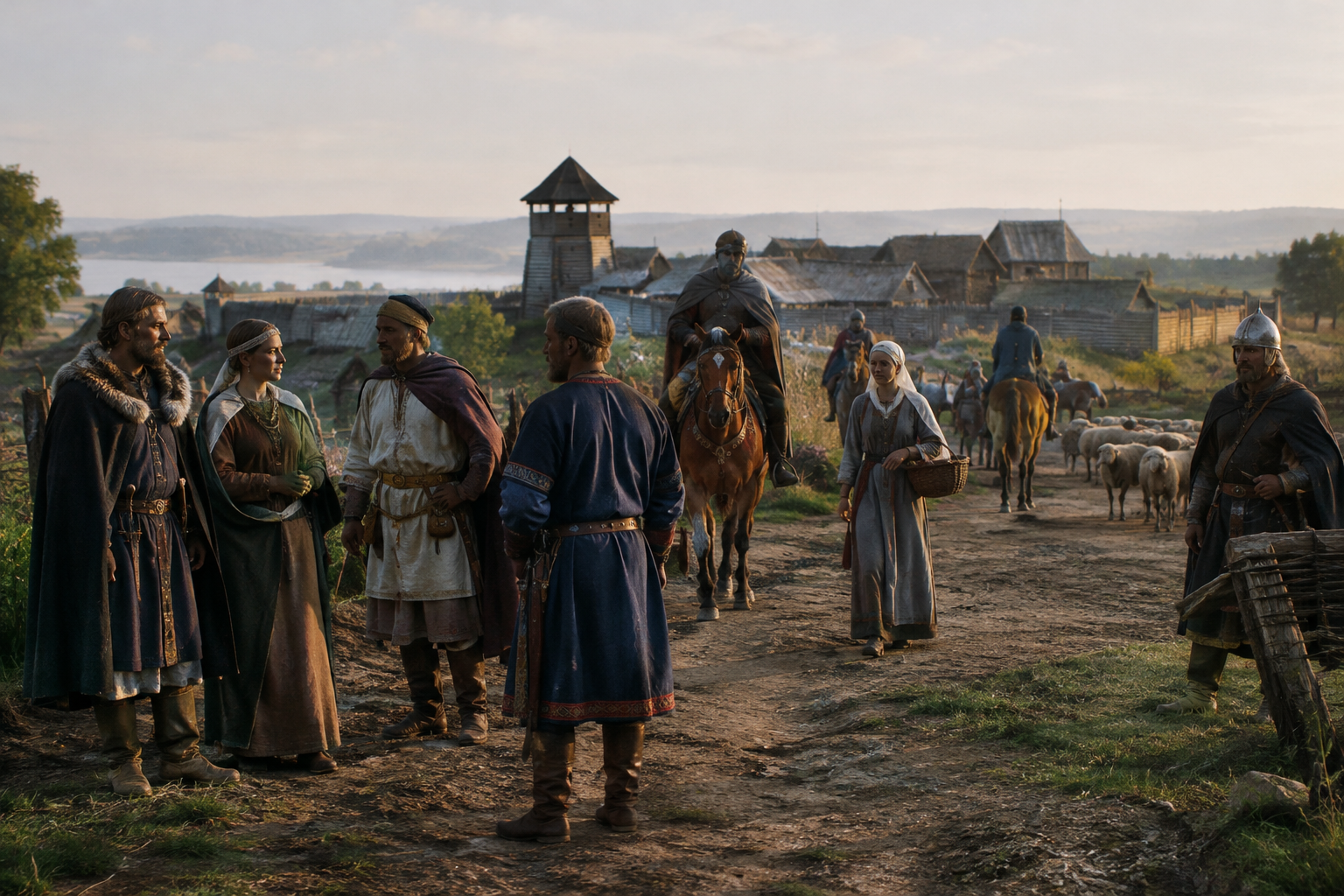
A haplogroup as specific as E1b1b1a1b1a10a2 can look, at first glance, like little more than an intimidating string of letters and numbers. But in historical terms it is rather like a surviving label on a long-lost archive shelf: narrow, technical, and unexpectedly revealing. This lineage belongs within the wider Y-DNA haplogroup E1b1b, a major paternal branch with deep roots outside and around Europe, the Mediterranean, and parts of western Asia and North Africa. What makes a fine-grained branch like this so interesting is not that it explains everything, but that it lets us trace one small paternal thread through a very complicated human past.
And that caution matters. Y-DNA follows only the direct paternal line: father to son to son. It does not describe a person's whole ancestry, culture, language, or identity. Still, when a lineage appears in ancient burials scattered across Roman frontiers, Gothic cemeteries, Avar-period graves, medieval Poland, and the lands of Halych-Volhynia, it tells us that this was not a static or isolated male line. It belonged to men moving through the great contact zones of central and eastern Europe, where empires, tribal confederations, military service, migration, and local continuity all overlapped.
The broader haplogroup E1b1b is well known to genetic historians because it turns up across a wide arc from North Africa and the eastern Mediterranean into Europe. For a very narrow downstream branch such as E1b1b1a1b1a10a2, however, one has to be more restrained. We should not simply transfer the entire grand history of E1b1b onto this one small twig of the tree. What we can say, more safely, is that this subclade belongs to a paternal family whose documented ancient appearances place it firmly in the mobile borderlands of late antiquity and the early Middle Ages.
That is already intriguing. The geography of the supplied ancient samples points especially toward the Danube world, the Carpathian Basin, central Europe, and the lands stretching into medieval Poland and western Ukraine. These were not marginal regions. They were among the busiest corridors in European history: Roman military roads, post-Roman frontier zones, Gothic settlements, Thuringian territories, Avar political networks, and later medieval Slavic and princely landscapes.
Explore Archaeogenetics and Ancient DNA
One of the most useful samples here is CGG021935, from Roman Slovakia Danube Gerulata, dated 310 AD. Gerulata sat on the Roman Danube frontier, part of that hard-working imperial edge where soldiers, traders, camp followers, and local communities mixed. A Y-lineage found here reminds us that paternal ancestry in the Roman world was often shaped by mobility. Men did not stay neatly in their supposed homelands; they served, settled, married, and were buried far from where earlier ancestors may have lived.
Then there is PCA0110 from Goth Maslomecz, dated 300 AD. Maslomecz has become famous for showing that Gothic-associated communities were not biologically uniform. A lineage like this appearing in such a setting is a useful corrective to old-fashioned history writing. "Goth" in the archaeological record was not a simple blood label. It was a lived social world, with people of mixed origins participating in it.
By the fifth century, the same broader paternal trail appears in several other important contexts: LIB11 from Dark Ages Breclav-Libiva Czech dated 450 AD, RTW003 from Migration Period Germany Rathewitz Saxony-Anhalt dated 500 AD, and OBM013 from the Thuringii Tribe Germany Obermoellern dated 500 AD. Put together, these samples suggest not a single migrating family caravan but a lineage present within multiple communities across the shifting political map of post-Roman central Europe.
If the Roman frontier gives us one chapter, the seventh century opens another. Several supplied samples cluster around the Vienna Basin and the Carpathian Basin, a region that became one of the great political crossroads of early medieval Europe. We have CSK004 and CSK016 from Early Medieval Austria Csokorgasse Vienna Basin, both dated 650 AD. Nearby is MGS006 from an Avar Period Grave Austria Moedling-An der Goldenen Stiege Vienna Basin, also dated 650 AD. And then RKC041 from Avar Elite Hungary Rakoczifalva, again 650 AD.
This cluster is especially valuable because it shows the lineage in more than one social and regional context at roughly the same time. The Avar world was itself a composite political order, stretching across the Carpathian Basin and drawing together people of varied origins. The presence of this paternal branch in both Austria and Hungary, including an Avar elite context, hints at how lineages could circulate within military, aristocratic, and local populations without belonging exclusively to any one ethnic label.
That is often how ancient DNA works best: not by confirming neat tribal myths, but by showing just how untidy the human past really was.
Explore Post-Roman DNA in Hungary
The story does not stop in late antiquity. This lineage also appears in PCA0306 from Medieval Poland Konskie Sub Carpathia, dated 1100 AD, and in KRW002 from the Principality of Halych-Volhynia Ukraine Korolivka, dated 1250 AD. These later appearances matter because they show a paternal line continuing in the historical landscapes of medieval eastern Europe.
That continuity across centuries is fascinating, but it should be handled sensibly. Shared haplogroup does not prove that the man buried in medieval Konskie was descended directly from the Roman frontier individual at Gerulata, nor that either was an ancestor of anyone in Halych-Volhynia. What it does show is that related paternal branches were present across a broad zone linking the Danube, the Carpathians, Poland, and western Ukraine over a very long period.
Readers interested in those eastern European dynastic questions may also enjoy broader work on medieval paternal history in the region, especially where ancient DNA and written sources begin to speak to each other.
Read About Medieval Polish Dynastic DNA
How, then, do we move from Danubian cemeteries and Gothic burials to an English noble family? Carefully. The supplied historical association is with the House Stafford, and the interest here is contextual rather than a claim of proven descent from any ancient sample.
Stafford Castle stands on a hill west of Stafford. It began as a Norman motte and bailey castle built soon after the conquest of England by Robert de Tosny in about 1070, designed both to control the area and to display new lordly authority. That is exactly what Norman castles so often did: they were military statements and political theatre in timber and earth, later translated into stone.
The site then passed to the Stafford family. Its history is one of destruction, rebuilding, rebellion, and reinvention. The first castle had already been destroyed in 1173 after the family backed the wrong side in the rebellion against Henry II. In the fourteenth century it was rebuilt in stone, only to decline later and suffer heavy damage during the English Civil War, when it was held for the king and then slighted by Parliament in 1643. In the nineteenth century, the Jerningham family erected a romantic Gothic revival house on the site, using parts of the old ruins. That house too later fell into ruin through fire and neglect. What survives today is therefore a layered monument: Norman conquest, medieval lordship, civil war violence, and Victorian medievalism all piled together on one hilltop.
There is a pleasing historical irony here. A lineage such as E1b1b1a1b1a10a2 appears in the record not as a tidy badge of one nation or dynasty, but as part of a much older continental story of movement and mixture. Stafford Castle, by contrast, represents the medieval urge to pin power to one place, one family, one lordship. Ancient DNA reminds us how unstable that picture really is. Noble houses preserve memory through documents, lands, and ruins; genetics preserves different kinds of memory, often older and less obedient to heraldry.
The most striking thing about E1b1b1a1b1a10a2 in this evidence is its presence across multiple historical worlds: Roman frontier society, Gothic-associated communities, Migration Period Germany, Avar-period Austria and Hungary, and later medieval Poland and Ukraine. That spread makes it a good example of how paternal lines can endure while identities, kingdoms, languages, and ruling powers change around them.
So if you carry this haplogroup today, what does that mean? It may place your direct paternal line within a branch that ancient DNA has already spotted in some of Europe's most dynamic contact zones. It does not mean you are "a Goth," "an Avar," "Roman," or descended from the Staffords. But it does place your paternal line inside the same long historical conversation.
That is really the charm of archaeogenetics. It does not shrink the past into a slogan. It makes it larger, stranger, and more human.
If you want to explore whether your own DNA shows links to ancient individuals like CGG021935, PCA0110, CSK004, or KRW002, MyTrueAncestry can help you compare your results with real archaeological discoveries. Those matches do not prove direct descent from a noble family or a named burial, but they can offer an extraordinary new perspective on where parts of your ancestry fit into the human past.






Comments