Haplogroup E1b1b1a1b1a

– 6 min read


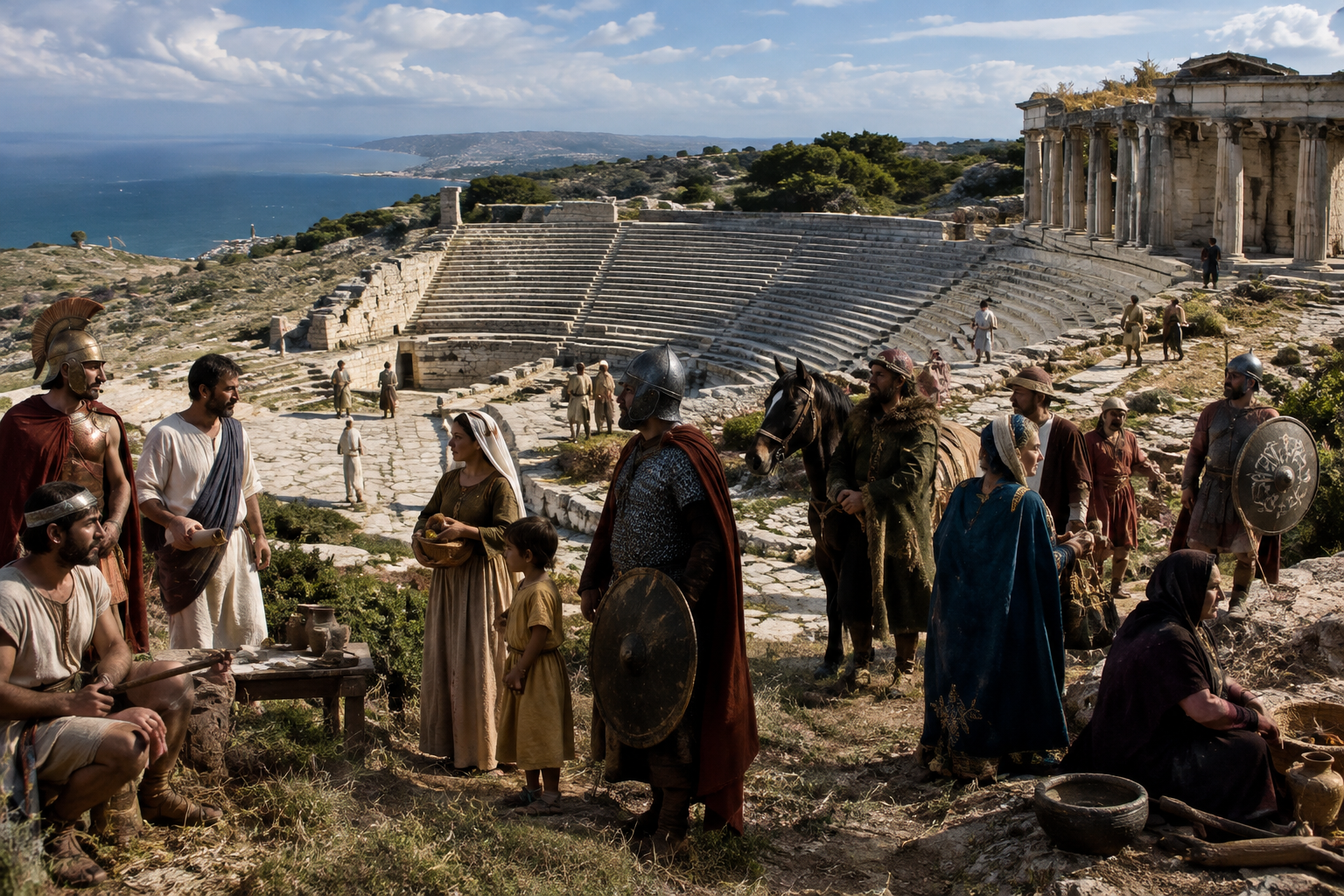
Some Y-DNA haplogroups behave rather like historical celebrities: they turn up in all the expected places, attached to famous peoples and familiar migration stories. E1b1b1a1b1a is more interesting than that. It appears in a scatter of ancient men from the north Pontic world, the Balkans, the Aegean, Roman frontier zones, medieval Sicily, and parts of central and western Europe. That distribution does not give us one neat tale. It gives us something better: evidence of movement, survival, mixing, and local continuities across centuries.
As ever with Y-DNA, a small warning is in order before we enjoy ourselves. A Y-chromosome haplogroup traces one direct paternal line only: father to father to father. It does not describe a person's whole ancestry, culture, language, or identity. Still, paternal lineages matter. They can show us how particular male lines moved through armies, ports, farming communities, frontier towns, and dynastic landscapes. In the case of E1b1b1a1b1a, the ancient DNA record points repeatedly toward the Mediterranean and Balkan worlds, while also showing how such lineages could travel far beyond any supposed homeland.
E1b1b is a major branch of the human Y-chromosome tree with a long and complicated history across parts of Africa, the Near East, the Mediterranean, and southeastern Europe. The narrower branch discussed here, E1b1b1a1b1a, is much more specific, so we should resist the temptation to dump the entire history of broad E1b1b onto it. What the sample set does support is that this paternal line, or closely related branches around it, had a notable presence in southeastern Europe and the wider Mediterranean over a very long span.
One of the earliest supplied appearances is UKR102 from ancient Deriivka in Ukraine, dated to 6397 BC. That is an arresting find because it places this paternal line, or a lineage assigned within this branching framework, in the north Pontic zone very early indeed. It does not prove that the haplogroup originated there, but it does show that men carrying it were present in the broader Black Sea hinterland long before classical antiquity, Rome, or medieval kingdoms entered the scene.
The wider picture suggested by the list is of a lineage repeatedly turning up in crossroads regions: the Balkans, the Black Sea coast, Aegean settings, Roman provinces, and later medieval ports. That is precisely the sort of evidence that reminds us how misleading modern national maps can be when reading ancient DNA.
Explore Black Sea migration history
The north Pontic and Black Sea worlds are especially important for this haplogroup's story. Several supplied individuals place it in Iron Age and classical contexts where Greek colonists, steppe peoples, Thracian communities, and local farming populations all met. At Bilsk in Poltava, the Scythian hillfort samples UKR091 from 450 BC and UKR089 from 400 BC show this paternal line in a setting associated with the Scythian sphere. Nearby in cultural terms, UKR007 from Kartal in Odesa, dated to 800 BC and described as Thracian Hallstatt, places it in an early Iron Age context on the northwestern Black Sea margin.
Then there is Crimea and the Greek colonial world. The supplied samples CGG021473 from the Scythian Bosporan Kingdom at Chernoseus Taurica, dated 200 BC, and CGG021475 from Hellenic Bosporan Kingdom Chernoseus Taurica, also dated 200 BC, are a splendid reminder that ancient Black Sea societies were not ethnic boxes. Scythian, Greek, and mixed local communities lived in close contact. A shared or related paternal lineage appearing in more than one political or cultural setting should not surprise us; it is exactly what ancient DNA keeps showing.
The same is true further south. The Minoan sample XAN016 from Chania on Crete, dated to 1575 BC, and the later modern-era Cretan sample 276_2 from Rethimno Adele in 1941 AD, do not establish uninterrupted direct descent between individuals, of course. But taken together, they make Crete look less like a sealed island and more like a place where eastern Mediterranean male lines could persist, reappear, or arrive repeatedly across the ages.
Discover prehistoric Aegean DNA
If one wanted a single historical setting that best suits E1b1b1a1b1a in this dataset, it might be the Roman and post-Roman Balkans. The sheer number of samples is striking. At Viminacium in Serbia we find I15490 dated 200 AD, I15512 dated 225 AD, I15504, I15507, I15513, and I15518 all around 250 AD, and R6750 from Roman-era Viminacium dated 150 AD. Nearby are I15544 from Timacum Slog Necropolis in 261 AD, R6764 from Naissus in 300 AD, and later Timacum Kuline individuals I15553 and I15554 around 400 AD, followed by the medieval-era Serbian sample I15537 at 900 AD.
This is not the profile of a one-off intruder. It suggests a paternal lineage well established in the Balkan provinces and still present as Roman rule gave way to the more fluid political world of late antiquity and the early Middle Ages. Add to this I40573 from a late Roman Gothic grave at Aquae Calidae in Bulgaria, I18792 from Boyanovo, and a cluster of Croatian finds such as I26702 at Trogir, R3745 at Zadar, R3659 at Scitarjevo, plus I34296 and I35009 from Hvar RadoSevic Palace, and one sees the Adriatic and Danubian worlds tied together by both imperial institutions and local continuity.
Then matters become even busier in the Migration Period and Avar age. Samples such as CSK016 from the Vienna Basin, MGS006 from Moedling-An der Goldenen Stiege, KUP021 from Kunpeszer, and the Rakoczifalva burials RKO016, RKC041, RKF026, RKC003, and RKF027, all around the 6th and 7th centuries, show this paternal line appearing among varied communities in the Carpathian Basin. These were centuries of soldiers, settlers, clients, elites, captives, and opportunists. Ancient DNA rarely offers a purer illustration of how mixed those societies were.
By the medieval period, the haplogroup's story has become unmistakably Mediterranean. Sicily is especially revealing. At Teatro di Segesta we have SGBN10 and SGBN20, both dated 1220 AD, and SGBN19 from a Segesta Muslim grave dated 1250 AD. In Palermo, GABN2a comes from an Islamic burial at La Gancia dated 925 AD. Earlier Sicilian finds broaden the picture still further: I12848, a Hellenic-Carthago mix individual from Mozia dated 569 BC, and I17872, an ancient mercenary from Himera dated 480 BC.
This is splendidly Sicilian: Phoenician and Greek contact, war, empire, Islamic rule, and multilingual medieval society all in one island record. The haplogroup here is not attached to a single people, but to Sicily's recurring role as a meeting ground of Mediterranean men and paternal lines. Western links also appear in I12031 from Visigothic early medieval Girona dated 558 AD, I10853 from Girona Sant Julia de Ramis dated 1060 AD, I3583 from Montefrio Granada dated 500 AD, and I7498 from Cordoba Caliphate dated 1050 AD.
What all this suggests is not a single migration event but repeated movement through military service, trade, colonization, settlement, and conversion-era reshuffling. Sicily and Iberia are ideal places to see how a paternal lineage can belong to many chapters of history without belonging exclusively to any one of them.
The noble-family field supplied for this article is empty, and that in itself is worth saying plainly. There are no named dynasties, clans, or castles here that can responsibly be tied to E1b1b1a1b1a from the provided evidence. That may seem disappointing, but it is actually rather healthy. Too much genetic storytelling rushes from an ancient burial to a medieval coat of arms as if history were a straight corridor. It is not.
What we can say is that many of the regions where this haplogroup appears in ancient DNA later became landscapes of castles, noble houses, and contested lordships: the Balkans, the Carpathian Basin, Sicily, Iberia, and parts of central Europe. Medieval lineages in such places were formed out of long local histories mixed with newcomers, soldiers, clergy, merchants, and migrants. A shared broad Y-DNA branch between an ancient man and a later noble house would at most suggest historical context, not proven dynastic descent.
That is why ancient DNA and written genealogy are such useful partners. DNA can illuminate the deeper population background of a region centuries before a family name appears in the records. The records, in turn, tell us who held the castle, married the heiress, lost the lawsuit, or backed the wrong king. Together they give us a fuller past, but neither should bully the other into claims it cannot support.
E1b1b1a1b1a emerges from this sample set as a paternal line with remarkable staying power in southeastern Europe and the Mediterranean, and with an ability to travel into many different historical settings. It is present in early north Pontic prehistory, in Iron Age Black Sea societies, in the Roman Balkans, among post-Roman and Avar-period communities, in Aegean contexts, and in the many-layered world of medieval Sicily and Iberia.
That does not make every carrier a Scythian, a Roman provincial, a Byzantine, a Muslim Sicilian, or a Visigoth. It makes the haplogroup historically interesting for exactly the opposite reason: it crossed those labels. It reminds us that paternal lines can outlast kingdoms, religions, and languages, slipping through the cracks of the categories historians later impose.
If this haplogroup appears in your own Y-DNA results, the most sensible conclusion is not that you "are" any one ancient people from this list. It is that your direct paternal line belongs to a branch with deep roots in some of the most connected regions of the ancient world, and one now visible through a growing body of archaeological DNA.
MyTrueAncestry lets you explore those connections for yourself, comparing your DNA with ancient individuals and historical populations from sites like Viminacium, Bilsk, Crete, and medieval Sicily. Those matches do not prove direct descent from a named ancient person or membership in a noble house, but they can offer an unusually vivid way to place your family story inside the long human past.






Comments