Haplogroup C2a1a3a6a

– 5 min read


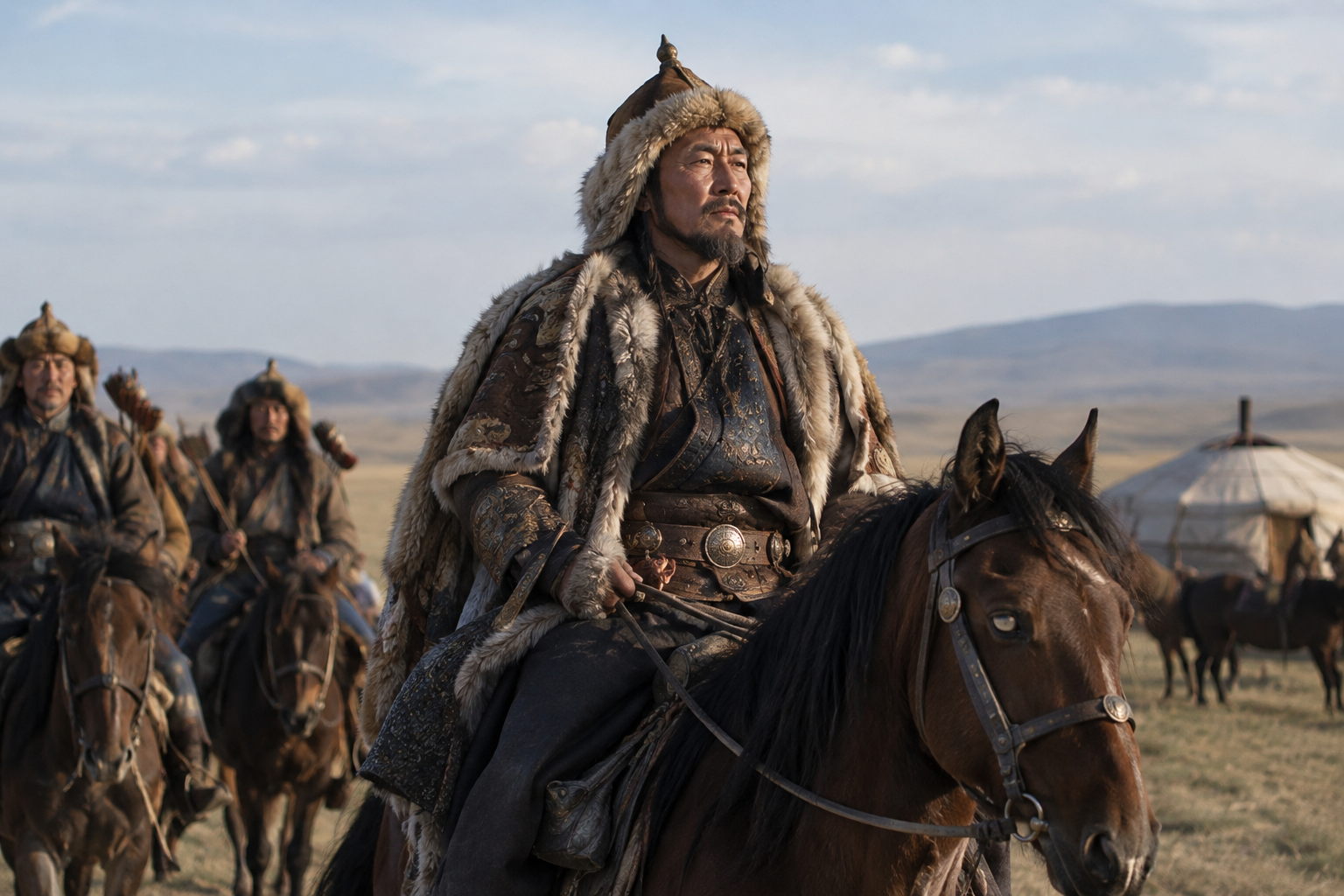
The most concrete ancient clue for Y-DNA haplogroup C2a1a3a6a in this set is a man identified as SHG003, dated to around AD 1350 and associated with the Sharga Uul site in Sukhbaatar, Mongolia, in a Mongol Horde context. That is already enough to make the lineage historically interesting. We are not dealing here with a vague prehistoric shadow, but with a paternal line appearing in the world of the later Mongol Empire, when steppe power still connected Mongolia, Inner Asia, and lands far beyond.
That does not mean one grave can stand for an empire. It cannot. But SHG003 gives us something rare and valuable: a direct paternal marker placed inside a historically charged landscape. Y-DNA traces one strict male line rather than a person's total ancestry, yet in steppe archaeology that narrow line can still be revealing, especially when it turns up in populations linked to elite mobility, military confederations, and the long political afterlife of Chinggisid rule.
By the mid-14th century, the Mongol imperial order had fragmented politically, but the steppe was hardly isolated or static. Eastern Mongolia remained part of a broad zone shaped by older imperial institutions, clan politics, horse-based mobility, and continuing exchange across Eurasia. A burial from this setting is never just local in significance: it belongs to a landscape where ancestry, alliance, and legitimacy mattered deeply.
Sample SHG003 is therefore important not because it lets us identify a famous individual, but because it anchors haplogroup C2a1a3a6a in a real medieval Mongolian context. The broad C2 family is well known across Inner Asia and the eastern steppe, but the article haplogroup here is a much narrower branch. That distinction matters. We should not lazily pour the entire history of haplogroup C2 into C2a1a3a6a. What we can say more carefully is that this subclade fits within a paternal landscape that has long been prominent in Mongolian and neighboring steppe populations.
A study connected to ancient population history on the Mongolian steppe helped frame many of these wider questions about continuity, mixture, and changing political horizons in the region; the supplied research link points to supplementary material associated with that ancient DNA work. Even without overclaiming from one record, SHG003 sits comfortably inside that broader archaeogenetic conversation.
If you carry C2a1a3a6a, the first sensible historical frame is Inner Asia rather than medieval Europe or the ancient Mediterranean. The wider C2 haplogroup has deep associations with populations of Mongolia, Siberia, and neighboring parts of East and Central Asia. In public discussions, this sometimes gets flattened into crude claims about one "Mongol lineage." Real history is more complicated.
Steppe societies were not genetically uniform, and they were certainly not built from one paternal line alone. The Mongol world absorbed and ruled peoples speaking different languages and living in very different environments, from forest margins to oasis towns. What makes a C2-related medieval Mongolian sample useful is not that it proves an unbroken dynasty, but that it places this paternal signal in exactly the sort of historical setting where such lineages mattered socially and politically.
That also helps explain why subclade resolution is so important. C2a1a3a6a is not a synonym for all C2, nor for every famous theory about steppe conquests. A narrower branch can have a much more specific story than its parent clade. In practical genealogical terms, that means a modern tester should treat the medieval evidence as a historically suggestive anchor, not as a shortcut to a named ancestor.
The phrase "Mongol Horde" can tempt people into romantic shortcuts, but the archaeology points to something more useful: a social world in which male-line descent could carry real political weight. Across the post-imperial steppe, legitimacy was often argued through kinship, remembered ancestry, and connection to prestigious lineages. That does not mean every man with a C2-related haplogroup belonged to an elite house. It means paternal descent was part of how power was discussed and organized.
In that sense, SHG003 belongs to a historically legible environment. Fourteenth-century Mongolia was living through the long aftermath of empire, when old imperial networks still mattered even as authority splintered. A burial from Sukhbaatar tied to that world gives C2a1a3a6a a setting shaped by mobility, mounted warfare, pastoral life, and the politics of descent.
There is a useful parallel here with broader MyTrueAncestry discussions of steppe and frontier populations: lineages travel with people, but also with institutions. Horse herding, marriage alliances, military incorporation, and political patronage all help spread paternal branches across large territories without making the population genetically simple.
Ancient DNA from the eastern steppe has repeatedly shown that political confederations could be genetically mixed even when they presented themselves through strong traditions of clan descent. That is one of the most interesting lessons of archaeogenetics in Mongolia and adjacent regions. The story is not one of a single people replacing everyone else in tidy sequence. It is one of repeated coalition-building.
That broader pattern matters for interpreting C2a1a3a6a. A paternal line found in a Mongol-period burial may reflect local continuity, incorporation into a larger confederation, or both at once. Steppe history is full of exactly that combination. Communities could preserve older regional ancestry while also being folded into new political identities under Xiongnu, Turkic, Mongol, or later formations.
Readers interested in the longer eastern Eurasian background to such paternal histories may want to compare this with research on ancient Y-chromosome patterns more broadly across East Asia, where coastal, inland, and steppe-linked histories do not always line up neatly.
For someone researching their own paternal ancestry, the strongest historically grounded point is this: C2a1a3a6a belongs in a northern and eastern Inner Asian frame, and the sample SHG003 shows that this branch, or a lineage reported in association with it, was present in a 14th-century Mongol-context burial in Mongolia. That is a meaningful placement. It links the haplogroup to the historical steppe rather than leaving it floating as an abstract code.
What it does not do is identify a tribe, a language, or a royal pedigree by itself. The same paternal branch could have moved through different populations over time. Genealogy, deeper subclade testing, and comparison with other ancient and modern results are what turn a broad historical placement into a family-level story.
Still, SHG003 is a fine starting point. He places C2a1a3a6a in a world of late medieval Mongolia where paternal descent had social meaning, where empires had recently risen and fractured, and where the steppe remained one of the great engines of Eurasian history.
So the distinctive value of this haplogroup is not grandeur for its own sake. It is specificity. C2a1a3a6a is not just "Asian" in some hopelessly broad sense; it is a paternal line with evidence in a documented Mongol-period burial from Mongolia itself. For descendants today, that is a small but solid bridge into the history of the eastern steppe.






Comments