Haplogroup C2a1a3a1

– 6 min read


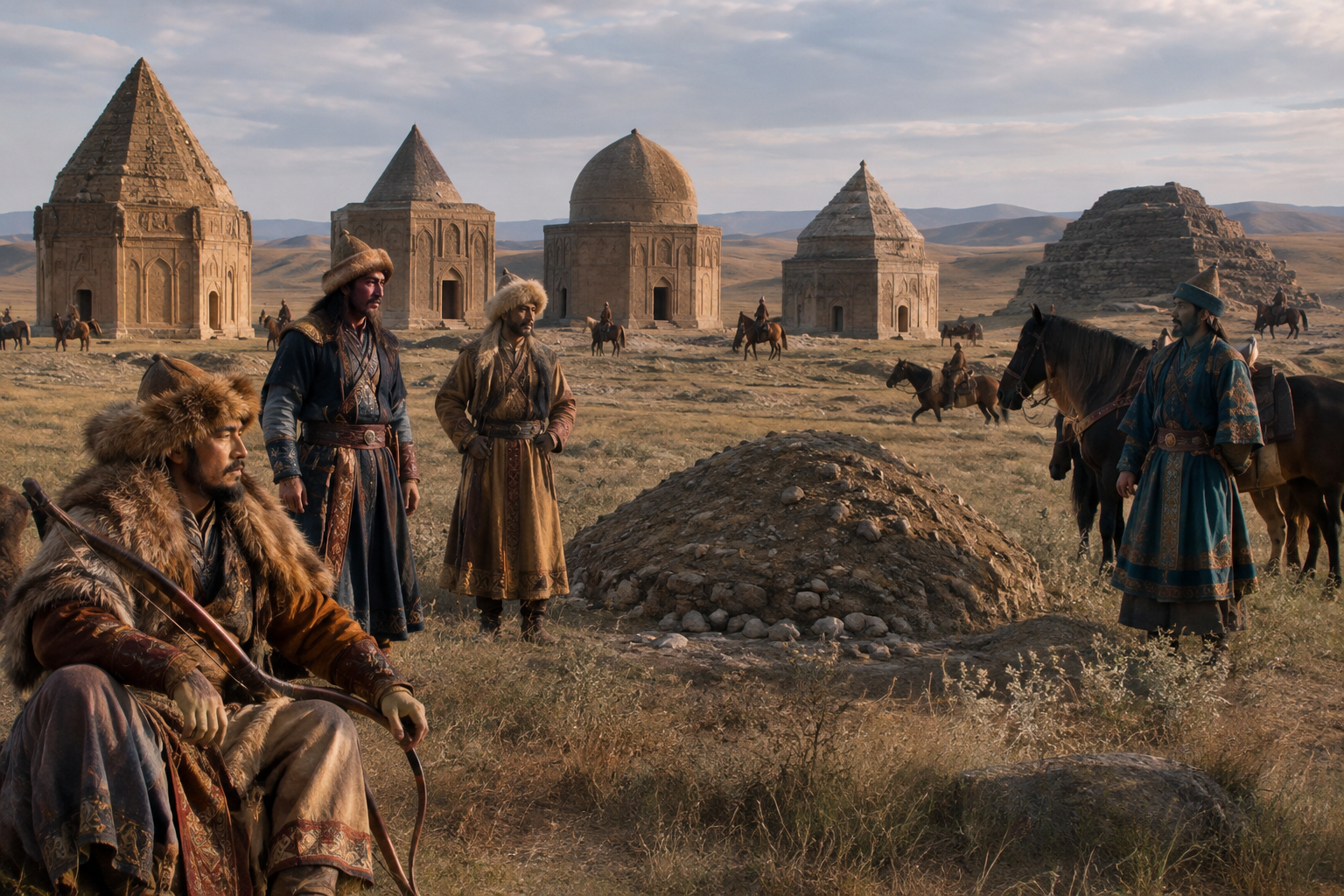
Some Y-chromosome lineages are easiest to understand in a village churchyard or a medieval castle. Haplogroup C2a1a3a1 is not one of them. Its story belongs, more fittingly, to the long belt of Eurasia where mounted empires rose and fell, where courts could be mobile before they became monumental, and where a paternal line might appear in the archaeology of nomads, imperial elites, and frontier communities spread across thousands of miles.
That is what makes C2a1a3a1 historically so interesting. As a Y-DNA haplogroup, it traces one direct paternal line only: father to son to son across deep time. It does not describe a person's whole ancestry, culture, language, or identity. But when a lineage like this turns up in medieval steppe burials, Golden Horde elite mausoleums, and later in the historical orbit of the Qing imperial house, it becomes a particularly vivid tool for thinking about how power, migration, and kinship moved across Inner Asia.
C2a1a3a1 sits within haplogroup C, one of the old and widely dispersed branches of the human Y-chromosome tree, with especially important history in East Asia, Inner Asia, Siberia, and among populations touched by the great nomadic confederations of the steppe. For this specific subclade, caution matters. We should not simply pour the entire history of broad haplogroup C into the much narrower branch C2a1a3a1. Still, the supplied evidence places this lineage firmly in a historical landscape shaped by eastern Eurasian and steppe-connected populations.
That landscape was never static. It linked Mongolia, northern China, the Altai, the Kazakh steppe, the Silk Road towns of Semirechye, and eventually the western steppe and Black Sea frontier. In such a world, paternal lineages could spread not only through ordinary family continuity but through political expansion, military recruitment, elite household formation, and the absorption of allied clans.
For readers interested in the deeper background to eastern paternal lineages and how ancient Y chromosomes help reconstruct them, one especially useful companion piece is this broader look at East Asian paternal history.
Explore East Asian Paternal History
The ancient samples supplied here do not give us a neat little family tree. What they do offer is something better for historians: a set of snapshots from different places and centuries that show this paternal line moving through major historical zones.
One of the earliest anchors is KLK002, a Medieval Nomad from the Kayalyk Mausoleum, dated to 950 AD. Kayalyk, in the wider Semirechye region, stood in a world of trade, pastoralism, and political mixing. This was no isolated camp on an empty plain, but part of a corridor connecting the steppe to urban markets and caravan routes. A lineage found here immediately suggests that C2a1a3a1 belonged to the human traffic of Inner Asia well before the full imperial age of the Mongols.
Then the picture sharpens in the era of conquest and khanates. DA28, from Golden Horde Medieval Kazakhstan Karasuyr and dated to 1300 AD, places the lineage within the western domains shaped by the Mongol imperial aftermath. This is the world in which a lineage could travel with armies, administrators, camp followers, and political marriages, eventually becoming part of the ruling and military landscape of the Golden Horde.
Even more striking are the elite burials: CZK002 from the Mausoleum of Jochi Khan in Kazakhstan, dated 1227 AD; CZK003 from the Mausoleum of Ayakkamir, dated 1310 AD; and CZK001 from the Mausoleum of Alasha Khan, dated 1700 AD. These are not just anonymous graves on the margins of empire. They come from memorial settings associated with elite status, dynastic memory, and political legitimacy on the steppe.
Here one must be properly careful. A shared haplogroup does not prove that these men were close paternal kin, nor does it automatically identify a single ruling dynasty in a strict genealogical sense. But taken together, these finds strongly suggest that this lineage belonged to populations embedded in the elite and aristocratic worlds of steppe polities over many centuries.
If you want to dig further into exactly this historical zone, the most directly relevant companion article is the one on Golden Horde elite burials and ruling-lineage genetics.
Read About Golden Horde Elites
The geographic spread of the supplied samples matters as much as their dates. TSA003, a Late Medieval Mongol from Tsagaan Chuluut, dated 1350 AD, pulls the story back toward Mongolia itself. That gives us an eastern anchor in the late medieval period, while the Kazakh and western steppe finds show the same broader paternal line in lands ruled from the imperial expansion westward.
Then there is UKR017, from Medieval Ukraine Zaporizhzhia Mamay-Gora, dated 1450 AD. That is a wonderful reminder that steppe history did not stop at Kazakhstan. By the late medieval period, the north Pontic region was a contact zone where Turkic, Mongol, Slavic, and other populations met, fought, traded, and intermarried. A lineage with eastern steppe associations appearing in Ukraine is not an oddity. It is exactly the sort of thing one might expect in a region repeatedly crossed by nomadic confederations and successor states.
For readers who want to follow that western extension of the story, from the Pontic steppe into medieval frontier zones, this article makes an excellent next step.
Explore Northern Black Sea DNA
Seen together, these individuals suggest not a single migration event but a durable steppe-connected paternal presence stretching from Inner Asia into the western reaches of the former Mongol world. Ancient DNA is especially good at showing this sort of continuity-with-movement: the same broad lineage appearing in different political settings, not because history was simple, but because mobile societies could carry paternal lines astonishing distances.
The noble family supplied with this haplogroup is the House of Aisin Gioro, the imperial clan of the Qing dynasty. This is precisely the sort of historical association that needs both interest and restraint. The appearance of C2a1a3a1 in this article's context makes the Aisin Gioro historically relevant to the lineage's wider story, but it does not mean that every member of the house, or every collateral branch, can be assigned that haplogroup without specific evidence.
What we can say is that the Aisin Gioro belong to the later state-building history of the eastern steppe and northeast Asia, where clan politics, conquest, banner organization, and imperial legitimacy all mattered. In them, the mobile political traditions of Inner Asia eventually converged with one of the most formal court cultures in world history.
The supplied architectural setting is the Forbidden City in Beijing. Built from 1406 to 1420 for the Yongle Emperor of the Ming dynasty, it later became the political and ceremonial heart of China under both the Ming and the Qing. There is something rather splendidly ironic here. A paternal lineage associated in the ancient DNA record with nomadic and steppe-connected worlds ends up, in historical memory, linked to one of the most enclosed and choreographed palatial spaces ever constructed.
Behind its walls, moats, gates, courtyards, and halls, emperors, their families, and top officials ruled for nearly five centuries. Foreigners called it the Forbidden City because it was closed to ordinary people; its Chinese name, the Purple Forbidden City, tied the emperor to the heavens. After the abdication of the last emperor in 1912, and the upheavals that followed, it became the Palace Museum, preserving an extraordinary archive of art, architecture, and ritual.
In other words, the building does not prove a genetic claim. But it does preserve the historical memory of the dynasty with which this haplogroup is contextually associated: a reminder that paternal lines do not only survive in bones and lab reports, but in institutions, monuments, and dynastic narratives.
Readers curious about that imperial house itself may want to continue with the dedicated family article.
Discover the House of Aisin Gioro
What, then, does haplogroup C2a1a3a1 reveal? First, it points toward a paternal history deeply tied to Inner Asia and the steppe world. Second, the supplied ancient DNA suggests presence in mobile and elite contexts from at least 950 AD through the Golden Horde centuries and beyond. Third, its appearance from Mongolia to Kazakhstan and as far west as medieval Ukraine shows how steppe lineages could move across enormous distances without losing continuity.
What it does not reveal is equally important. It does not tell us that everyone with this haplogroup descends from a khan, a Qing emperor, or a single famous clan. It does not assign ethnicity. It does not replace documentary genealogy. What it offers is a sharply focused paternal thread, one that can be compared against archaeology and history to illuminate broad patterns of kinship, mobility, and power.
That is, really, the excitement of ancient DNA. Written history often begins with courts and chronicles. Genetics can begin with a single burial in Kazakhstan, a mausoleum on the steppe, or a man buried in medieval Ukraine, and then ask how those lives fit into the larger human story.
If you would like to explore whether your own DNA shows links to ancient individuals, historical populations, or lineages like those discussed here, MyTrueAncestry offers a fascinating way to compare your results with the ancient past. These matches do not necessarily prove direct descent from a specific noble family or ancient person, but they can open an unusually vivid window onto your deeper ancestry.






Comments