Proving the Ottonians: Ancient DNA Confirms the Paternal Kinship of Emperors Otto I and Henry II
– 6 min read


Ottonian Emperors, Cathedrals, and DNA: Bringing the Early Empire Back to Life
This comprehensive study plunges readers into the political heart of 10th and early 11th-century Europe, following the bones of two of its most important rulers: Emperor Otto I "the Great" and Emperor Heinrich II "Saint Henry". By combining archaeology, cathedral history, and genetic analysis, it reveals how the early empire that later became the Holy Roman Empire can be explored through the remains of its first and last Ottonian emperors.
The Ottonian family emerged as architects of a revolutionary political experiment: transforming a patchwork of early medieval kingdoms into a functioning empire. This dynasty, also known as the Liudolfingians or Saxons, arose from noble families of the Saxon and Frankish world, with deep roots in the power networks that had served Charlemagne and his successors.
Their power base centered around the Harz Mountains, a region that functioned as a "King's Landscape", dense with royal estates, courts, and monasteries. From this core, they projected authority across the East Frankish Kingdom covering much of modern Germany and then expanded into Italy and beyond. When Otto I claimed the imperial title in 962, he achieved more than reviving an ancient Roman designation: he fused the concept of empire with East Frankish kingship, establishing foundations for what later centuries would recognize as the Holy Roman Empire.
The dynasty's political narrative unfolds through two men and their cathedral burial sites. Otto I represents the founder of an imperial project, while Heinrich II embodies its final Ottonian expression. Between them lies a century of warfare, alliances, church reforms, and dynastic marriages that integrated the Ottonians into elite networks stretching from Burgundy and France to Italy and beyond.
Otto I emerges as both battlefield commander and empire-builder. Born in 912, probably at Wallhausen, Otto grew up in the Saxon heartlands. Chroniclers credit him with participation in at least fifty sieges and sixteen battles, demonstrating that 10th-century rule demanded constant military engagement.
The Battle of Lechfeld in 955 stands as the defining moment of his reign. Facing a Hungarian army threatening the East Frankish realm, Otto reportedly vowed that victory would be commemorated by founding an archbishopric at Magdeburg. His triumph led to the fulfillment of this promise: Magdeburg achieved archiepiscopal status in 968, becoming both spiritual and political anchor on the empire's eastern frontier.
Magdeburg Cathedral thus represents more than ecclesiastical architecture; it embodies Otto's monumental statement about kingship, Christianity, and empire. Positioned on the Elbe, it symbolized expansion and authority. Otto selected it as the burial place for himself and his first wife, Queen Edgitha. When Otto died at Memleben in 973, his body was transported to Magdeburg, while his internal organs received separate burial at Memleben, following typical medieval elite practices.
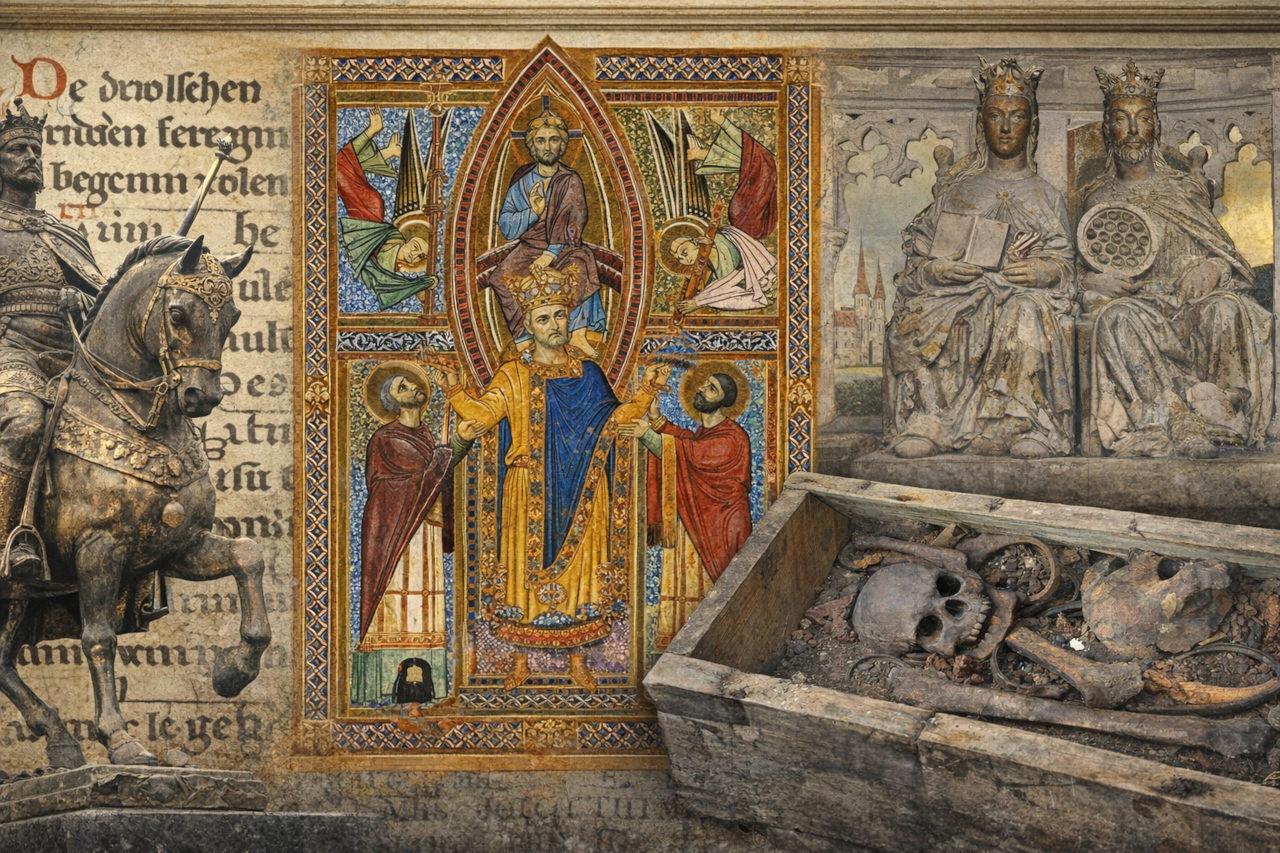
Magdeburg Cathedral serves as an active archaeological site. Otto's grave has experienced a turbulent history. The cathedral underwent multiple reconstructions, including complete rebuilding in the 13th century. The tomb was officially opened in 1844, but 19th-century documentation proves frustratingly inadequate: a rough sketch of the tomb interior and a skull drawing represent nearly all surviving records.
Poor security and casual handling of remains during that period created realistic possibilities for bone disturbance, mixing, or removal. Over subsequent decades, Otto's tomb remained an object of fascination, caught between religious reverence, national mythology, and early archaeological investigation.
During summer 2025, necessary renovation work on Magdeburg Cathedral provided exceptional opportunity to reopen the tomb under modern scientific conditions. This examination employed careful documentation and, crucially, ancient DNA sampling. From skeletal remains associated with Otto, researchers carefully sampled a tiny ear bone (the incus), a skull component that frequently preserves DNA effectively.
Otto's first wife Edgitha, whose remains also rest in Magdeburg Cathedral, offers important comparison. Her grave and bones underwent extensive study between 2008 and 2010. While burial context could be reconstructed comprehensively, DNA preservation proved insufficient for sequencing. Conversely, Otto's bones yielded unexpected genetic treasure.
Heinrich II represents the dynasty's final, complex phase. Born in 973, probably in Bamberg, Heinrich was Otto's brother's grandson. Through a chain of Bavarian dukes and strategic marriages, including his father Heinrich of Bavaria and mother Gisela of Burgundy, he emerged as leading claimant after cousin Otto III's death in 1002.
Heinrich combined piety with political acumen. His marriage to Queen Cunigunde of Luxembourg appears in contemporary documents using remarkably warm language for royal charters. However, the couple remained childless, a critical problem in a world where dynasties depended on heirs. Chroniclers attributed this to Heinrich's health problems, mentioning severe abdominal pain and possible injuries affecting fertility.
In his final years, Heinrich's illnesses intensified. During a 1024 journey to the Harz region, his pain forced travel in stages with extended pauses. He died that year in the royal castle at Grone. With his brother Bishop Brun of Augsburg's death in 1029, the Ottonian male line ended.
Heinrich's burial story proves even more complex than Otto's. He founded Bamberg's diocese and cathedral, creating a key spiritual and political center. Naturally, he chose Bamberg for his burial.
During the 16th century, most of Heinrich's skeleton was relocated to a new, highly visible tomb: a sculpted masterpiece by artist Tilman Riemenschneider, created between 1499 and 1513. This monument, rich in late medieval stone carving, remains a cathedral highlight today.
Heinrich's story continues beyond death because he became both emperor and saint. His canonization in 1146 created a thriving cult. His bones became precious relics, believed to confer spiritual power on devotees. This resulted in holy fragmentation typical of medieval Europe: saints and rulers were literally divided. Bones moved between churches, were placed in shrines, and sometimes mixed with other remains.
This fragmentation created archaeological challenges: identifying specific bones becomes nearly impossible when remains have been repeatedly moved, divided, and venerated. Heinrich's femur return in 2024 created exceptional opportunity. In early 2025, researchers received permission to sample both his skull and repatriated femur for ancient DNA, targeting the dense inner ear bone (petrous) for optimal DNA preservation.
The research transformed Magdeburg and Bamberg cathedrals into unexpected scientific laboratories. In each location, bones attributed to emperors Otto in Magdeburg and Heinrich in Bamberg were treated as biological samples containing information about family, ancestry, and identity.
Researchers carefully extracted tiny amounts of bone powder, which underwent processing in specialized laboratories. Heavily degraded DNA fragments were painstakingly extracted and converted into libraries collections of short DNA pieces prepared for sequencing. The study reports successful recovery of high-quality genetic material with minimal contamination, providing confidence that results reflected authentic ancient imperial genetic codes rather than later handlers or intruders.
Medieval chroniclers and historians have long claimed that Otto I and Heinrich II were closely related: Heinrich as Otto's great-nephew through the male line. Political narratives, charters, and genealogical tables rest on this assumption, but bones can reveal different stories.
The genetic analysis becomes historically significant through examination of both genomes for long identical DNA stretches segments inherited from shared ancestors. This enabled estimation of relationship closeness. The discovered pattern fits third-degree relatives in biological terms the expected level for great-uncle and great-nephew relationships.
Both men carried identical, extremely rare Y-chromosome lineage, a marker transmitted father to son. This particular lineage, labeled R1b-FTA63331, appears today in only scattered individuals across Denmark, Germany, the Netherlands, South Africa, and a few unknown origins. The estimated common male ancestor dates to the late Roman to early medieval period, compatible with Liudolfingian family origins.
Otto and Heinrich possessed different mitochondrial DNA, genetic material transmitted through maternal lines. This precisely matches expectations for shared male-line ancestry (great-uncle and grandnephew) with different mothers and grandmothers.
Combined evidence strongly supports authentic remains belonging to Otto I and Heinrich II. Alternative scenarios requiring wrong bones in both tombs, belonging to two men sharing correct male-line relationship and precise genetic relatedness, strain credibility beyond reasonable limits.
Early empire political history has been entangled with subsequent myth-making. During 19th and 20th centuries, particularly during the Nazi period, figures like Heinrich I and Otto I were recruited as symbols in nationalist narratives about "first German kings". This makes evidence-based discussion of the Ottonians increasingly important.
Confirming Otto I and Heinrich II identity through DNA provides invaluable "ground truth" for historians and archaeologists. These emperors are exceptionally well documented: birth and death dates are precisely known, movements recorded in royal itineraries, and political lives traced through hundreds of charters.
Authenticated bones become reference points for multiple scientific techniques. They enable calibration of radiocarbon dating methods, which can be distorted by elite diets. They provide known-age skeletons for testing age-estimation techniques. They offer genetic baselines for identifying other high-status burials potentially connected to Ottonian marriage networks.
The Ottonian dynasty married into and competed with other ruling houses: Burgundian kings, Capetian kings in France, and Salian dynasty successors. Because Otto and Heinrich's genomes are mapped, they function as genetic yardsticks. When archaeologists discover high-status burials possibly belonging to Ottonian or related dynasties, DNA comparison with these "anchor emperors" might reveal previously unknown princes, princesses, or collateral family branches.
https://www.biorxiv.org/content/10.64898/2026.03.18.712637v1?ct
Comments