Huns, Goths and the Turbulent World Behind the Tyniec Cemetery - Southwest Poland

– 8 min read



The article drops the reader straight into one of the most dramatic episodes in late antiquity: the Migration Period in Central Europe, when the arrival of the Huns from Central Asia set whole peoples in motion and reshaped the map from the Black Sea to the Rhine. Against this sweeping backdrop, the cemetery of Tyniec upon Ślęża in southwest Poland appears as a rare, almost haunting trace of those upheavals, preserving the bones and belongings of people who lived through the age of Attila.
Historically, the chain of events begins around 375 AD, when nomadic groups, especially the Huns, pushed into the Pontic Steppe north of the Black Sea. They subdued the Ostrogoths and by doing so set off a domino effect: Visigoths moved from Transylvania, Alans from the Caucasus, and various Germanic groups were squeezed and re-settled across Central and Western Europe.
The Huns did not stay politely at the empire's edges. They pressed into Roman Gaul and were only checked in 451 AD at the famous Battle of the Catalaunian Plains, where the Roman general Aetius, fighting alongside Visigothic allies, halted Attila's advance. After Attila's death, a coalition of subject peoples, led by the Gepid king Ardaric, turned on their former masters and defeated the Huns. The Gepids then settled much of the old Hunnic heartland in the Carpathian Basin, while other Germanic groups, such as the Herules, carved out rule in regions like Moravia.
These power struggles did not remain neatly south of the Carpathians. The article underlines that Hunnic pressure contributed to the unraveling of established cultural groups further north, including the Przeworsk culture in today's Poland, often linked with the Vandals and the powerful Lugian confederation. Archaeologically, there is a striking decline in finds across much of Poland in the late 4th and 5th centuries, especially in Lower Silesia. Earlier scholars even spoke of a "hiatus" – a seeming disappearance of people from the land.
Yet the Tyniec cemetery shows that some communities stayed, adapted, and buried their dead in ways that speak of both continuity and change under the shadow of the Huns.
When we read about vanished civilizations, it’s easy to forget that their descendants still walk among us. If you’re curious which of them you might share roots with, you can explore your own genetic links at www.mytrueancestry.com.
Before the Huns appeared, the centuries between the 1st and late 3rd century AD were a relatively settled, prosperous time for Central Europe. The article reminds us that communities north of the Roman frontier were far from cut off. They handled Roman coins, wore Roman jewelry, and laid Roman weapons into their graves. Elite graves in what is now Poland regularly contain swords, and tellingly, about half of these swords are Roman-made.
Trade routes shifted over time – the classic Amber Road faded, alternative links between the Black Sea and the Baltic took over – but contact never stopped. Alongside the trade went low-level warfare: Central European warriors fought for and against Rome, joined campaigns, and likely brought home plunder as well as pay. The people buried at Tyniec lived in the long afterglow of these centuries of entanglement, just as Roman power along the Danube and Rhine was weakening.
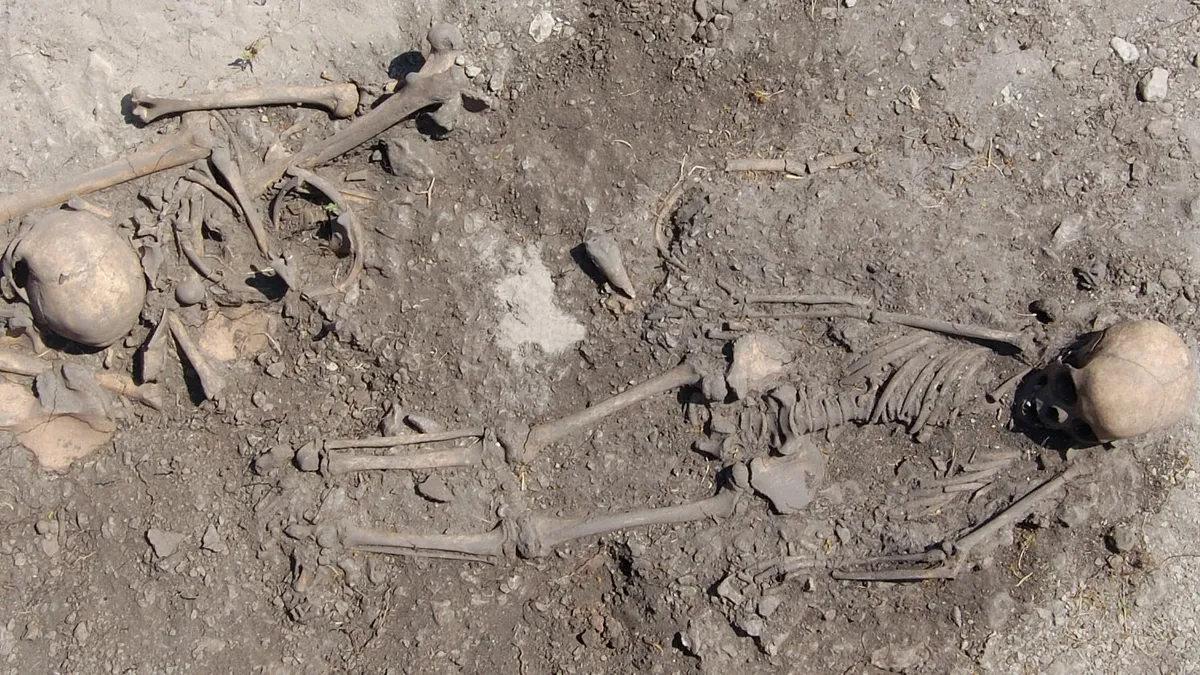
Archaeologically, the Tyniec upon Ślęża cemetery is a jewel simply because it exists. It lies on a terrace above the Ślęża river, a tributary of the Oder, about 29 kilometres south of modern Wrocław. Excavated in 2011, it is, as the article stresses, the only newly uncovered Migration Period cemetery in southern Poland and the first such discovery in Lower Silesia since the 1930s.
Earlier, a cemetery at Żerniki Wielkie near Wrocław – long regarded as a key site for late Roman and early Migration Period Silesia – was excavated, but most of its finds were lost during the Second World War. Other sites from the same broad horizon in Lower Silesia turned out to be mere isolated graves. In this bleak landscape of evidence, Tyniec stands out as a coherent burial ground, with enough graves, objects and human bones to say something concrete about life in the 4th and 5th centuries AD.
The cemetery contains inhumation graves – bodies buried rather than burned – with both adults and juveniles represented. The article notes two identified females and seven males, plus one adult whose sex could not be determined from the fragmentary skull. Two of the burials (graves TYN 1 and TYN 12) were marked by stone stelae, simple standing stones, and a third stele was found nearby.
Curiously, there are no infants or very young children. This strongly suggests that Tyniec was not a full community cemetery. Rather, it may have been reserved for a particular subset of the population – perhaps a warrior group and associated household members, or some other select category of the living community.
The graves are carefully arranged. Most bodies lie on their backs, heads pointing roughly west-south-west, in neat rows. Some graves held disarticulated bones – bones no longer in anatomical order – yet these were laid down deliberately, not as disturbed or accidental deposits. Two burials appear to be re-burials or partial deposits of earlier remains.
One of the most striking aspects of Tyniec is the grave construction. Several graves (notably 2, 6, 9 and 11) have elongated, human-shaped hollows cut into the bottom of the grave-pits. These "body-shaped" concavities probably once held wooden laths or planks and effectively formed an earthen coffin.
The article points out that such deepened, contoured grave bottoms are very similar to practices among Sarmatian and related steppe communities. In Sarmatian cemeteries – and in parts of the so-called Chernyakhov culture to the east, often associated with Ostrogothic and mixed populations – archaeologists find "pits with shoulders" or "pit-coffins", where the grave walls step inwards or the base is carved to roughly match a human figure.
At Tyniec, metal fittings in several graves likely belonged to wooden boxes or coffins supported over these hollows. There are direct parallels in the older cemetery at Żerniki Wielkie and further afield in sites like Tiszadob-Sziget in Hungary. The article reads these features as a local version of a much wider "eastern" burial tradition, adapted by Germanic groups in Silesia who were in contact – directly or indirectly – with steppe and Chernyakhov populations under Hunnic influence.
Grave furnishings at Tyniec are generally modest but revealing. Almost every grave includes an iron knife – the all-purpose tool of the day – and buckles of iron or bronze. These are standard kit across barbarian Europe in this period and not much use for fine dating.
A few burials stand out. Grave 6, a young adult female, contained glass and amber beads strung together in striking combinations, bronze buckles and dress fittings, a large loom weight carved from sandstone, and ornaments made from shells and possibly silver. This is a rich ensemble by local standards. It speaks of status, but also of connections: glass and amber link her to long-distance trade networks that still functioned in the age of Hunnic domination.
Grave 2, another adult female, is equally intriguing. Here the archaeologists found fragments of iron chain mail alongside the more usual iron knives, bronze buckles, and ceramic vessels. Chainmail in a woman's grave is unusual and has inspired debate. The article cautiously presents two interpretations. Either she really was part of a warrior milieu – perhaps one of those rare but not impossible women who participated in armed retinues – or the mail fragments had a symbolic, protective role, reused as amulets rather than battle gear. Earlier work on the "second life" of Roman military equipment in barbarian graves shows that such reinterpretations were common.
Male graves (such as 4, 5, 7, 8 and 9) also contain knives, buckles, sometimes bars of iron, tweezers (a small but telling sign of grooming), and in one case a ceramic mug or vessel. The overall impression is of a group that valued practical tools, simple personal grooming items, and the occasional piece of exotic finery.
The relative dating of the grave goods places the main use of the cemetery in the later 4th and early 5th centuries AD, the classic D phase of the Migration Period, around 360–430 AD. Radiocarbon dates from the bones extend that use down to roughly 540 or 550 AD, suggesting that burials continued into the 6th century.
The article sets these graves against the broader political drama along the Danube and in the Carpathian Basin. In the early 4th century, Roman emperors such as Diocletian and Constantine had still dominated the frontier. They imposed treaties, built the so-called "Sarmatian limes" of fortifications, and pushed their influence north of the river.
From about 370 AD onward, that confident system unraveled. The Huns swept into the Black Sea region, wrecked the Bosporan cities and the Chernyakhov settlements, and forced Goths and other peoples into Roman territory. The Danube provinces suffered repeated Gothic, Hunnic and mixed invasions; Pannonia and northern Italy were torn apart by coalition armies like that of Radagais. By the time Attila ruled, a Hunnic-led empire of subject tribes stretched from the Volga to the Rhine.
This had direct consequences in today's Poland. Traditional routes between the Hungarian Plain and regions north of the Carpathians were blocked or controlled by Hunnic forces and their allies. The article recalls finds from southern Poland that point to a strong Hunnic presence: distinctive horse-harness fittings, weapon types, and grave goods that mirror finds from the Carpathian Basin and the Pontic steppe.
The article also mentions recent genetic work from Czulice in Poland, where two boys show mixed Hunnic and European ancestry, further underlining how deep these Central Asian connections ran.
In this context, Tyniec looks like the burial ground of a small group that managed to persist in a zone otherwise marked by depopulation and abandonment. It may represent survivors of older Przeworsk communities, people resettled under Hunnic authority, or some mixture of both, living on through the fall of the Western Roman Empire and the re-ordering of Central Europe.
The human remains themselves are as eloquent as the objects. The article reports that the individuals from Tyniec were not in robust health. Many skeletons show evidence of nutritional stress, dental disease, and healed bone fractures that speak of hard lives in uncertain times.
One case (grave 12, a juvenile male) may represent death by dismemberment with a blunt-edged weapon – a grim reminder that these were people living in a world of raids, battles and reprisals.
Another man (grave 8) had extreme dental disease: vast crusts of calculus, multiple caries, and periodontal damage. His bone chemistry suggests a somewhat different diet, and the article suggests that his poor oral health alone might have altered what and how he was able to eat towards the end of his life.
One of the most arresting findings of the study lies in the chemical signatures inside the bones. By measuring the ratios of carbon and nitrogen in bone collagen, the researchers reconstructed what people at Tyniec ate over many years.
In simple terms, their diet was anchored in terrestrial crops and livestock – cereals, cattle, pigs, and sheep – the standard fare of Germanic farming communities. However, two individuals (TYN 9 and TYN 12) show unusually high nitrogen values, far above what would be expected for a purely land-based diet. These values fit best with regular consumption of freshwater fish high up the food chain, from large, nutrient-rich rivers such as the Oder. The article notes that local fish bones, including salmon, sturgeon, catfish and pike, have similarly elevated nitrogen values.
Rather than a gourmet taste for fish, the authors suggest something more sobering: in times of crisis, when fields were abandoned and herds lost to war, fish became a crucial fallback. Similar "crisis fish diets" are documented in late Roman Britain, where fish consumption rose sharply in the troubled 4th and 5th centuries. At Tyniec, heavy reliance on river resources may encode a story of disrupted agriculture and adaptive resilience during the Hunnic and post-Hunnic decades.
Discover how your DNA connects to ancient civilizations at www.mytrueancestry.com.





Comments