Haplogroup R1b1a1b1a1a2c1a2a1a1a1b

– 6 min read


Some Y-DNA haplogroups arrive with trumpets and banners. Others come into view more quietly, through one excavated burial, one medieval territory, one family tradition, one line of men stretching back beyond surnames and written memory. The subclade R1b1a1b1a1a2c1a2a1a1a1b belongs to that second category: a very specific paternal branch nested deep within the wider R1b tree, a lineage whose broader family is famously important in western European population history, but whose own narrower story must be told with much more care.
That caution matters. Y-DNA traces a direct paternal line only: father to father to father. It does not describe a person's whole ancestry, and it certainly does not turn a shared haplogroup into proof of noble descent. But when a branch like this appears in ancient DNA and is then considered alongside places such as Viking Age Denmark, Gaelic Ulster, and the frontier castles of Monaghan and Fermanagh, it becomes a fine historical tool. Not a magic key, but a way of asking better questions about continuity, migration, and the men whose lines endured while kingdoms rose and fell around them.
The wider haplogroup R1b is one of the major paternal lineages in western Europe today, and ancient DNA has shown that branches of R1b became especially prominent in many parts of Europe after large prehistoric population changes connected with the later Neolithic, Copper Age, and Bronze Age. That much is broadly established. What is harder, and more interesting, is narrowing the focus. A highly specific subclade such as R1b1a1b1a1a2c1a2a1a1a1b should not simply be handed the entire history of R1b as if nothing changed along the way.
Instead, we should think of it as one twig on a very large paternal tree. Its deeper ancestry almost certainly belongs within those long-term processes that helped shape later populations around the Atlantic world and the North Sea, but the exact path taken by this narrower branch is best reconstructed from particular evidence points, not sweeping assumptions. In practice, that means looking at where ancient samples appear, where medieval families are rooted, and how regions such as Scandinavia and Ireland were tied together by travel, raiding, settlement, trade, and war.
For readers interested in the longer background to how paternal branches like these became established in Europe, one useful companion piece is this broader look at prehistoric expansion and settlement.
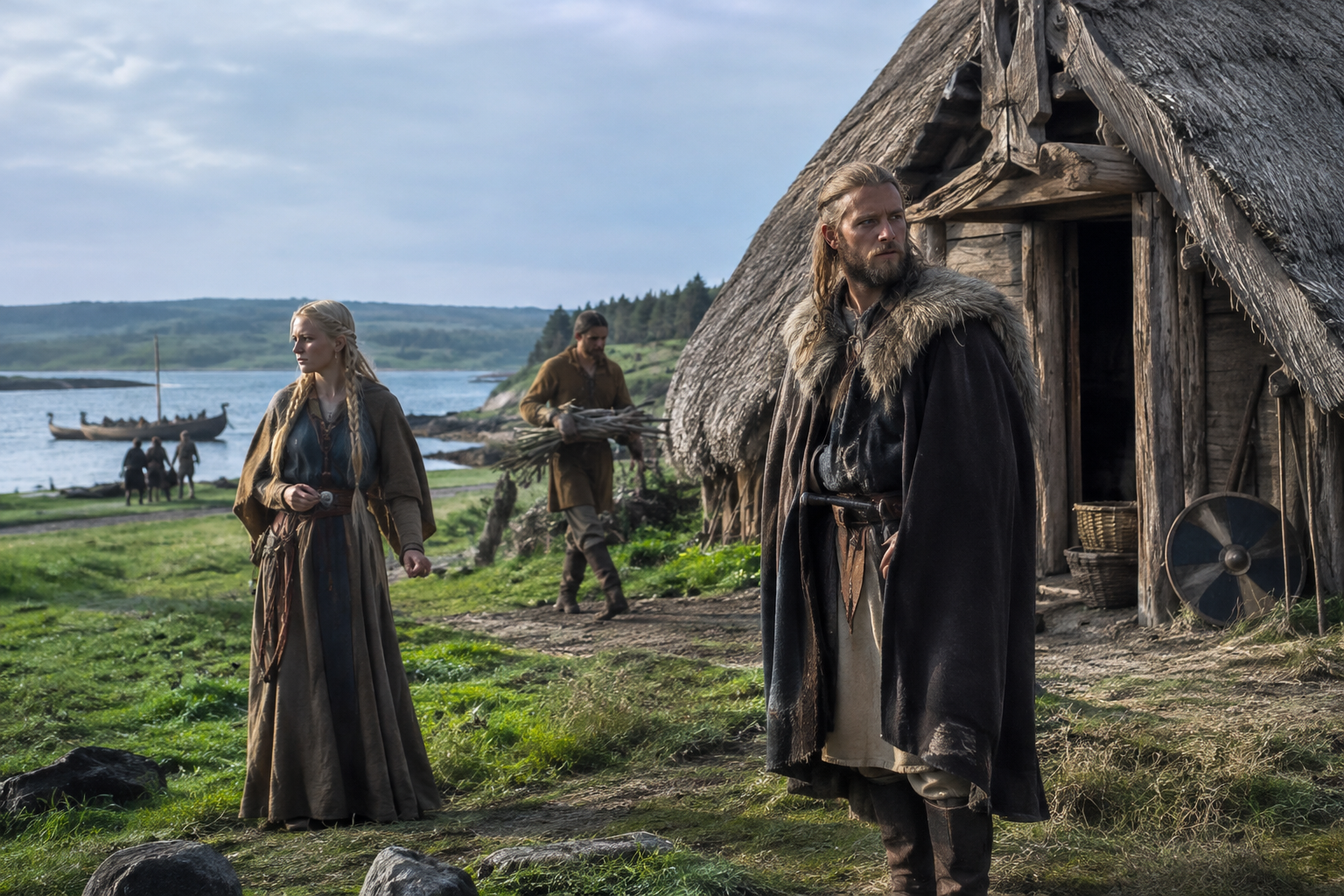
The clearest anchor in the supplied evidence is an ancient individual from Denmark: VK287, from Viking Age Kaargarden Grav Denmark, dated to 950 AD. It is a splendidly evocative setting. By the mid-10th century, Denmark was not some remote fringe of Europe but one of the engines of the Viking world: outward-looking, mobile, entangled with Britain, Ireland, the North Atlantic, the Baltic, and the emerging Christian kingdoms of northern Europe.
That is what makes VK287 so valuable. He is not evidence for a direct line to any later clan or castle, and it would be irresponsible to pretend otherwise. But he does show that this paternal branch, or a very close genetic position associated with it, was present in Viking Age Scandinavia. That matters because the Viking world was a world of movement. Men from Denmark and neighboring regions sailed, settled, traded, fought, married, took service abroad, and in some cases founded new local elites far from home.
If we are trying to understand how a specific R1b lineage could appear in later North Atlantic or Irish contexts, a Viking Age Danish sample is exactly the sort of evidence point that sharpens the conversation. It does not prove a migration into Ireland. It does remind us that by 950 AD paternal lineages were circulating through a connected northern seascape rather than sitting neatly inside modern national borders.
Readers who want a wider archaeological and genetic frame for that northern world might enjoy this article on Viking Age population history.
Once you move from ancient DNA into medieval history, the map becomes even more complicated, and more human. Ireland was never sealed off from the wider northwestern European world. Viking activity reshaped Irish coastal towns, maritime trade, kingship politics, and military geography. Over centuries, Norse and Gaelic worlds collided, merged, and adapted. Then came the Anglo-Norman expansion, adding another layer of incoming male lines, lordship structures, and fortified landscapes.
That larger setting is important when thinking about a haplogroup like R1b1a1b1a1a2c1a2a1a1a1b. A paternal lineage present in Viking Age Denmark could, in principle, enter Irish history through many different mechanisms: Scandinavian settlement, mercenary movement, later medieval mobility around the Irish Sea, or simply because branches of related R1b lineages had already become widespread in parts of northwestern Europe long before the Viking Age. Genetics can show us possibilities and patterns. It does not, by itself, assign a surname to the past.
That is particularly worth remembering in border regions such as Ulster, where Gaelic dynasties, church lands, Norse influence, and later Anglo-Norman and Tudor intervention all overlapped. A haplogroup may persist through these changes, but the language, politics, and identity attached to it can alter dramatically from century to century.
For another perspective on how northern migrations shaped Britain and Ireland across the long term, this article offers a useful broader backdrop.
That brings us to the noble families and their strongholds. The supplied associations point first to Clan MacGuire and Enniskillen Castle in County Fermanagh. The castle stands by the River Erne and began as a stronghold of the Maguire chiefs in the fifteenth century, guarding an important crossing and displaying power in Gaelic Ulster. It is a classic example of how a dynasty fixed itself in the landscape: not merely by blood, but by control of water, roads, levy, and local allegiance.
Then came rupture. In 1594, during the Nine Years War, Enniskillen Castle was taken by English forces, and after that it became part of the Tudor conquest of Ireland. Over the seventeenth century it was rebuilt and adapted for soldiers, later serving as a British army barracks for centuries before restoration in modern times as a museum. It is, in short, a structure that contains multiple political lives inside one shell: Gaelic fortress, conquest prize, imperial barracks, and now historical archive in stone.
Could a paternal lineage like R1b1a1b1a1a2c1a2a1a1a1b have existed among men in the wider MacGuire orbit? Certainly it could. Do the supplied materials prove that the Maguire chiefs themselves carried this exact haplogroup? No, they do not. The responsible connection is contextual. The haplogroup belongs to a paternal landscape that fits well within the historical world of northwestern Europe and Ireland, while Enniskillen Castle preserves the memory of one regional power that stood at the meeting point of continuity and upheaval.
Readers curious about the MacGuires themselves can continue with the related clan article.
The second family setting is Clan McMahon and Clones Castle in County Monaghan. Here the story is slightly different and in some ways even more revealing. Clones Castle began as a Norman motte and bailey fort, probably built in the late twelfth or early thirteenth century, in the period when Anglo-Norman lords were pushing into Ulster and planting strongpoints across the countryside. Yet it stood above an older monastic town founded by Saint Tigernach in the sixth century. So from the beginning this was a hill of layered authority: monastic prestige, local kingship, and colonial ambition all sharing the same ground.
Over time the timber fortification was replaced or strengthened in stone, and the site became bound up with the politics of frontier lordship, raiding, and control between Gaelic chiefs and Anglo-Norman families. That is precisely the kind of setting in which paternal lineages mingle without becoming simple. A Y-DNA branch may persist through conquest, but the men carrying it may serve different rulers, adopt new languages, or pass into entirely new social identities.
Clones, like Enniskillen, is therefore not "proof" of a haplogroup. It is something more historically interesting: a reminder that medieval castles are theatres of inherited power, where paternal descent mattered intensely, even though the written record and the genetic record only occasionally meet in a way we can document precisely.
The real value of R1b1a1b1a1a2c1a2a1a1a1b lies in its scale. It is narrow enough to feel personal, but broad enough to belong to real historical movements. The Viking Age sample VK287 places this paternal line in Denmark in 950 AD. The associated Irish clans and castles place our attention on later lordship, warfare, and continuity in Ulster's contested borderlands. Between the two lies a northern European world of ships, strongholds, dynasties, and migrations.
Still, a final note of sobriety. Sharing a Y-DNA haplogroup with an ancient individual does not make him your named ancestor. Sharing a haplogroup associated with a clan context does not prove descent from that clan's ruling line. What it does offer is a historically grounded clue: your direct paternal line may belong to one of the same wider branches that moved through the Viking North, medieval Ireland, and the shifting political worlds that castles like Enniskillen and Clones still embody.
If you want to see whether your own DNA shows links to ancient individuals such as VK287, or connections to the populations behind these medieval landscapes, MyTrueAncestry lets you explore those comparisons for yourself. The results can open remarkable windows onto your past, while still respecting the difference between ancient genetic similarity and documented genealogy.






Comments