Haplogroup R1b1a1b1a1a2c1a1a1a1a1

– 6 min read


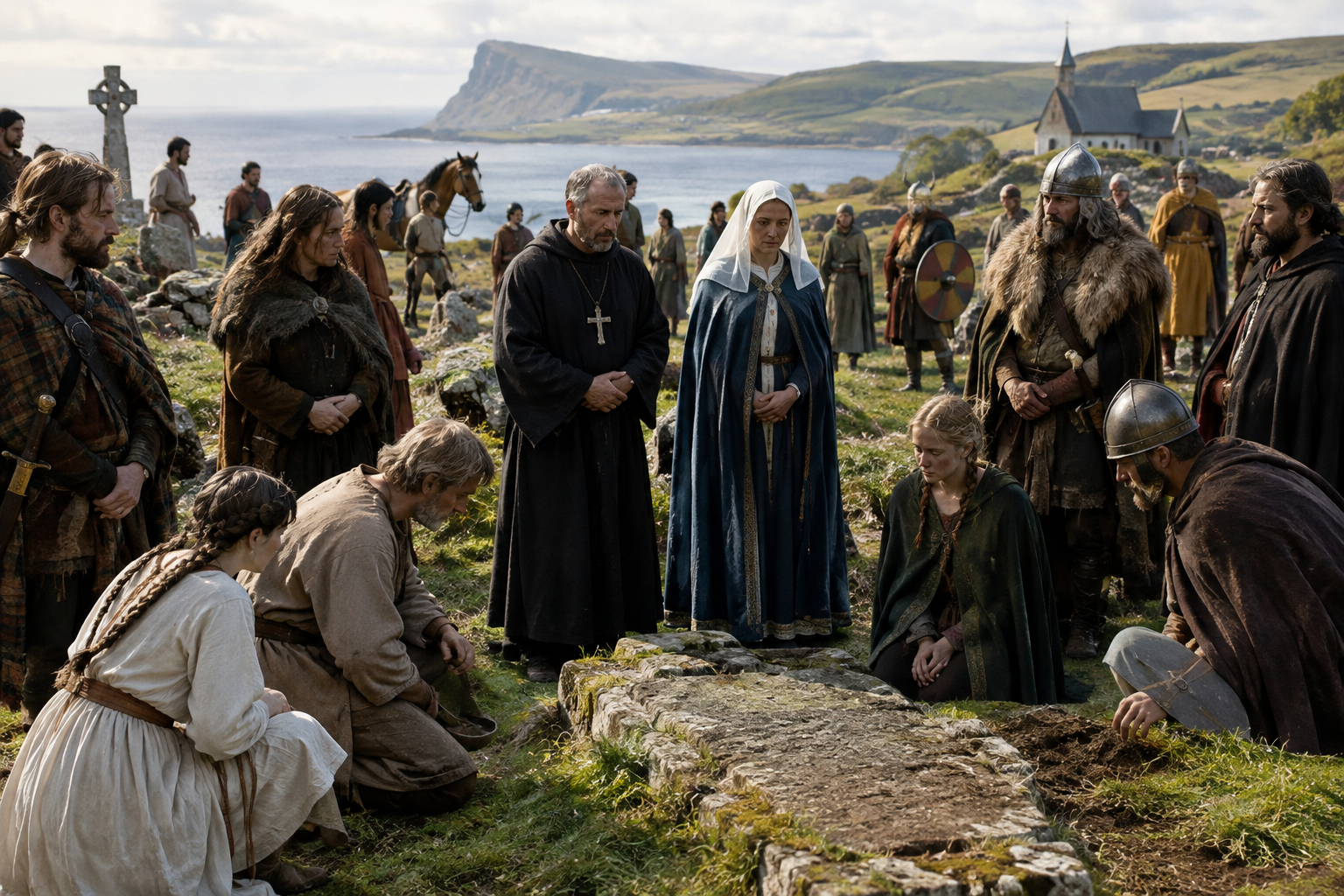
Some Y-chromosome lineages are easy to place in the imagination. They seem to belong, broadly speaking, to one region or one historic story. Others are more interesting precisely because they refuse to stay put. The haplogroup R1b1a1b1a1a2c1a1a1a1a1 belongs to that second category: a very narrow paternal branch whose ancient appearances, based on the supplied evidence here, stretch from Bronze Age Austria to Iron Age France and Britain, from early medieval Ireland and Germany to Viking North Atlantic settlements and even into colonial Maryland.
That does not mean one simple tale, one tribe, or one dynasty. Quite the opposite. Y-DNA haplogroups trace a direct paternal line only, not a person's whole ancestry, identity, or family story. Still, when a rare or specific paternal branch turns up again and again across archaeology, it gives us something unusually vivid: a way to follow one thread of male-line continuity and movement through very different worlds of burial, conquest, settlement, lordship, and memory.
This lineage sits deep within the wider R1b family, one of the major Y-chromosome groupings in western Eurasia. For non-specialists, it helps to think of the long string of letters and numbers as an address on a giant family tree. The longer the string, the narrower and more specific the branch. So while the broader history of R1b reaches across large parts of Europe, we have to be careful not to dump the entire story of that huge parent haplogroup onto this very specific downstream subclade.
What the supplied samples do suggest is that this branch, or very close paternal kin within its immediate neighborhood on the tree, had a marked presence in western and central Europe over a long period. The spread is striking: Bronze Age Austria, Iron Age Gaul and Britain, early medieval Ireland, the Low Countries, German-speaking regions, Scandinavia, the Faroes, Iceland, and the English-speaking Atlantic world. That pattern fits a lineage moving through societies shaped by later prehistoric mobility, Iron Age exchange, early medieval migrations, and seaborne expansion in the Viking and colonial eras.
Explore Celtic origins through ancient DNA
One of the earliest supplied anchors is DSH008, from Bronze Age Austria Drasenhofen, dated to 2000 BC. A sample like this matters because it places this paternal line, or something very close to it, in central Europe long before the familiar historical names of Celt, Saxon, Viking, or Norman. It belongs to a world of Bronze Age communities whose identities were not recorded in writing, but whose burial customs, exchange systems, and kinship structures are increasingly visible through archaeogenetics.
By the Iron Age, the branch appears in settings that feel much more recognisable to historians. In France there is PECH8, from Aquitani Pech-Maho France, dated to 350 BC, and I19359 from Iron Age Chemin de Coupetz Marne France, dated to 250 BC. In Italy there is 3232s, from a Gallic Cenomani Tribe Horse Co-Burial Italy Verona Seminario Vescovile, dated to 300 BC. That horse co-burial is especially evocative. It places this paternal line in an Iron Age milieu where status, warfare, and display were written into the grave itself.
Britain adds more pieces: I27382 from Iron Age Long Bredy Dorset England dated to 550 BC, I22060 from Iron Age Briton Thornholme East Riding of Yorkshire dated to 180 BC, and I14347 from Late Iron Age West Yorkshire Wattle Syke dated to 200 BC. Taken together, these do not prove a single "Celtic haplogroup" in any simplistic sense, but they do place this paternal branch within the broad human landscape of later prehistoric western Europe, especially the Atlantic and transalpine zones.
In other words, this is not a line that suddenly appears in the Middle Ages. It is already there, in the bones of Iron Age Europe.
The early medieval evidence is where the historical texture becomes richer. In Ireland, four supplied individuals stand out: KIL009, KIL033, KIL037, and KIL043, all from Medieval Ireland Kilteasheen Roscommon, with several specifically noted as Bishops Seat, and dated to 650 AD. Four men from one Irish setting carrying this paternal signature is no small detail. It suggests not just a passing visitor but real local embedding of the lineage in early medieval Connacht.
That matters especially when placed beside Rathcroghan in County Roscommon, associated here with Clann Laigin. Rathcroghan is one of those Irish places where archaeology and legend sit almost uncomfortably close together. It was a royal center of Connacht for over a thousand years, a landscape of mounds, enclosures, caves, and political memory. Tradition tied it to Medb, to the Tain, and to Oweynagat, the Cave of the Cats, later imagined as a threshold to the Otherworld. No DNA result can verify saga, of course. But the Kilteasheen burials remind us that Roscommon was not merely a mythic backdrop. It was a lived early medieval landscape in which paternal lines persisted, communities reproduced themselves, and power was rooted in place.
Elsewhere in northern Europe, the same branch appears in changing post-Roman societies: DRH026 from Thuringii Tribe Germany Deersheim Saxony-Anhalt dated to 500 AD, IND007 from a Merovingian Grave North Rhine-Westphalia Germany Alt-Inden dated to 600 AD, SED005 from Anglo-Saxon Sedgeford England Norfolk dated to 600 AD, and GRO005 from Carolingian Era Groningen Netherlands dated to 1040 AD. This is exactly the period when old Roman provinces, emerging kingdoms, and migrant groups overlap untidily in both text and archaeology. The lineage shows up in that muddle not as a badge of one ethnicity, but as evidence that paternal lines could pass through multiple political and cultural worlds.
Read about DNA in post-Roman Britain
By the Viking Age and later medieval period, the branch is present in the North Atlantic too: VK95 from Viking Age Hofstadir Iceland dated to 1050 AD, VK24 from Viking Age Faroe Islands Panum dated to 1050 AD, FOV-A1 from Viking Iceland dated to 1270 AD, and VK44 from Medieval Age Faroe Islands Sandoy Church dated to 1600 AD. Then there is CGG100512 from Medieval Jutland Denmark Vor Frue Kirkegard Aalborg dated to 1336 AD.
These finds fit a world in which Scandinavian and Norse-linked networks stitched together Britain, Ireland, Denmark, the Faroes, and Iceland. Again, one must not leap from haplogroup to identity: sharing a paternal line does not prove someone was ethnically Norse, Gaelic, Anglo-Saxon, or anything else. But the geographical distribution makes historical sense. Maritime corridors moved people, not just goods. Male lines could spread through settlement, alliance, fosterage, service, intermarriage, and ordinary family growth.
This North Atlantic setting also gives us a useful backdrop for thinking about Clan McNab and Eilean Donan. The castle stands where three sea lochs meet in the western Highlands, a place shaped by exactly the kind of seaborne politics that defined medieval Scotland. Built in the 13th century for chiefs allied to the Lords of the Isles, it was part frontier defense, part statement of power in a region long touched by Norse influence. Later it passed through struggles involving the Mackenzies and Macraes, was bombarded in 1719 during a Jacobite rising, and then rebuilt in the 20th century into the image now famous worldwide. It is a reminder that the history of paternal lines in the north is not only buried in graves. It is also written into choke points, sea routes, and strongholds.
The most unexpectedly modern turn in the evidence comes with 2099, Philip Calvert Coffin Maryland, dated to 1682 AD, and I2097, Son of Philip Calvert Lead Coffin Maryland, also dated to 1682 AD. Here the branch appears not in a tribal grave or an early medieval cemetery, but in the family of one of colonial Maryland's leading figures.
That makes Kiplin Hall in North Yorkshire, associated here with the Barony of Baltimore, especially resonant. Built in the 1620s for George Calvert, the first Lord Baltimore and founder of Maryland, the house links English landed ambition with Atlantic expansion. Over the centuries it passed through changing fortunes, decline, and restoration. In genetic terms, the Calvert burials do not prove some sweeping aristocratic monopoly on this lineage. But they do show the branch persisting into an early modern family whose political reach extended from Yorkshire to North America.
What is so striking about this sequence, from DSH008 in Bronze Age Austria to the Calverts in Maryland, is not that it tells one neat family story. It does not. It tells a more interesting historical truth: paternal lines can survive across immense spans of time while the societies around them change almost beyond recognition.
So what should a MyTrueAncestry reader take from R1b1a1b1a1a2c1a1a1a1a1? First, that it appears deeply rooted in the historical populations of western and central Europe represented in the supplied evidence. Second, that ancient DNA can show continuity of paternal branches across very different archaeological and historical settings: Iron Age burials, early medieval ecclesiastical sites, Viking settlements, noble households, and colonial elites.
But there are limits. A shared haplogroup is not proof of direct descent from any ancient sample, still less from a saga figure, an Irish royal house, a Scottish clan chief, or the Calverts of Maryland. Noble family associations are historically interesting context, not automatic genealogical certification. Genetics works best here when paired with archaeology, geography, and documentary history, each correcting the fantasies of the others.
If this article has sparked your curiosity, MyTrueAncestry lets you explore whether your DNA shows links to ancient individuals and historical populations like those discussed here. Those matches can offer remarkable context for your paternal heritage, even when they do not prove a direct line to a named family or castle.






Comments