Haplogroup R1b1a1b1a1a1c2b2a1b1b1

– 6 min read


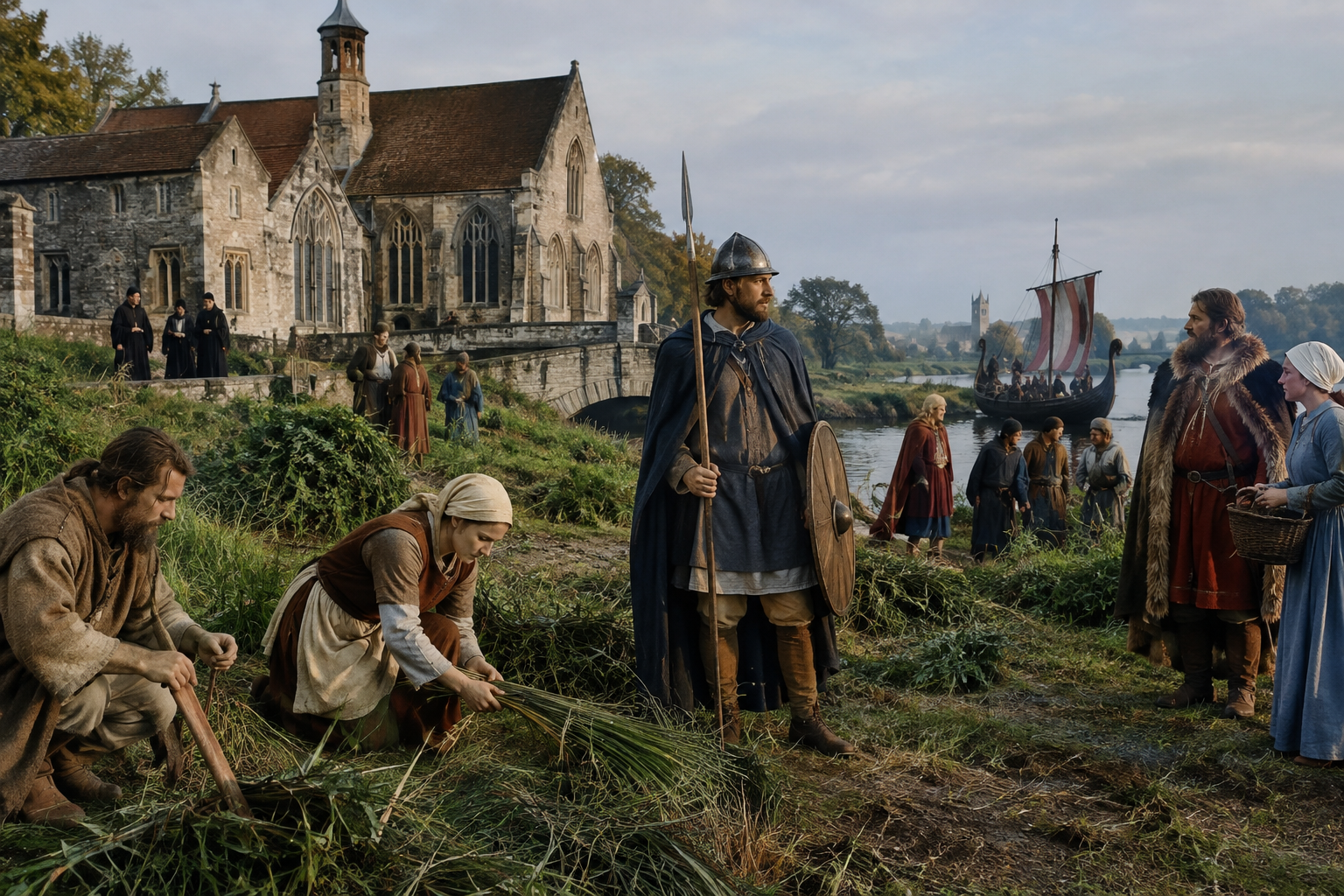
Some Y-chromosome lineages are so widely travelled that they appear less like the property of any one people and more like a thread stitched through centuries of movement around the North Sea. The subclade R1b1a1b1a1a1c2b2a1b1b1 belongs to that sort of story. It sits within the enormous R1b branch of the Y-chromosome tree, one of the major paternal lineages in western Eurasia, yet this very specific downstream branch must be treated much more cautiously than its famous parent. A broad R1b history is not automatically the history of this exact subclade.
That caution, however, does not make the story dull. Quite the reverse. The ancient samples associated here place this paternal signal in a strikingly historical landscape: Jutland, early Anglo-Saxon Cambridgeshire, Kent, Viking Age Sweden, Oxford in the year of the St. Brice's Day massacre, and medieval Cambridge. In other words, this is a lineage seen not in abstract population charts but in the world of bog warfare, migration, conversion, raiding, hospitals, and the slow making of medieval Britain. As ever with Y-DNA, we are tracing one direct paternal line only, not a person's total ancestry.
The first thing to say plainly is that R1b1a1b1a1a1c2b2a1b1b1 is a very narrow branch. Its significance comes from where and when it appears, not from any right to borrow the whole prehistory of R1b as if nothing changed along the way. Still, its placement inside R1b matters. The wider R1b family became important across large parts of Europe over long prehistoric timescales, and some of its descendant branches later became especially common in western and northwestern Europe. For a lineage like this one, the most responsible approach is to begin with that broad framework and then ask when the evidence starts becoming historically specific.
Here the supplied ancient DNA points strongly toward a northern European and North Sea setting. That does not prove a single homeland for the exact subclade, but it does suggest that by the Roman and early medieval periods, men carrying closely related paternal lines were present in Denmark, Sweden, and England. That is precisely the sort of geography one would expect in a world linked by migration, warfare, trade, and seaborne mobility.
The oldest supplied anchor in this set is CGG019209, described as a Jute Early Roman Era Denmark Jutland Bog War Alken Enge individual dated to 88 AD. Alken Enge is one of those archaeological sites that reminds us how brutal Iron Age and Roman-era northern Europe could be. This was not a tidy courtly world of genealogies and heraldry. It was a place of conflict, deposition, and memory. A paternal lineage found in that setting belongs to a human landscape of war bands and regional power, not yet to nations in the later sense.
The Jutland context is especially suggestive because southern Scandinavia and the Danish peninsula are central to later discussions of movements into Britain. One must not leap from one individual to an entire migrating people, still less claim direct descent from a later family. But when a lineage appears in Roman-era Jutland and then again in early medieval England, the pattern is historically interesting.
That later English appearance is represented by HAD011, an Early Anglo Saxon Period Hatherdene Close Cambridgeshire England sample dated to 500 AD, and by POH008, an Early Medieval Polhill Kent England sample dated to 600 AD. These are exactly the centuries when eastern and southern England were being reshaped by migration and settlement from across the North Sea. Cambridgeshire and Kent were not marginal places in that process. Kent, in particular, has long been tied to early Anglo-Saxon and Jutish narratives, even if archaeology and genetics often reveal a more mixed and complicated picture than old origin legends suggest.
So what might these samples tell us? Not that one man from Jutland fathered England, obviously. Rather, they show that paternal lines within this part of the R1b tree were present in precisely the zones where post-Roman migration into Britain is most visible. Ancient DNA turns what used to be a rather literary argument about "Angles, Saxons, and Jutes" into something far more concrete: real individuals, buried in real cemeteries, carrying lineages that tie eastern England into a wider North Sea world.
Read about Anglo-Saxon migration DNA
The story does not stop with the first Anglo-Saxon settlements. The supplied material also includes VK444, a Viking Age Oland Island Sweden individual dated to 847 AD, and VK174, from the Viking St. Brice Massacre Oxford dated to 1002 AD. These two samples sit on either side of the Viking world: one in Scandinavia, one in England, and both in periods of intense movement across the sea.
Oland, off the Swedish coast, belonged to a maritime corridor linking the Baltic and the wider Viking sphere. Oxford in 1002, by contrast, evokes one of the grimmest episodes in late Anglo-Saxon England, when King Aethelred ordered the killing of Danes living in his kingdom. The St. Brice's Day massacre has become one of the clearest examples of how ancient DNA can put individuals back into political history. A lineage appearing in both Viking Age Scandinavia and Viking Age England does not prove kinship between VK444 and VK174, but it does underline how connected those regions were.
Then there is ATP_PSN_78, a Medieval England Cambridge St Johns Hospital individual dated to 1250 AD. By this point we are deep into the high medieval period, in a Christian urban institution rather than a warrior burial or massacre context. That matters. It suggests not simply intrusion or one-off mobility, but the survival of paternal branches across changing social worlds: pagan Scandinavia, post-Roman migration cemeteries, Viking violence, and settled medieval English life.
The later historical association supplied here brings us north to Clan Russell and Banff Castle in Banff, Aberdeenshire. This is where one has to keep one's scientific manners. A clan or noble family appearing alongside a haplogroup does not prove that every Russell carried this Y-line, nor that the ancient men from Denmark, Sweden, Oxford, or Cambridge were ancestors of the clan in a documented genealogical sense. What it does provide is a regional and historical setting in which readers can think about how paternal lineages persist, divide, and attach themselves to remembered landscapes.
Banff Castle itself is a particularly telling monument because it is not a simple medieval fortress frozen in time. Its story begins with an earlier stronghold on Castle Hill, where a medieval castle once stood before decline and demolition. The present Banff Castle was built in the mid eighteenth century for James Duff, later Earl Fife, as a Georgian country house. In other words, it was designed to display order, taste, and status rather than to repel attack. That change from stronghold to residence says a great deal about how power evolved in Scotland.
Over time the estate became known for its interiors and landscaped grounds, then passed through changing uses, neglect, and eventually public ownership with wartime and civic roles. It survives as a piece of social memory as much as aristocratic architecture. For a haplogroup article, that matters because Y-DNA is also about memory, though of a very different sort: not the memory kept in masonry and title deeds, but in a direct paternal line passing through generations whether or not the paperwork survives.
The most interesting lesson of R1b1a1b1a1a1c2b2a1b1b1 is not that it belongs neatly to one modern nation, one tribe, or one noble surname. The evidence supplied here points instead to a paternal branch moving through the historically busy arc of the North Sea: Jutland in the Roman era, eastern and southern England in the early medieval centuries, Viking Age Sweden, Oxford at a moment of anti-Danish violence, and medieval Cambridge in a hospital setting. That is not a single identity. It is a sequence of connected worlds.
Ancient DNA is so useful precisely because written records are uneven and often late. Surnames arrive late. Clans change. Castles are rebuilt. Political labels come and go. But a Y-line can appear in different archaeological settings across many centuries, allowing us to ask new questions about continuity and mobility. Still, shared haplogroups are not proof of direct descent, and they are certainly not proof that someone today belongs to a medieval noble house simply because of a paternal match.
What they do offer is context. If your own paternal line falls near a branch like this one, you may be seeing part of a larger northern European history shaped by migration, settlement, and survival around the North Sea and the British Isles.
If you want to explore whether your DNA shows connections to ancient individuals such as CGG019209, HAD011, POH008, VK174, VK444, or ATP_PSN_78, MyTrueAncestry can help place your results beside the archaeological record. Those comparisons can reveal remarkable historical parallels, even when they do not prove direct descent from any one ancient person or noble family.






Comments