Haplogroup R1b1a1b1a1a1c2b2a1b1a4b2

– 6 min read


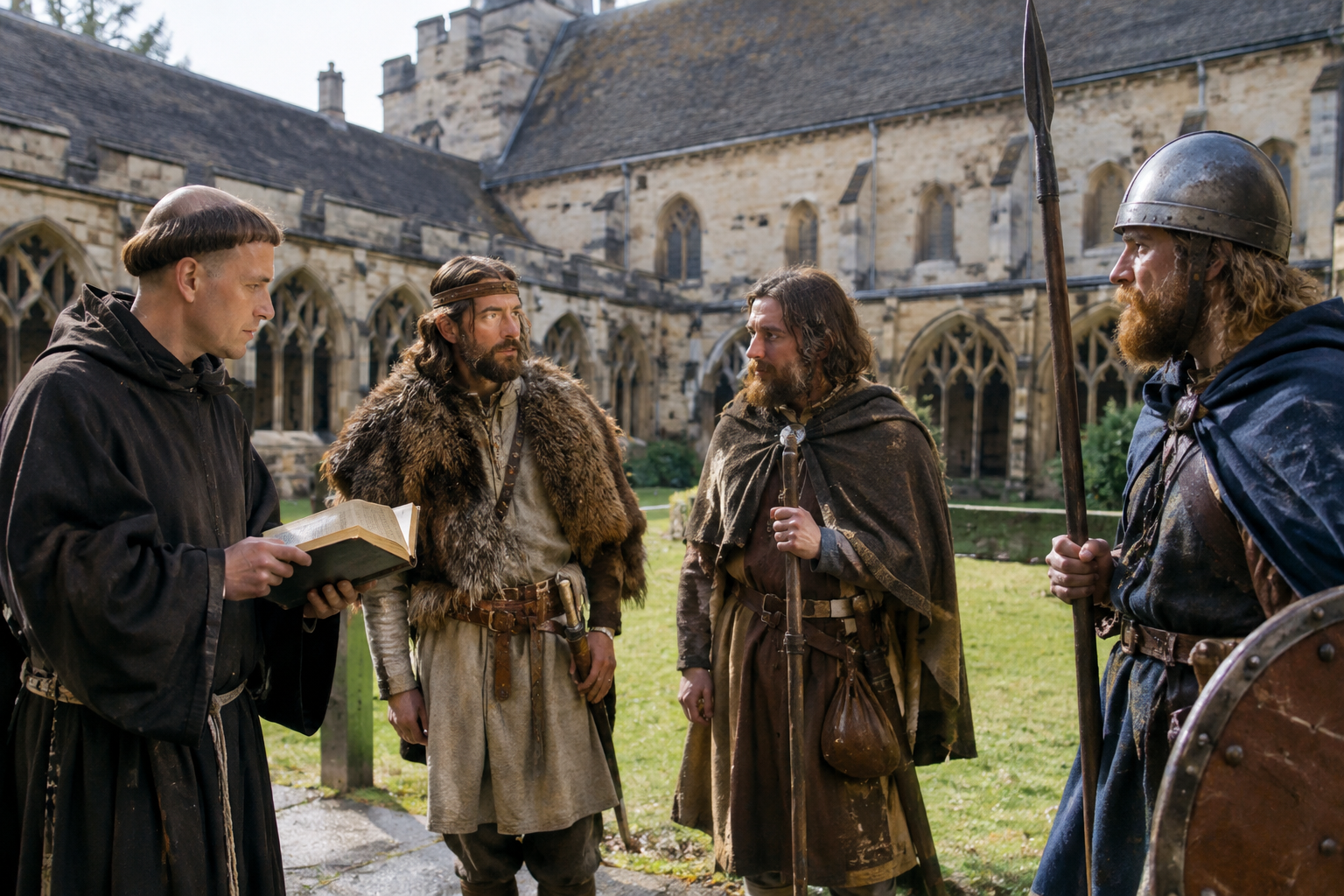
Some Y-DNA haplogroups arrive with a fanfare: royal burials, famous surnames, a neat map and a tidy origin story. Haplogroup R1b1a1b1a1a1c2b2a1b1a4b2 does not quite behave like that. It is a very narrow paternal branch, far downstream within the much larger R1b tree, and that is exactly what makes it interesting. Tiny branches like this remind us that the history of Europe was not made by abstract populations alone, but by innumerable paternal lines carried by individual men whose descendants moved through changing worlds of tribe, kingdom, monastery, manor, and battlefield.
That also means a note of caution is needed at the outset. Y-DNA traces one direct paternal line only: father to son to son. It does not represent a person's whole ancestry, culture, or identity. And with a highly specific subclade such as this one, we should be especially careful not to project the entire story of broad R1b onto a much narrower later branch. What ancient DNA can do, though, is show us where related paternal lines appear in the historical record, and in this case the pattern is strikingly northwestern and central European, with evidence stretching from Viking Age Norway to medieval England and the post-Roman and Slavic worlds of what is now Germany.
The long label tells its own story. R1b1a1b1a1a1c2b2a1b1a4b2 is a descendant branch within haplogroup R1b, one of the best-known Y-chromosome lineages in western Eurasia and especially common in many parts of western Europe today. But a deep modern branch is not the same thing as the ancient root. The older history of R1b involves multiple expansions and subdivisions over thousands of years; this particular subclade belongs to a much later chapter in that larger tale.
What the supplied evidence suggests is not a single ethnic label, but a corridor of paternal continuity and movement across the North Sea world and central Europe. We find relevant ancient individuals in Telemark, Saxony-Anhalt, Oxfordshire, and a medieval Slavic-settler context in Steuden. That spread fits a familiar historical landscape: regions shaped by Germanic-speaking groups, Viking mobility, frontier settlement, and the mixing of older local populations with newcomers in the centuries after Rome.
For readers interested in the deeper prehistoric backdrop to western European paternal history, MyTrueAncestry's discussion of Bell Beaker change in the Lower Rhine-Meuse region offers useful context for the wider world from which many later R1b branches ultimately emerged.
Explore Bell Beaker R1b Context
The most vivid way to understand this haplogroup is to look at the people connected with it in the ancient DNA record.
First there is DRH057, dated to 500 AD, from Roman Deersheim, Saxony-Anhalt, identified in the input as a Thuringii Tribe Germany individual. This is a wonderfully awkward historical setting, in the best sense. Around 500 AD, old Roman structures of power had broken down in much of the west, while central Europe was full of mobile confederations, regional elites, and successor peoples whose identities were political as much as biological. A paternal line found in a Thuringian-associated context in Saxony-Anhalt places this branch in the post-Roman central European world where older provincial landscapes and so-called barbarian polities overlapped.
Then comes VK389, a Viking Age Spearman from Telemark, Norway, dated to 900 AD. This is the kind of sample that instantly broadens the picture. Telemark is not merely a dramatic Scandinavian setting; it is part of the larger Norse world that linked the North Atlantic, the British Isles, the Irish Sea, and the Baltic. A related paternal branch appearing there suggests that this lineage was at home, or at least present, within the Scandinavian sphere as well as in central Europe. That does not make the haplogroup "Viking" in any simple sense. It does show that men carrying related lines were among the populations participating in Viking Age society.
Later still, we meet SDN003 from Steuden, Sachsen-Anhalt, dated to 1050 AD, described as a Western Slav Settler. This is one of the most historically useful samples in the set, because it lands in a region where Germanic and Slavic histories were deeply entangled. Medieval eastern Germany was not a blank map waiting for settlers; it was a contact zone of communities, lordships, and shifting languages. A paternal lineage found here in a Western Slav settler context reminds us that Y-DNA branches can move across cultural boundaries and become part of quite different historical worlds over time.
Finally there is C11119 from Medieval Oxfordshire Magdalen College Longwall Quad, dated to 1170 AD. By the twelfth century we are in a very different landscape: urban growth, ecclesiastical institutions, and the fully medieval society of England. Yet the appearance of this paternal line in Oxfordshire shows the same underlying point as the earlier samples. These lineages persist not as museum relics, but in ordinary and extraordinary men living through major transformations.
If you want to think more broadly about this sort of northwestern European movement after Rome, the article on North Sea Migrations to Britain: From Vikings to Industrial Revolution is a good companion piece.
Read the North Sea Migration Story
If one were forced to summarise the historical atmosphere around this haplogroup, it would be this: mobility without simplicity. The line appears in a Thuringian setting, a Viking Age Norwegian burial, a Western Slavic medieval settlement, and a medieval English context. That is not a tidy ethnic signature. It is better understood as evidence that related paternal branches circulated across the connected worlds of northern and central Europe.
This is exactly why ancient DNA has become so valuable. Written sources tend to preserve the names of kings, bishops, monasteries, and occasionally raiders. Genetics catches something rather different: the persistence of paternal lines through changes in language, allegiance, burial custom, and political identity. A man buried as a Viking spearman and a man buried in medieval Oxford may be separated by sea, by social world, and by centuries, yet their Y-chromosome can still place them in a related paternal framework without implying any documented genealogical connection.
For a broader look at how central and eastern European populations shifted in the early medieval period, the MyTrueAncestry article on Slavic populations is especially relevant here.
Explore Early Medieval Slavic DNA
The supplied noble association brings us to Clan Caldwell and Caldwell Tower in East Renfrewshire. Here it is important to be precise. The presence of Clan Caldwell in this article does not prove that every Caldwell male line carried this exact haplogroup, nor that the family can be directly linked to any one of the ancient individuals above. What it does offer is a historically resonant setting in which to think about how paternal lines become anchored to land, status, and memory.
Caldwell Tower is described as the surviving fragment of the old Caldwell House estate near Uplawmoor. That alone is evocative enough. Not a mighty royal fortress, but the remnant of a long-landed presence in Renfrewshire. The wider Caldwell lands were held for centuries by the Mures, with roots back into the medieval period, and over time they built up a baronial seat reflecting wealth, standing, and changing taste. In the eighteenth century an earlier house was replaced by a grand mansion with landscaped policies and woodland. Then came decline, fire, decay, demolition. What remains most visibly is the tower.
And this is where history becomes rather moving. A tower like Caldwell does not prove a Y-chromosome, but it preserves the social world in which paternal descent mattered intensely: inheritance, estate continuity, family naming, territorial identity, and the long memory of local power. In that sense, a paternal haplogroup and a ruined tower are odd companions but suitable ones. One survives in DNA, the other in stone.
Readers interested in the specific family background can follow that thread further in the MyTrueAncestry community article on Clan Caldwell.
The great temptation with a lineage as specific as R1b1a1b1a1a1c2b2a1b1a4b2 is to demand a single answer: was it Viking, English, Germanic, Slavic, or Scottish? The ancient DNA here suggests that this is the wrong question. The better question is how one paternal branch could appear in several overlapping historical zones of northern and central Europe.
The answer is that Europe was never static. Men moved as settlers, warriors, tenants, retainers, monks, traders, and husbands. Regions changed language. Elites changed allegiance. Estates rose and vanished. Yet paternal lines could persist through all of that, sometimes in continuity, sometimes by migration, often by both. Ancient DNA gives us glimpses of those continuities where written genealogy cannot reach.
So if this haplogroup appears in your own Y-DNA results, it is best understood as an invitation rather than a verdict. It may connect you with a broad historical zone stretching across the North Sea and central Europe. It may place your direct paternal line somewhere in the long story that runs from post-Roman Saxony-Anhalt to Viking Age Norway, medieval Oxfordshire, and the landed landscapes remembered at Caldwell Tower. But it does not by itself prove descent from any specific ancient man, clan, or noble family.
That, really, is the pleasure of it. The line is narrow, but the history around it is gloriously untidy.
MyTrueAncestry lets you compare your DNA with ancient individuals and historical populations, offering a new way to think about paternal ancestry alongside archaeology and family history. A match to ancient DNA can reveal fascinating historical connections, even though it does not by itself prove direct descent or noble family membership. If you want to see whether your own results echo the worlds of Viking Age Telemark, medieval Oxfordshire, or the old landed landscapes of Renfrewshire, start exploring.






Comments