Haplogroup R1b1a1b1a1a1c2b1b3

– 6 min read


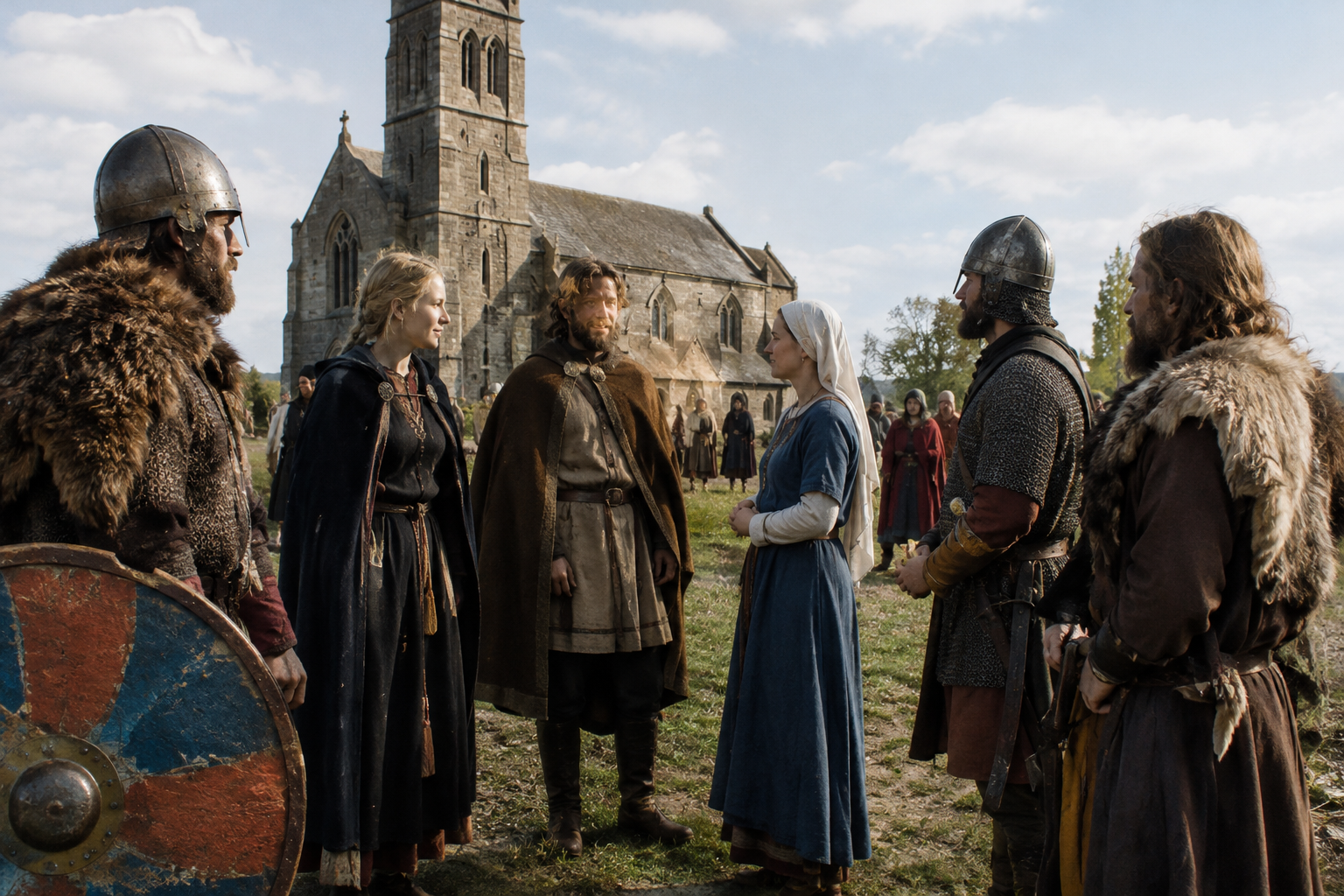
Some Y-chromosome branches seem to sit tidily inside one place and one period. Others do not. Haplogroup R1b1a1b1a1a1c2b1b3 is interesting precisely because the evidence supplied here points us across a wide arc of Europe: from Classical Macedonia to early medieval Yorkshire, from medieval Belgium to Viking Age Denmark and Sweden, and on to medieval Trondheim in Norway. That does not mean one neat tribe, one kingdom, or one dynasty. It means a paternal line that appears in very different historical settings, which is exactly what makes Y-DNA so useful and so humbling.
Y-DNA haplogroups trace the direct paternal line only: father to son to son across the centuries. They are powerful tools for reconstructing ancient male-line ancestry, but they are only one strand of a person's full family history. In other words, a man may belong to this haplogroup and yet draw the overwhelming majority of his ancestry from many other lines. Still, when ancient DNA repeatedly turns up related paternal branches in distant places, it lets us ask an old historical question in a new way: how did some male lineages move, persist, and reappear across so many landscapes?
The haplogroup named here is a very narrow subclade within the much larger R1b family of Y-chromosome lineages. That broader family has an enormous history across western Eurasia and, in later periods, across much of Europe. But caution matters. We should not lazily pour the entire story of R1b into one highly specific downstream branch. A subclade such as R1b1a1b1a1a1c2b1b3 represents only one twig on a very large tree.
What the supplied ancient individuals do suggest is that this twig, or very closely related paternal lines, had a presence in Europe across a long time span and in several regions linked by mobility, trade, warfare, migration, and settlement. The pattern is especially striking around the North Sea and the Scandinavian world, but it also reaches farther south into the Balkans through the sample from Aigai in Macedonia. That does not prove a single migration route. It does suggest that this paternal line belonged to populations participating in the great movements that connected Iron Age, Roman, post-Roman, and Viking Age Europe.
Readers interested in the deeper background to ancient population movement in the northwest of Europe may also enjoy this broader piece on the Rhine-Meuse world, one of the key corridors in later prehistoric western Europe.
Explore Rhine-Meuse Population Change
The value of a lineage like this becomes much clearer when we stop staring at the code and look at the people. One of the oldest supplied cases is DEM3235, from the Royal Tombs of Aigai Macedonia Elite Tomb I, dated to 400 BC. Aigai is no ordinary archaeological backdrop. It was the ancient royal center of Macedon, a place where burial, power, and dynastic display were bound tightly together. To find this paternal branch in such a context reminds us that lineages now discussed in genetic databases once belonged to men moving in worlds of court politics, military ambition, and elite burial ritual. It does not prove any direct connection to later European families. But it firmly places this paternal stream in the historical Mediterranean-Balkan sphere at a significant moment.
Several centuries later, the picture shifts north and west. I17274, from Early Medieval Yorkshire England Norton Bishops East Mill, dated to 550 AD, places the lineage in post-Roman Britain. This is a fascinating period, when old Roman structures had faded, new kingdoms were emerging, and Britain was tied ever more closely to movements across the North Sea. A Y-line found in Yorkshire in this era belongs to that unsettled world of migration, local continuity, and political reinvention.
Then come the Scandinavian finds, and they are hard to ignore. VK134 from Viking Age Galgedil Funen Denmark dated to 925 AD, VK290 from Viking Age Kumle Hoje Grav Denmark dated to 950 AD, and VK424 from Viking Age Skara Varnhem Sweden dated to 1050 AD together suggest that this paternal line was well within the orbit of the Viking Age world. Add VK117 from Medieval Trondheim Norway dated to 1200 AD, and we see continuity into the high medieval Scandinavian sphere.
This is not evidence that all these men were closely related in a genealogical sense. Shared haplogroups can unite men separated by many centuries and many branches. But taken together, they place this lineage squarely inside the maritime and mobile networks of northern Europe.
If you want to dig further into that wider context, this community article expands on how genetics has sharpened our picture of Viking Age populations.
The Belgian material adds another layer. Two supplied samples come from Sint-Truiden Onze-Lieve-Vrouwekerk, both dated to 900 AD: ST2320 and ST1189, the latter identified as Medieval Belgium Outsider Sint-Truiden Onze-Lieve-Vrouwekerk. There is something particularly revealing in that word "outsider." Medieval towns and churches were not sealed containers of static local bloodlines. They were nodes in networks of movement: pilgrims, traders, clerics, craftsmen, soldiers, dependants.
So here the haplogroup appears not in one remote valley preserving some untouched paternal relic, but in a connected medieval urban world. Sint-Truiden sat in a region shaped by exchange and political overlap, and these individuals remind us that lineages travel not only with conquering war bands but with ordinary and semi-ordinary human motion. The outsider and the local can end up buried in the same sacred ground.
That is why ancient DNA can be so useful to historians. Written genealogies usually begin with the literate, the landed, and the remembered. Genetics catches the anonymous as well. For more on that exact setting, the Sint-Truiden study is well worth exploring.
Read About Medieval Sint-Truiden
The noble-family material supplied here points us to Clan Middleton and to Fettercairn House in Aberdeenshire. This is exactly the sort of setting where genetics and history should be made to speak carefully to one another. We are not entitled to say that Clan Middleton "was" this haplogroup, still less that every Middleton male belonged to it. Nor do the ancient samples prove descent from any specific noble house. What they do offer is context.
Fettercairn House, built in the early nineteenth century near the old village of Fettercairn, stands in a district whose history runs much deeper than the present structure. The landscape had prehistoric settlement, medieval lordship, and later landed ambition layered one atop another. After the Wars of Independence, the Ramsay family became local lairds, and over time the estate accumulated status. The village itself preserved the memory of a royal visit by James IV in 1504, with the famous arch of triumph said to have inspired the name Fettercairn, "the slope by the thicket."
Later, the house was associated with the Gladstone family and other owners. Around it lay farming country, coaching routes, nearby Fasque, and the Cairn o Mount road: all reminders that Scottish estates were never simply grand houses dropped onto empty moorland. They sat in landscapes worked, crossed, renamed, and politically reassembled over centuries.
That matters for haplogroup history. A paternal line such as R1b1a1b1a1a1c2b1b3 may appear today in a Scottish clan context not because one noble founder single-handedly created it, but because Scotland itself was shaped by repeated currents from Britain, the North Sea, Scandinavia, and the Continent. Fettercairn is a good emblem of that layered past: Georgian in facade, medieval in lordship, prehistoric underfoot.
For readers who want to place the family itself more fully in context, the Clan Middleton article is the natural next stop.
So what can we responsibly say? This haplogroup, as represented by the supplied evidence, appears across an impressive geographic spread: Macedonia, Belgium, England, Denmark, Sweden, and Norway. It is visible in elite and non-elite settings, in churchyards and Viking Age graves, in early medieval Britain and medieval Scandinavia. That pattern strongly suggests a paternal lineage participating in broad European history rather than belonging to one isolated pocket.
But the limits are just as important. Shared Y-DNA does not prove shared ethnicity, language, or social identity. It does not prove that a man from Viking Age Funen and an elite burial at Aigai would have recognized one another as belonging to the same people. It certainly does not prove direct descent from ancient samples to later noble families in Scotland. What it gives us is something subtler and, in its own way, more interesting: a way of tracing one male-line thread through many different historical worlds.
That is where archaeology, documents, and genetics work best together. Castles and houses such as Fettercairn preserve memory in stone. Ancient graves preserve memory in bone. DNA does not replace history; it widens the cast of characters.
If your paternal line belongs somewhere in the vast R1b family, or if you are simply curious how your DNA compares with ancient individuals like DEM3235, I17274, ST2320, ST1189, VK134, VK290, VK424, or VK117, MyTrueAncestry can help place your results beside the archaeological record. Those comparisons can reveal remarkable historical connections, even if they do not by themselves prove direct descent from a particular noble family or ancient burial.






Comments