Haplogroup R1b1a1b1a1a1c2b1b1

– 6 min read


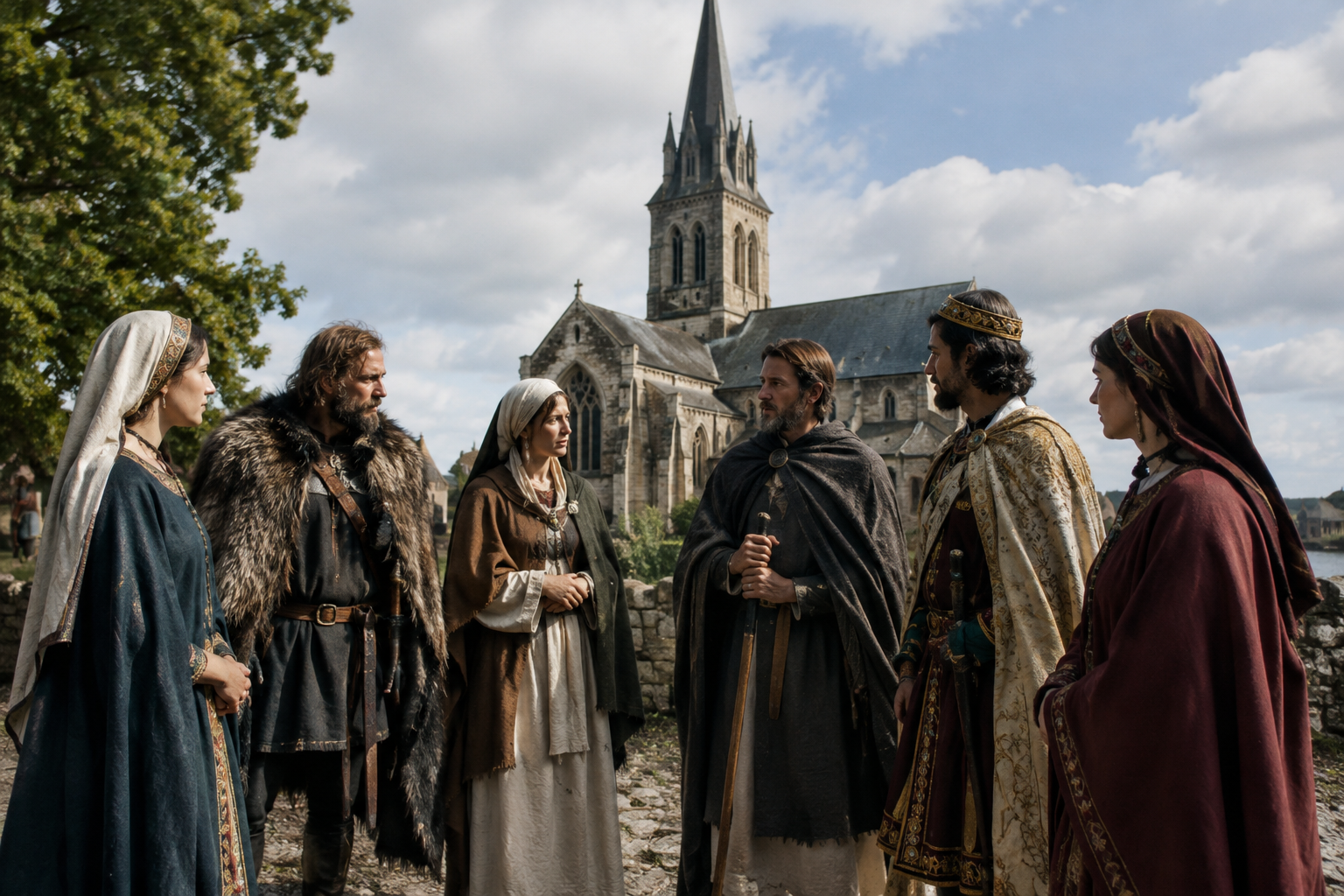
Some Y-chromosome lineages are easy to tell as broad continental stories. Others are more like finding a name scratched into several very different walls and then asking how it got there. Haplogroup R1b1a1b1a1a1c2b1b1 belongs to that second category. It sits inside the wider R1b family, one of the major paternal branches in western Eurasia, but this particular subclade is much narrower and therefore much harder to discuss responsibly in sweeping terms. That is precisely what makes it interesting.
What ancient DNA gives us here is not a grand slogan, but a trail: Macedonia in the age of royal tombs, early medieval Yorkshire, medieval Belgium, Viking Age Denmark, and Viking Age Sweden. That spread does not prove a single neat migration story. It does, however, show that this paternal line, or closely related branches around it, appeared in several important historical landscapes of Europe. As always, Y-DNA traces one direct paternal line only. It does not describe a person's whole ancestry, still less their language, culture, or identity.
The long label R1b1a1b1a1a1c2b1b1 tells us that this is a downstream branch within the large and historically important R1b tree. In broad terms, many branches of R1b became widespread across parts of Europe over prehistoric and later historic periods. But caution matters: the history of the entire R1b macro-haplogroup cannot simply be pasted onto one highly specific twig of that tree.
What can safely be said is that this lineage belongs to a paternal family with deep roots in western Eurasia and that ancient DNA now lets us spot some of its later appearances in very different settings. For genealogists, that is often the point where the story becomes more human. Instead of asking for an abstract origin myth, we can ask where men carrying this branch, or very near relatives within its cluster, actually turn up in the archaeological record.
Readers interested in the bigger prehistoric background to western European paternal history may also enjoy this broader look at Bell Beaker-era change in the Low Countries and nearby regions.
Explore Bell Beaker Rhine-Meuse DNA
The earliest sample in the material supplied here is especially striking: DEM3235, from the Royal Tombs of Aigai Macedonia Elite Tomb I, dated to 400 BC. Aigai was no obscure backwater. This was the old royal center of Macedon, a place tied to the dynasty that transformed the Greek world and then much of the eastern Mediterranean. One should not leap from a Y-haplogroup to dynastic certainty, ethnicity, or a named historical figure. But the presence of this paternal branch in such an elite funerary setting reminds us of something important: lineages we later meet in medieval and northern European contexts could already be moving through, or established within, major centers of the ancient Balkans.
That matters because Macedonia was a crossroads. Armies, mercenaries, marriage alliances, colonists, and court networks connected it to the Aegean, the Balkans, and lands beyond. A Y-line that appears there in the Classical period and then much later farther north does not prove one continuous aristocratic chain. It does show, however, that the branch was present within a world of intense mobility long before the medieval record begins to sharpen.
The next important point on the map is I17274, from Early Medieval Yorkshire England Norton Bishops East Mill, dated to 550 AD. This is a very different world from royal Macedonian tombs: post-Roman Britain, where old Roman structures, incoming groups from across the North Sea, and surviving local populations all met in unstable new political landscapes. A paternal lineage found here belongs to the era in which early English kingdoms were forming, and when ancestry in Britain was anything but simple.
If you want a wider look at that complicated period, this related article is a useful companion.
Read Roman and Early Medieval Britain DNA
By the early medieval and Viking Age periods, the samples form an intriguing northern cluster. At Sint-Truiden Onze-Lieve-Vrouwekerk in medieval Belgium, we have two individuals dated to 900 AD: ST2320 and ST1189. The latter is described as a Medieval Belgium Outsider, an unusually suggestive label because it hints at mobility within an urban or ecclesiastical setting. Medieval towns and churches were not sealed communities. They drew merchants, clerics, craftsmen, pilgrims, servants, and strangers. A paternal lineage appearing there might reflect local continuity, long-distance arrival, or both.
That is one reason Sint-Truiden is so useful. It turns genetics into social history. The question is not merely where a lineage began, but how men bearing it moved through institutions, settlements, and power structures. Medieval church sites often preserve exactly those mixed communities which written history mentions only in passing.
Then there is VK134 from Viking Age Galgedil Funen Denmark, dated to 925 AD, and VK424 from Viking Age Skara Varnhem Sweden, dated to 1050 AD. Now we are in the Scandinavian world of sea routes, local lordship, Christian conversion, and expanding connections across the North Sea and Baltic. Again, the temptation would be to call the lineage simply "Viking." That would be sloppy. What the evidence really shows is that this branch appears in Viking Age contexts in Denmark and Sweden, alongside its appearances in England and Belgium. That makes it part of the human traffic of northern Europe in the early and central Middle Ages.
For more on that wider Scandinavian picture, this article is an excellent next stop.
The supplied family connection here is Clan Creel, associated with Dover Castle. That is immediately evocative, because Dover is not merely a castle but a geological and political statement: a stronghold above the shortest crossing to Europe. Its history stretches from the Iron Age to the Cold War. The Romans built a fort there, and the great Pharos lighthouse still stands beside a later Saxon church. After 1066, William the Conqueror took control, and in the 1180s Henry II reshaped the site into the vast stone fortress we now picture, with formidable walls, towers, and a great keep.
It later faced Prince Louis of France in 1216 during the barons' wars, then continued for centuries as one of the kingdom's key gateways. In the Napoleonic period, tunnels were cut into the chalk for troops and storage; in the Second World War, those same tunnels became a command center for the Dunkirk evacuation. In other words, Dover Castle is almost absurdly layered: Roman, Saxon, Angevin, Napoleonic, and modern, all stacked on the same cliff edge.
Why does that matter in an article about a Y-lineage? Because castles like Dover preserve the history of regions where paternal lines met, settled, and were remembered. They do not prove that a clan or noble house carried one exact haplogroup. They do, however, anchor us in the landscapes through which such lineages moved. If a branch like R1b1a1b1a1a1c2b1b1 appears in England, Belgium, Denmark, and Sweden across the first millennium AD, then Dover makes a fitting symbol of the world that connected them: ferries, fleets, forts, invasions, mercenaries, pilgrims, and administrators crossing the narrow sea.
Readers interested in the specific family tradition can continue with the Clan Creel article itself.
The real lesson of R1b1a1b1a1a1c2b1b1 is not that one branch can be neatly assigned to Macedonians, Anglo-Saxons, Vikings, Belgians, or any later clan. It is that a paternal line can surface in all these settings and remind us how entangled European history really was. Ancient DNA is at its most useful when it unsettles tidy labels. A man buried in elite Macedonia, one in early medieval Yorkshire, two at Sint-Truiden, and others in Viking Age Denmark and Sweden may share a paternal thread without belonging to one single historical "people" in any simple sense.
That is also why Y-DNA and written genealogy complement one another rather than replace one another. Genealogy gives names, documents, and family memory. Ancient DNA gives deeper context, sometimes far beyond the reach of written records. But shared haplogroups do not by themselves prove direct descent, noble status, or membership in a particular medieval house. They show that lines endured, spread, and resurfaced in places where history was being made.
If you are curious whether your own paternal story intersects with ancient samples like DEM3235, I17274, ST2320, ST1189, VK134, or VK424, MyTrueAncestry can help you explore those connections. The comparisons may reveal fascinating ancient affinities and historical context, while not necessarily proving direct genealogical descent from any one individual or noble family.






Comments