Haplogroup R1b1a1b1a1a1c2a1

– 6 min read


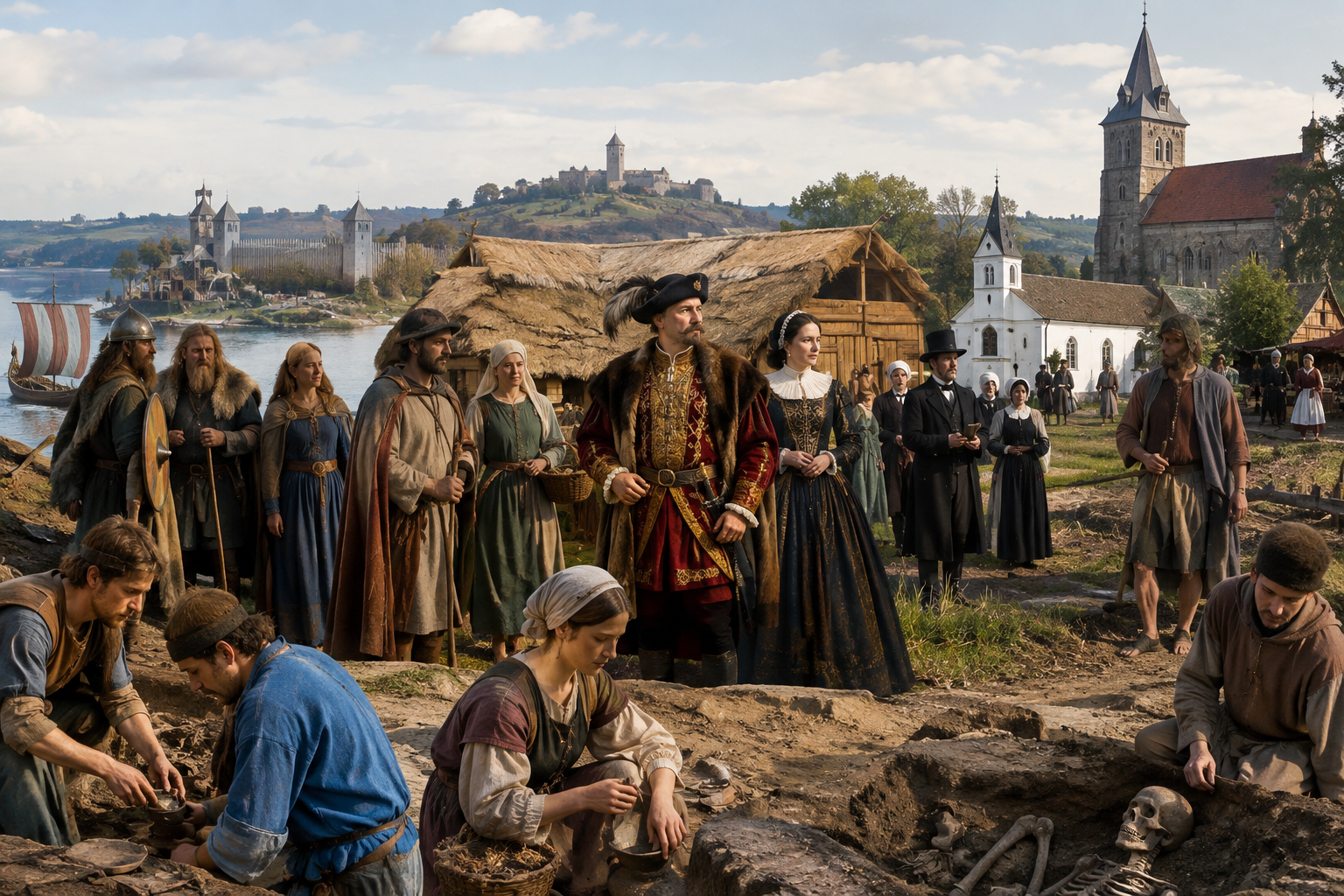
Some Y-chromosome lineages announce themselves with trumpet blasts: a famous royal burial, a well-known prehistoric horizon, a neat map. Haplogroup R1b1a1b1a1a1c2a1 is more interesting precisely because it does not behave so tidily. It appears in the supplied ancient DNA evidence across a remarkably wide stretch of medieval and early medieval Europe, from Jutland-linked settlers in England to Viking Age Denmark, from Belgium and Bavaria to Piast-era Poland and a later noble context in Hungary. What we are looking at is not a single people marching across a map, but a paternal line embedded in many of the societies that made medieval Europe.
That is worth pausing over. Y-DNA haplogroups trace one very specific line of ancestry: the direct paternal line, father to son to son. They do not describe a person's whole ancestry, culture, language, or identity. Still, they can be wonderfully revealing. In this case, the branch sits within the broader R1b family, one of the major Y-chromosome lineages in western Eurasia. For a narrow subclade like this one, we should be cautious: the deeper history of the wider R1b tree cannot simply be pasted onto this exact branch. But the ancient samples do let us tell a grounded story about where this lineage turns up in the historical record, and what sort of worlds its carriers inhabited.
The safest way to approach a specific branch such as R1b1a1b1a1a1c2a1 is from the evidence upward, not from grand theory downward. Broadly speaking, many R1b lineages became important across large parts of Europe over later prehistory and after. Yet the supplied evidence for this particular branch is strongest not in the Bronze Age, but in the early medieval and medieval worlds around the North Sea, the southern Baltic, and central Europe.
That pattern matters. It suggests a lineage that was established within the populations who later appear in written history as Jutes, early medieval communities in England, Viking Age Scandinavians, and a range of medieval continental societies. This is not proof that the branch originated in any one of those groups. It is, however, strong evidence that by the first millennium AD it was circulating across the same connected zone of migration, trade, warfare, marriage, and settlement that linked Denmark, northern Germany, the Low Countries, England, and central Europe.
The most vivid part of this story comes from individual burials. Take OAI002, a Jute-associated individual from Oakington, England, dated to 470 AD, and POH003, another Jute-associated sample from Polhill, Kent, England, dated to 600 AD. These are precisely the centuries when post-Roman Britain was being reshaped by migration and settlement from across the North Sea. To find this lineage in such contexts places it squarely within that historical transformation. It does not mean every Jute carried it, of course. But it does mean this paternal branch was among those present in the communities that helped form early medieval England.
Then there is the Scandinavian cluster. VK313 from Rantzausminde Grav, Funen, Denmark, dated to 875 AD, CGG105938 from Trelleborg, Kingdom of Denmark, dated to 939 AD, and CGG019689 from Sjaelland, Kongsted Lyng, Denmark, dated to 958 AD, place the lineage in the Viking Age heartland. Trelleborg in particular evokes the organized power of the late Viking kingdom: ring fortresses, royal authority, military planning. A shared haplogroup does not make these men close kin, still less founders of nations, but it does show this paternal branch was part of the male population of Viking Age Denmark.
Further south and east, the same line appears in R10665 from Wels, Austria, dated to 740 AD, and in HVN006 from Haeven, Mecklenburg-Vorpommern, dated to 250 AD, described here as Longobard. The date and location of HVN006 remind us that the roots of these later medieval distributions may lie in the fluid post-Roman and Migration Period world, when groups moved, merged, and re-labeled themselves repeatedly. Ancient DNA is very good at puncturing the fantasy of neatly bounded peoples.
Read About Anglo-Saxon Migration DNA
By the High Middle Ages, the branch is visible across a broad European arc. ST0044 from Sint-Truiden Onze-Lieve-Vrouwekerk, Belgium, dated to 1090 AD, places it in an urban and ecclesiastical setting in the Low Countries. Petersberg from Upper Bavaria, Germany, dated to 1068 AD, shows it in southern Germany. PCA0549 from Silesia, Milicz, Poland, dated to 1100 AD, ties it to the Piast-era world of medieval Poland.
That Polish context is especially intriguing because Piast Poland sat at a crossroads of western, central, and northern European influences. A haplogroup turning up there after appearing in Denmark, England, Germany, Austria, and Belgium is a useful reminder that medieval Europe was not a patchwork of sealed containers. Men moved with armies, merchant networks, ecclesiastical careers, colonization, and dynastic service.
Finally, the supplied noble sample PER04B, identified as Medieval Hungarian Bathory Male Nobility Pericei and dated to 1500 AD, shows the branch in an aristocratic context in Hungary. This is historically exciting, but also a moment for restraint. A noble burial can demonstrate that the haplogroup occurred in that family line or associated noble milieu represented by the sample; it does not prove sweeping genealogical claims about all bearers of the Bathory name, nor about everyone sharing the haplogroup today.
Explore Piast Dynasty Genetics
The later historical associations supplied for this haplogroup bring us west to Britain, where paternal lineages, family memory, and stone architecture become tangled together in the most pleasing way. In Fife, Largo Castle in Lower Largo began as a medieval stronghold of the Durham family, probably in the 13th century, before developing into a fortified tower house overlooking the Firth of Forth. Much of what survives belongs to its 17th-century expansion, though a fire in 1670 left it a ruin. The place is also shadowed by the story of Alexander Selkirk, the Largo sailor whose adventures helped inspire Robinson Crusoe.
Why does this matter for a Y-DNA article? Because castles such as Largo are reminders that lineages do not float abstractly through time. They become rooted in lordship, landholding, and local reputation. A haplogroup cannot tell us who stood on that tower stair or who gave the orders in the hall. But when ancient DNA shows related paternal branches distributed around the North Sea world, and later history gives us family seats in eastern Scotland, we can see the long continuity of male-line inheritance as a social fact, even when the precise genealogy remains unproven.
Further south, St Donat's Castle in the Vale of Glamorgan offers a rather different story. Associated here with the House of Stradling, it began as a Norman stronghold in the 12th century on a site linked to earlier medieval settlement. Over time it became less a pure fortress than a grand fortified manor, reshaped in the late Middle Ages and Tudor period with halls, towers, and more comfortable living spaces. Its battlements still dominate the Bristol Channel, and its later restoration by William Randolph Hearst added another historical layer rather than replacing the older ones.
The Stradlings and their castle belong to that Anglo-Norman and Welsh borderland world where conquest, settlement, intermarriage, and local adaptation reshaped Britain after 1066. That does not prove a specific genetic link to this haplogroup. It does, however, fit the broader geographical world in which this paternal branch appears: one connected to North Sea mobility, continental links, and the making of medieval Britain.
Discover the House of Stradling
The most striking lesson of R1b1a1b1a1a1c2a1 is not that it belongs to one tribe, kingdom, or dynasty. Quite the reverse. In the evidence supplied here, it turns up in Jutish England, Viking Denmark, early medieval Austria, medieval Belgium, Bavaria, Piast Poland, Hungarian nobility, and even an Early Modern Period England Providence Calvinist Baptist Chapel burial, ATP_PSN_873, dated to 1833 AD. That is a long afterlife for one paternal branch.
So the haplogroup becomes a thread through different historical settings: migration-age settlements, Viking military and rural communities, medieval churches, noble houses, and post-medieval religious burial grounds. Ancient DNA gives us the thread. Archaeology gives us the burial context. Written history gives us names, castles, lordships, and kingdoms. None of them alone is enough. Together, they make the past less like a family tree drawn in ink, and more like a crowded historical landscape in which some male lines endure while societies change around them.
If this lineage appears in your own results, the value lies not in claiming a Viking warrior, a Piast courtier, or a castle outright. The value is in seeing how one direct paternal line could pass through many different European worlds, leaving traces in graves, churches, fortresses, and historical memory.
If you want to see whether your DNA shows connections to ancient individuals such as OAI002, VK313, CGG105938, ST0044, PCA0549, or PER04B, MyTrueAncestry lets you explore those comparisons for yourself. These matches can offer remarkable historical perspective, even when they do not prove direct descent from a named noble house or medieval dynasty.






Comments