Haplogroup R1b1a1b1a1a1a

– 6 min read


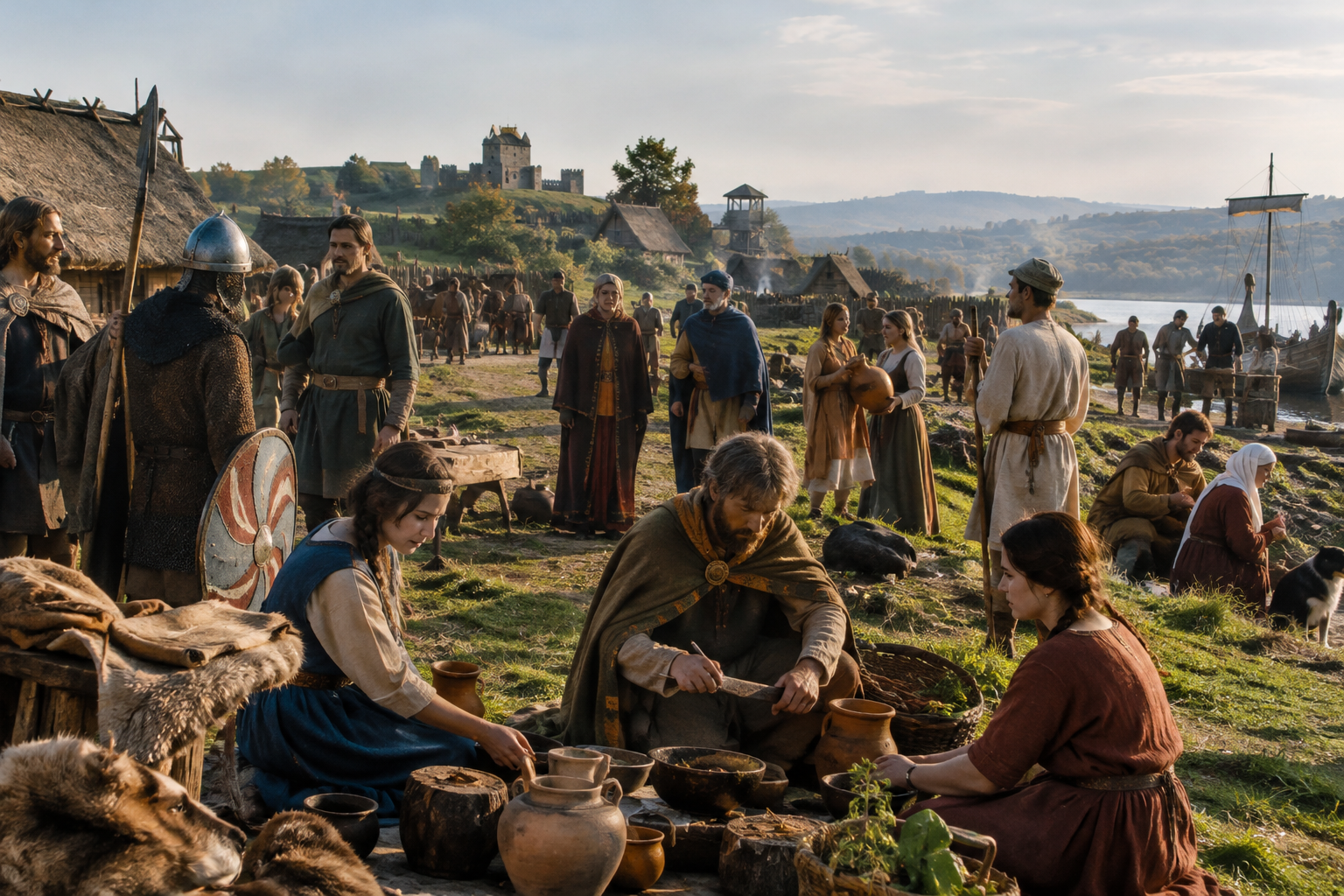
Some Y-DNA haplogroups seem to sit quietly in the background until ancient DNA pulls them into view from one burial after another, in one region after another, and suddenly a pattern begins to emerge. Haplogroup R1b1a1b1a1a1a is one of those lineages. It appears across a striking spread of European contexts: Early Bronze Age France, Unetice-period Germany, Iron Age Celtic burials, Roman frontier communities, Anglo-Saxon England, medieval Belgium, Portugal, Spain, and beyond. Not one kingdom, not one people, not one language, but a long, complicated male-line history across western and central Europe.
That is precisely why it is interesting. Y-DNA traces a direct paternal line only - father to father to father - and does not represent a person's whole ancestry. Still, paternal lineages can be remarkably useful historical markers. They show us that some male lines persisted through enormous social changes: the rise of Bronze Age chiefdoms, Iron Age tribal confederacies, Roman rule, post-Roman migration, and medieval dynasties. For a lineage as specific as R1b1a1b1a1a1a, we should be careful not to assign the entire history of broader R1b branches to it automatically. But the ancient evidence supplied here makes one thing plain: this was a lineage with a deep and durable European footprint.
The earliest supplied anchors for this haplogroup are already suggestive. In Early Bronze Age France, we find BRE445FK from les Pointes et les Grevottes, Greviandes, Aube, dated to 2339 BC, and SMGB54 from Saint-Martin-la-Garenne, Yvelines, Ile-de-France, dated to 2139 BC. There is also PIR3116B from Rec de Ligno in Bronze Age France, dated to 2230 BC. These are not late medieval aristocrats peering back into prehistory; they are prehistory itself.
Then the line appears in the wider Bronze Age world of central Europe: LEU040, LEU065, and LEU007 from Bronze Age Unetice Thuringia, Leubingen Sommerda, Germany, all dated to 1950 BC. Add to that Corded Ware and related contexts such as VLI092 from Bronze Age Vlineves Bohemia CWC, dated to 2100 BC, OBR003 from Corded Ware Prague Obristvi, dated to 2050 BC, and STD002 from Stadice Bohemia CWC, dated to 2100 BC. The picture is not of a tiny local curiosity, but of a paternal line present in some of the societies that shaped Bronze Age Europe.
What exactly does that prove? Not that every Bronze Age movement was carried by this branch, and not that every later bearer descends from one famous warlord or chieftain. But it does show that this lineage was established early in the archaeological landscapes of France, the Low Countries, Bohemia, and Germany - regions deeply implicated in later population expansions and cultural transformations.
Explore Bell Beaker change in the Rhine-Meuse
By the Iron Age, R1b1a1b1a1a1a appears in settings that would have been familiar to classical writers, though never to them as genetics. Among the most vivid are the elite Celtic burials from Ludwigsburg Roemerhuegel in Germany: LWB002_ss and LWB002_ss_b, both dated to 450 BC. There are other Iron Age markers too: CGG022436 from Belgic Suessiones Iron Age France at Bucy-le-Long, dated to 330 BC; CGG101214 from Celtic Iron Age Austria Hallstatt, dated to 550 BC; and I11715 from Celtic La Tene Iron Age Bratislava, dated to 95 BC.
In Britain, the line turns up in Celtic contexts as well: I7632 from Celtic Briton Slonk Hill, Sussex, dated to 295 BC, I19653 from Ham Hill Fort, Somerset, dated to 250 BC, and I20632 from Fin Cop, Derbyshire, dated to 200 BC. Then comes WBK106, a Celtic Durotriges individual from Duropolis, Winterborne Kingston, dated to 125 AD, already living in a Britain reshaped by Roman rule.
That is one of the chief lessons of ancient DNA: political change does not wipe the slate clean. A paternal line visible in Iron Age tribal Europe can remain visible in Roman provincial settings. We see that too on the continent with I21059 from Gallic Belgium, Gallia Belgica, Tongeren, dated to 35 AD, and I15527 from Imperial Roman Viminacium, Serbia, Pecine Necropolis, dated to 100 AD. This is not evidence for a single ethnic story; it is evidence for movement, recruitment, settlement, and continuity inside the Roman world.
Discover ancient DNA and Celtic expansion
Once the western Roman Empire gives way to the migration period and early Middle Ages, the haplogroup does not disappear. Quite the contrary. It shows up in a host of early medieval settings that remind us how mixed and mobile post-Roman Europe was.
In England, examples include EDI064c from Anglo-Saxon Edix Hill, Cambridgeshire, dated to 545 AD; BUK064, BUK070, BUK060, BUK012, and BUK007 from Buckland Dover, dated to 400 AD; OAI006 and OAI013 from Oakington, dated to 470 AD; and I11583, I11584, and I20652 from West Heslerton, dated to 500 AD and 550 AD. In Scotland, the remarkable cluster from Rosemarkie Cave on the Black Isle - KD001, KD001_2, KD001_3, KD001_4, KD001_6a, and KD001_6b, all dated to 541 AD - places the lineage in a Pict-era setting.
On the continent, the story is equally busy. There are Saxon and migration-period individuals from Saxony-Anhalt and Lower Saxony, such as BRC006x, DRH017, DRH046, RTW012, HID003, HID004, and the Dunum samples DUN002, DUN006, DUN009, and DUN011. In Pannonia and Bavaria we find GYS029, SZL050, SZL051, SZL061, SZL073, SZL076, MFC006, and Bur6. These contexts include Germanic, Longobard, post-Gothic, and frontier communities. The point is not that the haplogroup "belongs" to any one of them. The point is that it moved through all of them.
Explore ancient DNA in post-Roman Britain
Medieval Iberia offers another revealing thread. In northern Spain, ldo040 dated to 1000 AD and ldo046 dated to 1025 AD, both from Las Gobas, show the lineage in a Christian medieval context. Portugal supplies several more: LP112_13 from Early Medieval Portugal Castro de Avelas Torre Velha, dated to 750 AD; CGG018558 from Visigothic Portugal Gruta do Caldeir, dated to 845 AD; LP117_2 from Christian Conquest Portugal Castro de Avelas Torre Velha, dated to 1100 AD; LP115_5 from Loule Quinta da Boavista under the Umayyad Caliphate, dated to 1250 AD; and LP117_12, LP117_7, and LP123_5 from Santarem Rua dos Barcos, dated to 1300 AD.
Meanwhile, the Low Countries preserve a notable medieval concentration: ST2969 from Carolingian Belgium Sint-Truiden Groenmarkt, dated to 795 AD; ST2455, ST0323, ST0786, ST3076, ST3037, and ST2335, largely dated to 900 AD; and later individuals such as ST0024 and ST2542, dated to 1090 AD. Add WPK005 from Post Carolingian Flanders Wulpen, dated to 1162 AD, and the same broad pattern continues: not a flash in the pan, but enduring regional presence.
That is where castles and dynasties become historically useful, if not genetically conclusive. In Belgium, Coudenberg Palace in Brussels grew from the fortified seat of the counts of Leuven into one of the great princely residences of the Low Countries. Later dukes of Brabant, Burgundian rulers, and Habsburg sovereigns enlarged it into a center of court ceremony and government, and Charles V famously abdicated there in 1555. The palace burned in 1731, and its buried remains now survive beneath modern Brussels. No palace can prove a Y-lineage, of course, but the archaeological and medieval record together show that this paternal branch was present in the same wider historical landscape from which such courts later emerged.
Portugal offers a similar resonance. The Palace of the Dukes of Braganza in Guimaraes, built in the early 1400s by Afonso, the first Duke of Braganza, stands near the old heart of one of the formative regions of Portuguese statehood. The palace fell into ruin, became a barracks, and was later restored in the twentieth century. Again, the careful point is not that Bronze Age or medieval samples prove descent from the Braganzas. It is that this haplogroup is well attested in Portugal's deeper population history, making the later dynastic landscape all the more intriguing for anyone studying paternal ancestry.
Even Vrana Palace near Sofia, though much later in date, reminds us how royal residences can embody layers of political change. What began as an Ottoman chiflik became a Bulgarian royal country estate under Tsar Ferdinand after 1898, then passed into communist state hands after the monarchy's abolition in 1946. A paternal lineage may survive across many such regime changes, long before and long after the buildings that symbolize power are erected.
Read the genetic history of Portugal
R1b1a1b1a1a1a is historically interesting because it keeps turning up in the sort of places where European history was being made: Early Bronze Age cemeteries in France and Germany, elite Celtic burials, Roman provincial towns, Anglo-Saxon cemeteries, Pict-era caves, Carolingian and medieval settlements in Belgium, and medieval communities in Iberia. That does not make it the haplogroup of Celts, Saxons, Picts, Belgians, Portuguese nobles, or anyone else in any exclusive sense. Ancient DNA is rarely so neat, and human history never is.
What it does show is continuity through change. Written genealogies usually begin late and privilege elites. Ancient DNA reaches much further back and includes the ordinary dead as well as the exceptional ones. Put the two together - archaeology below ground, charters and palaces above it - and a fuller picture emerges. The castles of Brussels, Guimaraes, and Sofia belong to later chapters, but the paternal lines that fed medieval and modern populations often have roots far deeper than heraldry can reach.
If this haplogroup appears in your own results, MyTrueAncestry can help place it in that wider human story. You may find links to ancient individuals from Bronze Age France, Roman Belgium, Anglo-Saxon England, or medieval Iberia. Such matches do not prove direct descent from a named noble house or a single ancient person. But they can offer something better: a grounded, evidence-based glimpse into the long male-line history behind your DNA.






Comments