Haplogroup R1b1a1a2

– 6 min read


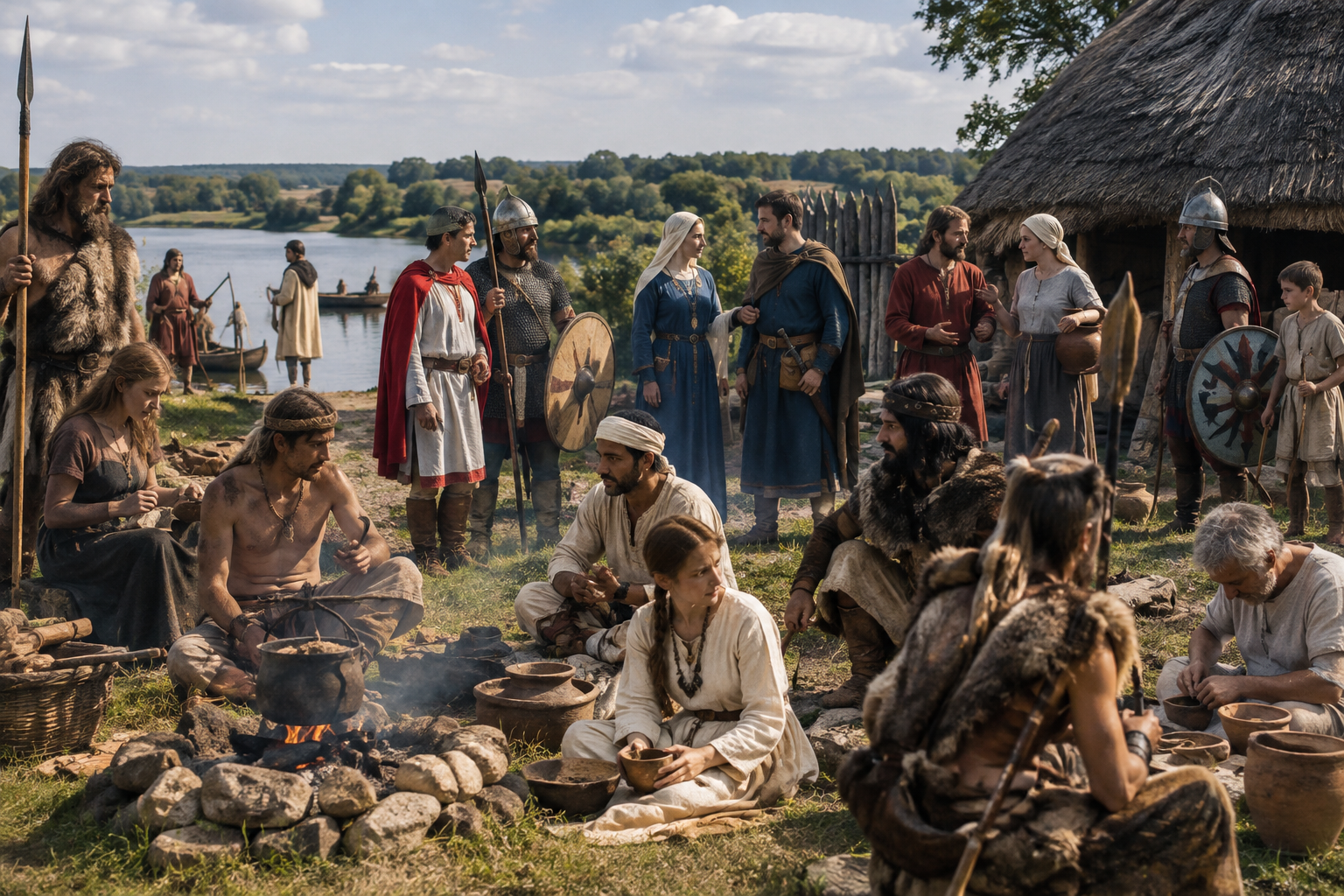
There is something wonderfully awkward, and therefore historically useful, about a Y-chromosome lineage such as R1b1a1a2. It sounds like a filing error in a museum basement. Yet behind that string of letters and numbers sits a long paternal story that turns up in surprising places: Mesolithic Latvia, Bronze Age Iberia, Iron Age Britain, medieval Portugal, Sweden, Poland, and England. Not a single neat people, not a tidy tribe, and certainly not a ready-made family tree. Instead, it is a reminder that the past was busy, mobile, and gloriously inconvenient for anyone hoping for simple answers.
Y-DNA haplogroups trace one narrow line of ancestry: the direct paternal line, father to son across generations. They do not describe a person's whole ancestry, culture, language, or identity. In the case of R1b1a1a2, we are looking at a branch within the wider R1b family, one of the best-known paternal lineages in western Eurasia. For a broad branch like this, the sensible historical approach is caution. Some of its deeper history belongs to much older and wider R1b developments, while the evidence here shows that lineages classed within this part of the tree appeared across a remarkably wide geographical and chronological range.
The supplied ancient DNA evidence does not point to one narrow homeland or one single historical people. Quite the reverse. Some of the earliest samples linked here to this haplogroup sit far to the northeast of later medieval strongholds. At Zvejnieki in Latvia, for instance, we find I4439 dated to 5696 BC and I4628 dated to 4850 BC, with additional Zvejnieki-related individuals such as I4436 at 4080 BC and I4436x at 4159 BC. Then there is the forest-zone world of Sakhtysh and the Upper Volga: I8438 at 5350 BC, I8411 at 4980 BC, and I8404 at 3870 BC. These are not medieval knights or heraldic clansmen. They belong to prehistoric communities living by rivers, lakes, forests, and seasonal rhythms.
That matters because it shows how deep and scattered paternal lineages can be long before written history begins. It also warns us not to flatten R1b1a1a2 into a single Bronze Age or later identity. Some branches clearly circulated among northern and northeastern European forager and early farmer worlds long before the political map of Europe existed.
From there, the picture broadens further. We see Kivisaare3 in Neolithic Estonia at 4630 BC, and VK531 from Battle Axe context in Troms, Norway, at 2400 BC. We also find samples in the Volga region, such as I0124a from Lebyanzhinka IV at 5555 BC and I0371 from Grachevka Sok at 2250 BC. Those dates and places span very different archaeological settings. So if there is a headline here, it is not "one lineage conquers Europe," but rather "one paternal branch appears in many of the societies that helped make prehistoric Europe what it became."
By the Bronze Age, the lineage appears in places that historians and archaeologists usually discuss in terms of movement, exchange, and changing social worlds. In southeastern Europe there is BOY001 from Boyanovo, Bulgaria, dated to 2770 BC. In the Alpine zone we have I5755 from Sion-Petit-Chasseur Dolmen XI in Switzerland at 2225 BC, and OTTM_154, a North Alpine Middle Bronze Age outlier dated to 1756 BC. In Poland there are I4251 and I4253 from Samborzec at 2290 BC, I6534 from Kornice at 2300 BC, and later poz712 from Pielgrzymowice Grave 669 at 1375 BC.
Then there is Iberia, where the evidence becomes especially striking. We find I6472 in Bronze Age Spain at 2250 BC, I12855 from Castillejo del Bonete in Iberia at 1825 BC, pir001 from Argar Culture Priego de Cordoba, Andalusia, at 1775 BC, VAD002 from Valdescusa in northern Spain at 1700 BC, and two individuals from Cabezo Redondo in Villena, Valencia: I3488 at 1625 BC and I3486 at 1600 BC.
That Iberian cluster does not prove that every later western European bearer of R1b1a1a2 descends from a particular Bronze Age Iberian founder. But it does show that this paternal branch, or closely related lines grouped under it, was firmly present in Bronze Age western Europe. For readers interested in how ancient DNA reshapes our understanding of these prehistoric shifts, MyTrueAncestry's coverage of broader Bell Beaker-era change is an excellent companion.
Read about Bell Beaker turnover
Once we move into the Iron Age and historic periods, R1b1a1a2 turns up not in one imperial corridor but in several. In Britain there is I12610 from Potterne, Wiltshire, dated to 500 BC, followed later by DUX013 from pre-Roman Cambridgeshire Duxford at 180 BC. In central Europe we have I16269 from Iron Age Prague Jinonice in Central Bohemia at 300 BC. In France, there are PECH3 from the Gaulish site of Pech-Maho at 212 BC, I13621 from Roquepertuse in Bouches-du-Rhone at 300 BC, and PEY163 from Le Peyrou Agde at 300 BC.
The Mediterranean world also appears repeatedly. At Emporion there are Greco-era individuals I8344 at 450 BC and I8210 at 375 BC, followed by I8343 in the late Roman era at 550 AD. In Catalonia we see I12641 at 680 BC, I12877 linked to the Ilergetes at 440 BC, and I3326 from Ullastret at 225 BC. Add I3775 from post-Roman Barcelona at 650 AD and I19662 from early medieval Guadalajara Gualda El Tesoro Carramantiel at 725 AD, and the point becomes obvious: this was a lineage present across Iberia before, during, and after Rome.
Elsewhere the branch appears in R2206 from late Roman Tes Mlynany, Slovakia, at 300 AD, in I11582 from Worth Matravers, Dorset, at 600 AD, in mbs071 from medieval Sigtuna, Sweden, at 1100 AD, in LP116_7 from Santarem Rua dos Barcos in the medieval Kingdom of Portugal at 1150 AD, in ATP_PSN_129 from Cambridge St Johns Hospital at 1250 AD, and in the Piast Masovian Dynasty Prince sample PCA0649 dated to 1200 AD.
That last example is especially useful for a public history lesson. A shared haplogroup between an ancient burial and a medieval dynasty does not prove a close genealogical link. But it does show how paternal lineages can persist, diversify, and reappear in very different social settings: from village cemeteries and trading towns to dynastic burials.
So where does this leave a family such as Clan Forbes? In the proper place: not as a proven endpoint of every ancient sample above, but as part of the later historical landscape in which paternal lineages like R1b1a1a2 continued to matter. The Forbes family rose to prominence in medieval northeast Scotland, a region shaped by older layers of settlement, migration, and political consolidation. By the time the family emerges in the documentary record, the haplogroup story is already many thousands of years old.
Castle Forbes in Aberdeenshire is the family's seat, and like many noble residences it preserves memory as much as masonry. The original house was burned in 1562 during the violent feud with the Gordons after Lord Forbes supported the opponents of Queen Mary. The present castle, built in the early nineteenth century for the 17th Lord Forbes, recast the ancestral seat in a grand Scots baronial style. It was not a royal fortress but a private home, and that distinction is rather important. It reminds us that noble power in Scotland was as much about landholding, lineage, and display as about battlements and kings.
There is a temptation, whenever genetics and castles appear in the same article, to start pretending that stone walls can certify bloodlines. They cannot. What a place like Castle Forbes does provide is historical context: a durable family center in a region where paternal descent, inheritance, and memory were politically potent. Genetics can illuminate the broader paternal landscape in which such families lived; it does not magically authenticate every pedigree claim ever attached to a surname.
Discover the history of Clan Forbes
The most interesting thing about R1b1a1a2 is not that it belongs to one famous people, but that it refuses to do so. It appears among Mesolithic and Neolithic individuals in the Baltic and Russian forest zone, among Bronze Age communities from Bulgaria to Switzerland to Iberia, among Iron Age burials in Britain, France, and Bohemia, and among medieval individuals in Portugal, Sweden, England, and Poland. That spread suggests a long and complicated paternal history shaped by local continuity, migration, social change, and sheer demographic luck.
Ancient DNA gives us a view that written genealogy rarely can. Medieval charters may tell you who inherited a manor. Archaeology may show how a community buried its dead. Genetics adds another layer: it can reveal that paternal lines survived across enormous stretches of time while moving through entirely different languages, political systems, and cultural worlds. But the responsible lesson is modesty. Shared haplogroups are clues to deep ancestry, not automatic proof of direct descent, ethnic identity, or noble kinship.
If you want to see how your own results compare with ancient individuals such as I4439, BOY001, I5755, DUX013, LP116_7, or PCA0649, MyTrueAncestry offers a way to explore those connections in context. You may discover links to ancient populations and historical regions discussed here, while remembering that genetic similarity to ancient samples is fascinating evidence of deep ancestry, not a certificate of direct descent from a specific castle lord or clan chief.






Comments