Haplogroup R1a1a1b1a2b3a1d

– 6 min read


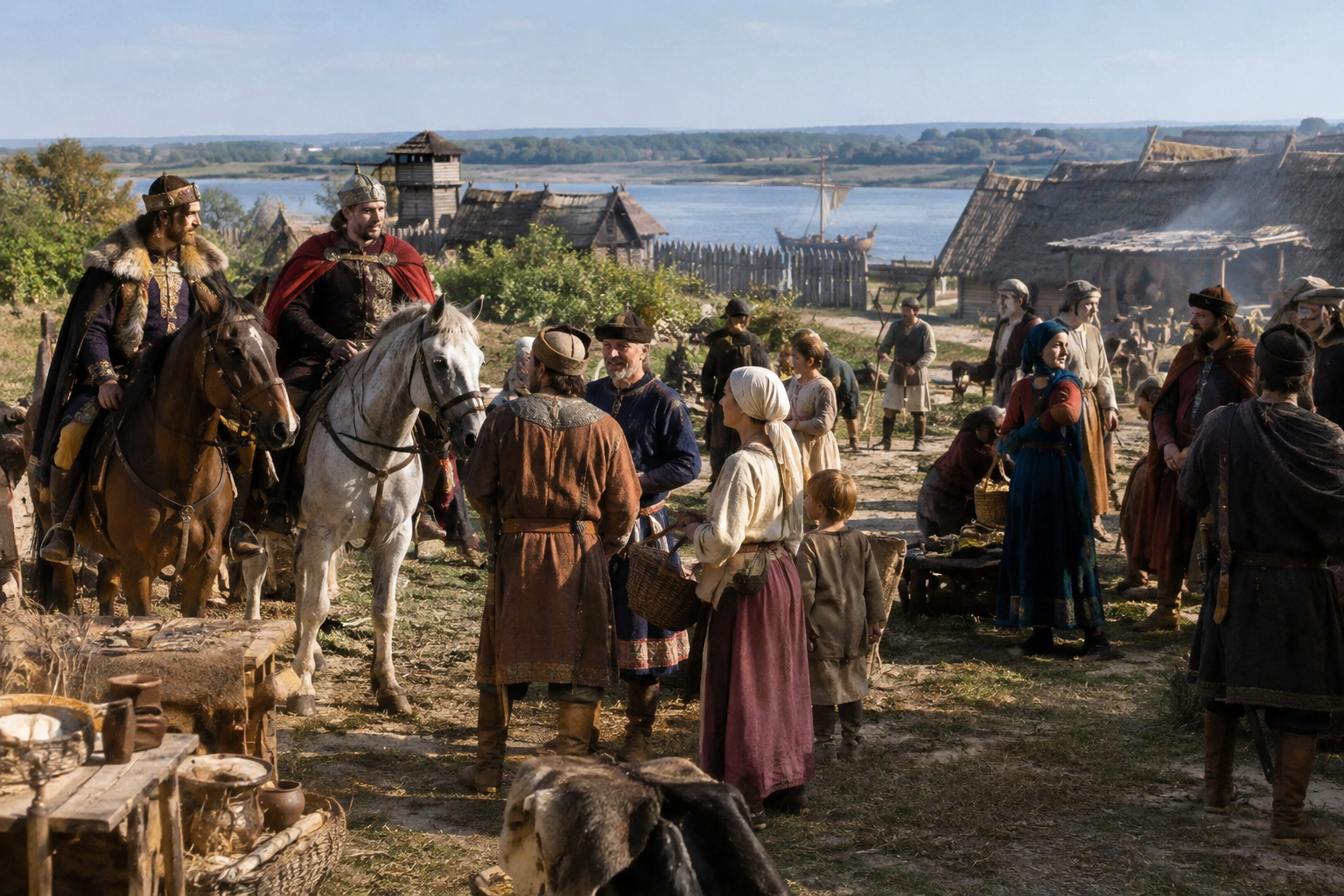
Some Y-DNA branches announce themselves with a trumpet blast. Others are more intriguing because they appear in fragments: a burial here, a frontier settlement there, a medieval stronghold much later on. Haplogroup R1a1a1b1a2b3a1d belongs to that second category. It sits within the wider R1a paternal family, a major branch of Eurasian Y-chromosome variation that has often been discussed in relation to eastern and central Europe, the steppe, and parts of northern Eurasia. But a narrow subclade like this is not the whole of R1a in miniature. It is one twig on a very large tree, and its history has to be approached with care.
That caution is part of the fascination. Y-DNA traces one direct paternal line only: father to father to father across the generations. It does not describe a person's total ancestry, culture, language, or identity. Still, when a subclade turns up in ancient burials from Bronze Age Hungary, Late Antique Pannonia, Avar-period elites, medieval western Slavic settlers, Piast-era Poland, Croatia, and even Iron Age Ingria, it begins to sketch a remarkably broad historical landscape. What we see is not a single tribe marching neatly across a map, but a paternal lineage appearing in many of the zones where eastern, central, and southeastern European history was made.
The broader R1a family is well known in studies of Eurasian paternal ancestry, especially in connection with eastern Europe and steppe-linked population history. For a highly specific branch such as R1a1a1b1a2b3a1d, however, it is wiser to speak of context rather than certainty. Its deeper ancestry belongs somewhere within those wider R1a expansions, but the exact route by which this particular branch emerged and spread cannot be reconstructed from the supplied evidence alone.
What the evidence does suggest is that this lineage, or closely related paternal lines, became established across a corridor running from the Carpathian Basin and the Danube world into the western Slavic lands and the Baltic-facing north. That is historically plausible terrain for a branch nested within R1a: a world of Bronze Age mobility, Iron Age frontier zones, post-Roman reshuffling, and medieval state formation.
Readers interested in the wider archaeological backdrop to such paternal histories may enjoy this overview of steppe-facing mobility and settlement in the region.
Explore North Pontic Migrations
The earliest supplied sample is S9, from Bronze Age Hungary Balaton Region Somogyvar-Vinkovci, dated 2290 BC. Even a single Bronze Age appearance matters. It places this paternal branch, or a very close equivalent in the classification used here, in the Carpathian Basin long before medieval kingdoms, before Slavs, before Avars, before the written political geography of the region. That matters because it warns us against telling too short a story.
Another early marker appears in I6185, from Bronze Age Romania Trestiana, dated 1750 BC. Together, S9 and I6185 point toward a Bronze Age presence in the broader Carpathian and lower Danubian world. That does not prove uninterrupted descent from those men to later medieval carriers, but it does show that paternal lines of this kind were already present in the region deep in prehistory.
Then comes the complicated world of late Rome and its aftermath. GYS058, from Late Antique Pannonia Arrabona Szechenyi Square Hungary, dated 425 AD, stands almost at the hinge between imperial administration and post-imperial fragmentation. Not far away in time is SEI-5, from Dark Ages Hungary Gothic Tribe Sandorfalva-Eperjes Ivotavak, dated 400 AD. Labels such as "Gothic Tribe" are archaeological-historical designations, not simple ethnic truths written in DNA. But taken together, these finds show that this paternal line was present in the mixed, militarized, mobile world of the Middle Danube during late antiquity.
The Avar period sharpens the picture further. RKC051 and RKC052, both from Avar Elite Hungary Rakoczifalva, dated 650 AD, place the haplogroup in an elite context within the Avar Khaganate. That is especially interesting because Avar society brought together steppe traditions, local populations, and inherited Roman landscapes. A Y-line appearing in Avar elite graves does not make it "Avar" in any exclusive sense, but it does show the branch participating in one of the most powerful political formations of early medieval central Europe.
For readers drawn to that turbulent post-Roman world, this related article gives a broader view of the region in which several of these samples lived.
By the early and high Middle Ages, the cluster shifts decisively into Slavic and Polish territory. In present-day Germany, several samples come from Medieval Germany Sachsen-Anhalt Western Slav Settler contexts: SDN028 and SDN029 at Steuden, dated 900 AD, and NDW017, NDW025, NDW036, NDW038, and NDW043 from Niederwuensch, dated 1100 AD. These are especially valuable because they show the lineage not in princely glamour, but among the populations that filled and defended the borderlands of the Elbe-Saale region.
That western Slavic presence is echoed further east in Poland. The Santok area is particularly striking: PCA0404 from Piast Dynasty Lubusz-Greater Poland Border Santok Lad, dated 1100 AD; PCA0520 from Piast Dynasty Poland Santok Lubusz Province Gorzw Wielkopolski, dated 1100 AD; and PCA0381 and PCA0382 from Poland Santok Lubusz Province Gorzw Wielkopolski Santok Poland Santok IA, also dated 1100 AD. Add PCA0198 from Medieval Poland Piast Dynasty Lad, dated 950 AD, and the pattern becomes hard to ignore.
This does not prove that the Piast dynasty as a whole belonged to this exact subclade, nor that all men buried in Piast-associated settings were close paternal kin. What it does show is that this lineage was present in the political and military world of early medieval Poland, especially in frontier strongholds like Santok, where river routes, border warfare, and dynastic expansion all converged.
If you want to go deeper into that dynastic setting, this article is the natural next stop.
The distribution does not stop there. PDH011 and PDH012, from Duchy of Sandomierz Lublin Region Pidhirtsi, dated 1150 AD, carry the story into another important Polish regional polity. Meanwhile VEM035 and VEM049, from Early Medieval Croatia Velim-Velistak, dated 750 AD, show that the same paternal branch also appeared in the eastern Adriatic sphere. And in the far north, VII15 from Iron Age Ingria, dated 125 AD, hints that related lineages reached the Baltic-Finnic contact zone as well.
By the later Middle Ages, our story arrives at Kreva Castle in present-day Belarus, associated here with the House Koreiva. The castle was a major stronghold of the Grand Duchy of Lithuania, built in the early 14th century, probably under Grand Duke Gediminas. Its historical fame rests above all on the Union of Kreva in 1385, the agreement that tied Lithuania to Poland through the marriage of Jogaila and Jadwiga and helped reshape eastern European politics.
That alone would make Kreva important. But it also carries darker memories. It was the place where Grand Duke Kestutis was imprisoned and died in 1382 during his dynastic struggle with Jogaila. In other words, this was not merely a residence or a picturesque ruin. It was a hard political place, one of those fortresses where family ambition, regional identity, and state formation collided head-on.
The castle later lost military importance, suffered war damage, and gradually fell into ruin. Its broken brick and stone walls still preserve something essential about the borderlands: this was a region where Lithuanian, Polish, Ruthenian, and broader eastern European histories met, overlapped, and often fought. That makes it an apt setting for a haplogroup found repeatedly in Polish and wider east-central European medieval contexts. Not proof of direct descent from any named house, certainly not. But a historically fitting stage on which such paternal lines were part of the human background.
Readers interested in that noble and regional context can continue with this related family feature.
R1a1a1b1a2b3a1d is historically interesting not because it can be made to stand for one people, one kingdom, or one dynasty, but because it refuses to stay in a single box. In the supplied evidence it appears in Bronze Age Hungary and Romania, in Late Antique and Dark Age Pannonia, in Avar elite burials, in western Slavic settlements in medieval Germany, in Piast-connected Poland, in Croatia, and in Iron Age Ingria. That is the sort of pattern that reminds us how badly simple national stories fit the past.
Ancient DNA gives us something written genealogies usually cannot: a view across very long spans of time, often among ordinary people as well as elites. But it also has limits. Shared haplogroups do not automatically mean close kinship. A medieval noble family and an ancient burial may belong to the same broad paternal branch without any demonstrable direct line between them. The value lies in context: seeing how paternal lineages can persist, disperse, and reappear in different political worlds.
So if this haplogroup appears in your own Y-DNA results, the most responsible conclusion is not "I descend from this castle" or "I belong to that dynasty." It is something subtler, and in many ways more interesting: your direct paternal line may connect you to a long history across the Carpathian Basin, Slavic borderlands, and the state-building zones of medieval eastern Europe.
Upload your DNA to MyTrueAncestry to explore ancient matches, compare your results with archaeological samples like S9, GYS058, RKC051, PCA0404, or VII15, and see how genetics can place your paternal line in the wider human past. These matches can reveal real historical connections in deep time, even when they do not prove direct descent from a specific ancient individual or noble house.






Comments