Haplogroup R1a1a1b1a1a1c2

– 5 min read


Some Y-DNA haplogroups arrive in history dressed in certainty. Others come to us half-lit, glimpsed in a shipwreck, a castle genealogy, or the long shadow of broader paternal lineages that moved across Europe over thousands of years. Haplogroup R1a1a1b1a1a1c2 belongs to that second category, and that is exactly what makes it so interesting. It sits within the larger R1a branch of the Y-chromosome tree, a major paternal lineage with a deep and complicated history across Eurasia, but this particular subclade is much narrower, more specific, and therefore more elusive.
That matters because Y-DNA is not a summary of all ancestry. It traces one direct paternal line only: father to son to son, back through time. It can reveal something remarkable about a lineage, but it does not define an entire people, nation, or family. For a branch as specific as R1a1a1b1a1a1c2, the responsible question is not "what civilization does this belong to?" but rather "what parts of the historical record can it illuminate?" With that caution in place, the answer turns out to be rather compelling.
R1a is one of the best-known Y-chromosome haplogroups in Eurasian population history. Ancient DNA has linked different branches of R1a to major prehistoric and historic movements across the steppe, into parts of Central and Eastern Europe, and across the Baltic and Scandinavian worlds. But one must be careful here. The fact that a broad parent haplogroup has a large and well-studied history does not mean every tiny downstream twig can simply inherit all of it by assumption.
For R1a1a1b1a1a1c2, the safest historical framing is this: it belongs to a paternal family tree whose wider branches were involved in long-term movements across northern and eastern parts of Europe, and whose later descendants appear in historical settings far removed from their prehistoric origins. That makes it especially useful for thinking about continuity, mobility, and the way male lineages can persist while languages, kingdoms, and political identities change around them.
If you want to step further back into the wider ancient background that made such later branches possible, MyTrueAncestry readers may enjoy a broader look at how archaeogenetics reconstructs deep human history.
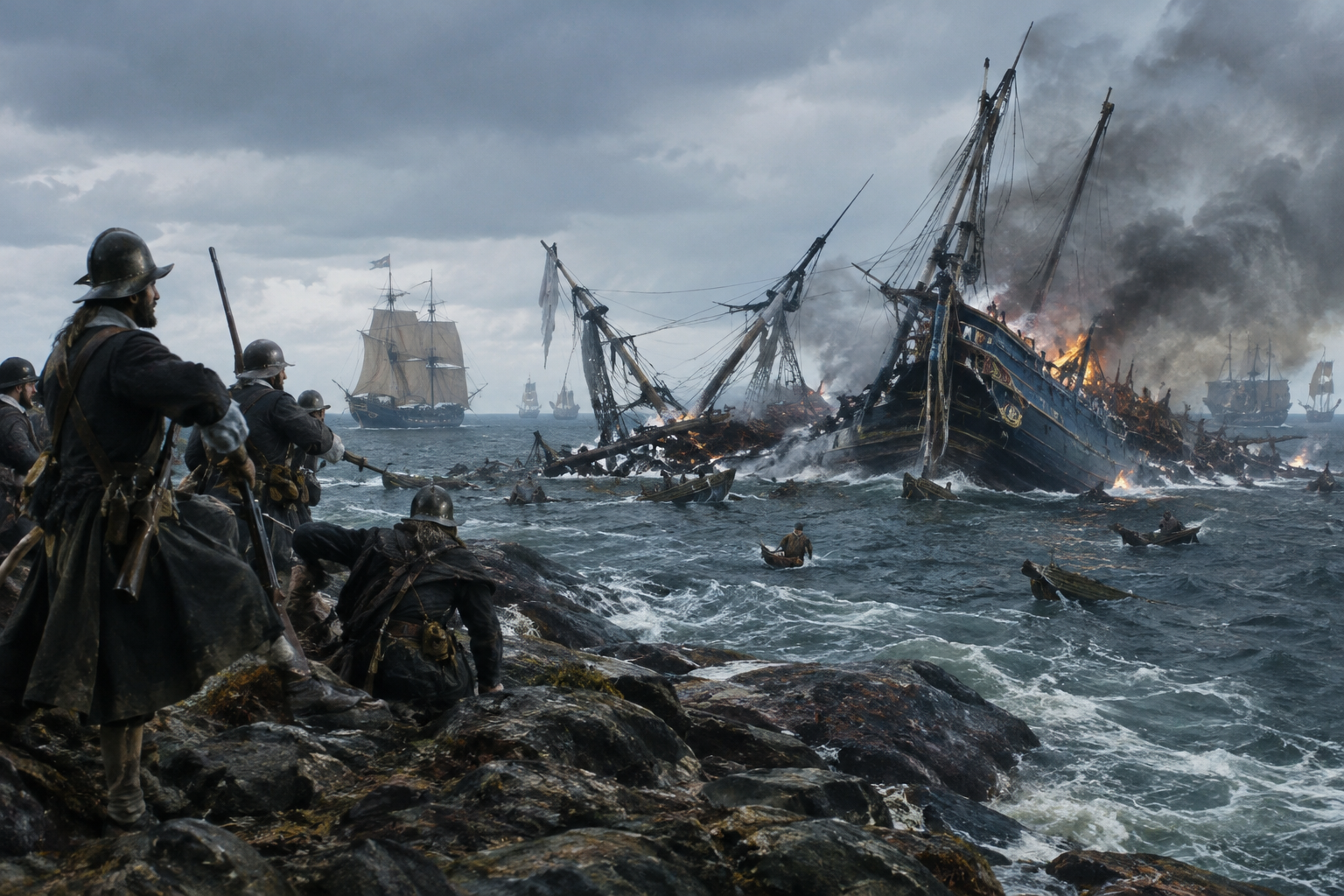
The most vivid anchor we have here is not a Bronze Age chieftain or a medieval duke, but a man from one of the most dramatic naval disasters in Swedish history. The ancient individual kro002, from the Stora Kronan Shipwreck Battle of Oland Sweden, dated 1676 AD, places this paternal line in the violent world of early modern Scandinavia.
The Stora Kronan was lost during the Battle of Oland in 1676, when Sweden fought for mastery in the Baltic. This was an age of cannon, dynastic rivalry, and imperial ambition, but also of intensely mixed military populations. Crews could include men from different regions, social backgrounds, and family histories. So while kro002 gives us a concrete historical bearer associated with this haplogroup, he should not be made to stand for all Sweden, all Scandinavia, or all R1a lineages. He is more interesting than that: he is a real individual whose DNA shows that this paternal branch survived into the documented, post-medieval world.
There is something wonderfully arresting about finding a Y-lineage not in a royal tomb but in a warship wreck. It reminds us that paternal history was not carried only by dynasties. It was carried by sailors, soldiers, farmers, clerks, and men whose names may be lost even when their lineage is not.
Readers interested in the wider setting of this discovery may want to follow the archaeology of the wreck itself.
What, then, can we reasonably say about the historical geography of this branch? The presence of kro002 in Sweden suggests that by the 17th century this paternal line was established in the Scandinavian-Baltic sphere. That is not surprising in the larger context of R1a, which is well represented across parts of northern and eastern Europe in both modern and ancient populations. But the value of the sample lies in historical texture. It shows that a highly specific branch could be living, and dying, within the maritime military networks of the Baltic world.
This is the great lesson of Y-DNA when used sensibly. A lineage may begin deep in prehistory, pass through eras for which we have no names at all, appear later among Iron Age or medieval populations, and finally emerge in a context as precise as a dated shipwreck. The line continues; the world around it changes. Kingdoms rise and fall, languages shift, armies recruit across regions, and yet a paternal marker can endure through all of it.
That is why Scandinavian ancient DNA studies are so useful, especially when they examine continuity and change across the Viking and post-Viking centuries rather than treating the region as genetically static.
At first glance, the House of Rohan in Brittany might seem very far from a 17th-century Swedish shipwreck. In one sense, of course, it is. We have a named noble dynasty in western France and an excavated individual from a Baltic naval disaster. No responsible historian or geneticist would claim that one proves direct descent from the other. Sharing a broad or even narrower haplogroup context is not the same as having a documented genealogical connection.
And yet the comparison is historically valuable. The Rohans show what happens when paternal history enters the written record and acquires stone walls, heraldry, and archives. Their seat at Josselin Castle in Brittany began as a fortress around 1008, built above the River Oust. Across the medieval centuries it became one of the great strongholds of Breton politics, damaged and rebuilt several times, especially in the 14th and 15th centuries. Much of the striking Gothic and early Renaissance frontage seen today belongs to that later rebuilding.
Then comes the deliciously medieval detail: in the late 15th century Duke Francis II ordered parts of the defenses dismantled because he feared the Rohans had grown too powerful. That is the sort of episode that tells you almost everything about aristocratic politics. Castles were not merely picturesque residences. They were arguments in stone, declarations of local power, and occasionally reasons for princely alarm.
Even after periods of decline and alteration, Josselin was restored in the 19th century and remains in Rohan hands, making it one of the rare French castles linked to the same great dynasty across roughly a thousand years. Historically, that continuity is extraordinary. Genetically, it is a reminder of why noble houses attract so much Y-DNA curiosity: they preserve paternal memory unusually well, even when the actual genetics of every branch and every individual remain untested or uncertain.
For readers interested in the family behind this Breton stronghold, there is a dedicated MyTrueAncestry article on the dynasty itself.
So what does R1a1a1b1a1a1c2 reveal? Not a neat ethnic label. Not proof of descent from a medieval lord. Not a shortcut to a castle inheritance, alas. What it offers instead is something more historically satisfying: a direct paternal thread that can connect very different kinds of evidence.
On one side there is ancient DNA, in this case kro002 from the Stora Kronan shipwreck, grounded in a precise archaeological context from 1676 AD. On the other there is the documentary and architectural world of families such as the Rohans, whose power survives in charters, chronicles, and the masonry of Josselin Castle. Genetics and history are doing different jobs here. DNA tracks biological lineages; archives track named kinship and property; archaeology restores lost lives and settings. Put together carefully, they give us a fuller account of the past than any one source could manage alone.
That is one of the pleasures of working with a specific Y-haplogroup. However narrow the branch, it reminds us that history was made not only by states and peoples, but by lines of fathers and sons moving through changing worlds, sometimes remembered in castles, sometimes recovered from seabeds.
If your own Y-DNA or autosomal results point toward lineages like R1a1a1b1a1a1c2, MyTrueAncestry can help you explore how your DNA compares with ancient individuals and historical populations. Those matches do not by themselves prove direct descent or noble ancestry, but they can open a wonderfully concrete window onto the worlds your paternal line once inhabited.






Comments