Haplogroup J2a1a1b2a1a

– 6 min read


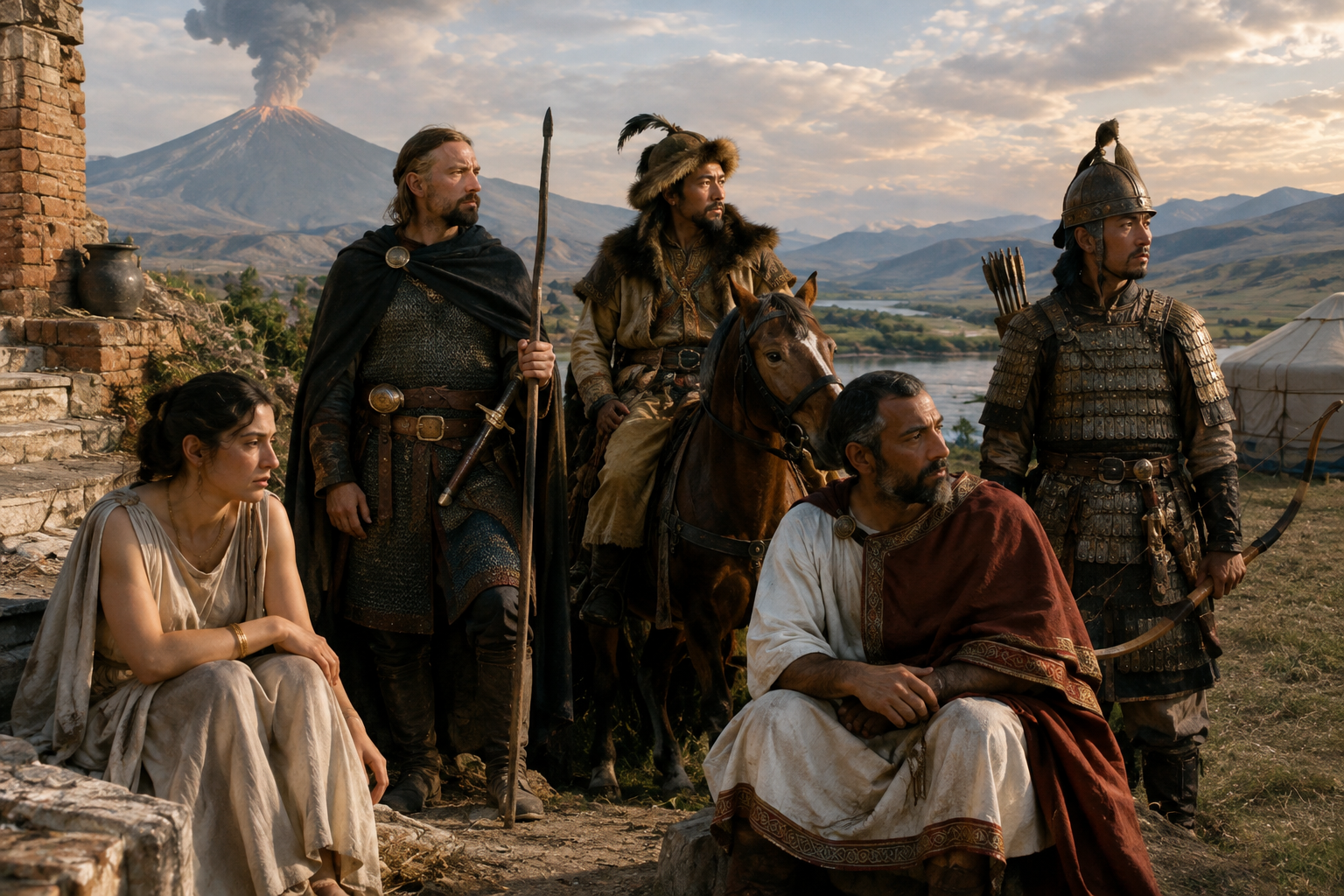
Some Y-DNA haplogroups behave rather like those difficult historical characters who refuse to stay neatly in one chapter. J2a1a1b2a1a is one of them. It belongs to the wider Y-chromosome haplogroup J2, a branch long associated, in broad terms, with parts of the Near East, the eastern Mediterranean, and the many corridors that linked them to Europe and Inner Asia. But this very specific subclade is not a badge of one people, one kingdom, or one language. What makes it interesting is precisely that it appears in settings that remind us how mobile the ancient world really was.
That is worth stressing at the outset. A Y-DNA haplogroup traces one direct paternal line only: father to father to father across the centuries. It does not describe a person's total ancestry, culture, or identity. Even so, when a lineage such as J2a1a1b2a1a appears in Roman Italy, Merovingian Germany, conquest-period Hungary, and even an Early Xiongnu context in Mongolia, it offers a splendid reminder that paternal lines can travel far beyond the tidy borders later historians like to draw.
J2a1a1b2a1a is a downstream branch within haplogroup J2a, itself part of the larger J family of Y-chromosome lineages. In broad archaeological and genetic discussions, J2 lineages are often connected with populations of the Near East and eastern Mediterranean, and with the spread of farming, trade, and urban life across western Eurasia. But one must be careful here: the deeper history of J2 is not automatically the same as the documented history of this much narrower branch.
What we can say responsibly is that lineages within J2a became woven into some of the busiest human networks of the ancient world: Anatolia, the Aegean, the Levant, Italy, the Balkans, and the lands north of the Black Sea. These were regions shaped by seaborne trade, imperial expansion, military recruitment, colonisation, and marriage across cultural boundaries. A lineage like J2a1a1b2a1a is therefore historically interesting not because it "belongs" to one civilisation, but because it appears at the crossroads.
One of the most vivid ancient anchors for this haplogroup is I3686, described as a Roman Pompeii Vesuvius Victim House of the Golden Bracelet Year:79 AD. There is something arresting about encountering a paternal lineage through an individual frozen in one of history's most famous disasters. Pompeii was not a provincial backwater. It was a Roman town deeply tied into Mediterranean commerce, culture, and movement. A lineage found there fits well with what ancient DNA has increasingly shown: Roman Italy was populated by people whose ancestors had come from many directions.
Another sample sharpens that picture further: R68, a Near East Outlier Imperial Rome ANAS Year:200 AD. Even from the label alone, the significance is clear. Imperial Rome drew in people from across the empire, and some individuals stood out genetically as having stronger Near Eastern connections than the local average. In other words, the Roman world was full of men whose paternal ancestry may have originated well beyond Italy, yet who lived and died under Roman rule. J2a-related lineages are entirely at home in that sort of setting.
Taken together, I3686 and R68 do not prove a single migration event, still less a simple one-way movement. But they do place this paternal line within the lived reality of Roman cosmopolitanism: merchants, migrants, soldiers, freedmen, administrators, and families moving between the eastern Mediterranean and the Italian peninsula.
Then the story shifts north. W67, identified as an Early Merovingian Frankish Warrior Elite Woelfersheim-Berstadt Germany Year:525 AD, places the lineage in an early medieval setting associated with Frankish power. This is exactly the sort of evidence that unsettles simplistic ideas about "Germanic" ancestry. The post-Roman kingdoms were not sealed ethnic containers. They emerged from centuries of contact along the Roman frontier, with soldiers, settlers, local provincials, and incoming groups mixing in complicated ways.
A paternal lineage found in an elite Frankish warrior does not mean the haplogroup was uniquely Frankish, nor does it mean all men in Merovingian elites shared it. What it does suggest is that lineages with deeper Mediterranean or Near Eastern roots could become fully embedded in the political societies of early medieval Europe. By the sixth century, ancestry and allegiance were not the same thing. A man could be buried with the status markers of a Frankish elite and yet carry a paternal line whose deeper story ranged much farther south and east.
That broader frontier world has become much clearer thanks to archaeogenetics, which keeps showing that late Roman and early medieval Europe was not a stage occupied by neatly separated "Romans" and "barbarians," but by mixed communities shaped by mobility over generations.
Read the Roman-Frankish frontier story
The sample BK-2, a Hungarian Conqueror Elite Bugyi-Kisvanpuszta Year:950 AD, adds another turn in the tale. By the tenth century, the Carpathian Basin was being reshaped by the Magyar conquest and the formation of new elite networks. Finding this paternal lineage in a conquest-period elite context is a useful warning against imagining the conquering population as genetically uniform. Medieval confederations were coalitions, and elite cemeteries often preserve exactly that complexity.
The Carpathian Basin had long been a meeting place between central Europe, the Balkans, and the steppe. A lineage such as J2a1a1b2a1a could have reached this world by several routes over time: through earlier Roman-era mobility, through Balkan and Black Sea contacts, through steppe intermediaries, or through more local continuity mixed with later political change. The ancient DNA evidence does not force a single explanation, but it does show that this lineage was present among high-status men in the Hungarian conquest period.
That makes BK-2 especially interesting for readers who want to understand how paternal lines survive political upheaval. Kingdoms rise, aristocracies reinvent themselves, and burial customs change, yet particular male lines can persist, reappear, or be absorbed into entirely new ruling structures.
Perhaps the most surprising appearance in the supplied evidence is SKT012, described as Salkhityn Am Khuvsgul Early Xiongnu Year:200 BC. Here we are a very long way from Pompeii. This is not a reason for sensational claims; it is a reason for historical curiosity. One ancient sample in an Early Xiongnu context does not mean that J2a1a1b2a1a was characteristically "Xiongnu" in any broad sense. But it does show that paternal lines now more familiar in western Eurasian discussions could also turn up in the eastern steppe world.
That should not astonish us too much. The steppe was not an isolated void. It was a vast zone of movement linking eastern and western Eurasia. Trade, alliance, captivity, migration, and military service could move people - and their Y chromosomes - over remarkable distances. SKT012 is a splendid little rebuke to any historian tempted to think in rigid continental boxes.
The supplied noble family field is empty, which is itself a useful reminder of method. Without specific family and castle data, it would be improper to attach J2a1a1b2a1a to named medieval dynasties, castles, or later aristocratic houses. That absence matters because genetic storytelling is most trustworthy when it resists the temptation to fill gaps with fantasy.
Even so, the ancient evidence helps us understand the kind of historical landscapes in which later noble houses emerged. Roman municipal elites in Italy, frontier warrior aristocracies in Merovingian Germany, and mounted conquest elites in tenth-century Hungary all belonged to societies where paternal lines from different regions had already been mingling for centuries. When later castles and noble genealogies appear in the written record, they stand on top of that deeper and messier human past.
In practical terms, that means a later noble family associated with a region where J2a-derived lines were present might offer an interesting historical parallel, but not proof of descent. Castles preserve memory, lordship, and landscape. Ancient DNA preserves glimpses of biological ancestry. They illuminate one another, but they are not the same kind of evidence.
So what does J2a1a1b2a1a reveal? Above all, that paternal ancestry can follow the great arteries of history: Mediterranean cities, imperial capitals, frontier warbands, and steppe-connected elites. In the supplied samples alone, this lineage appears in I3686 at Pompeii in 79 AD, R68 in Imperial Rome around 200 AD, W67 in Merovingian Germany around 525 AD, BK-2 in conquest-period Hungary around 950 AD, and SKT012 in an Early Xiongnu context at 200 BC.
That is not a family tree. It is something more interesting in its own way: evidence that one paternal branch participated in several of the most connected worlds of Eurasian history. Ancient DNA does not tell us that all these men knew one another's peoples, still less that they shared a recent ancestor in any genealogical sense. But it does let us watch a lineage move through very different political and cultural settings, which is precisely what makes archaeogenetics so valuable.
For MyTrueAncestry users, that is the real excitement. Your Y-DNA haplogroup is not a national label or a ready-made identity. It is a clue - one thread among many - that may connect your direct paternal line to ancient movements, forgotten communities, and historical landscapes far older than any surviving surname.
If you want to see whether your own DNA shows links to ancient individuals like those discussed here, MyTrueAncestry can help you explore those connections. Ancient DNA matches can offer remarkable historical perspective, even when they do not prove direct descent from a particular person, dynasty, or noble house.






Comments