Haplogroup J2a1

– 6 min read


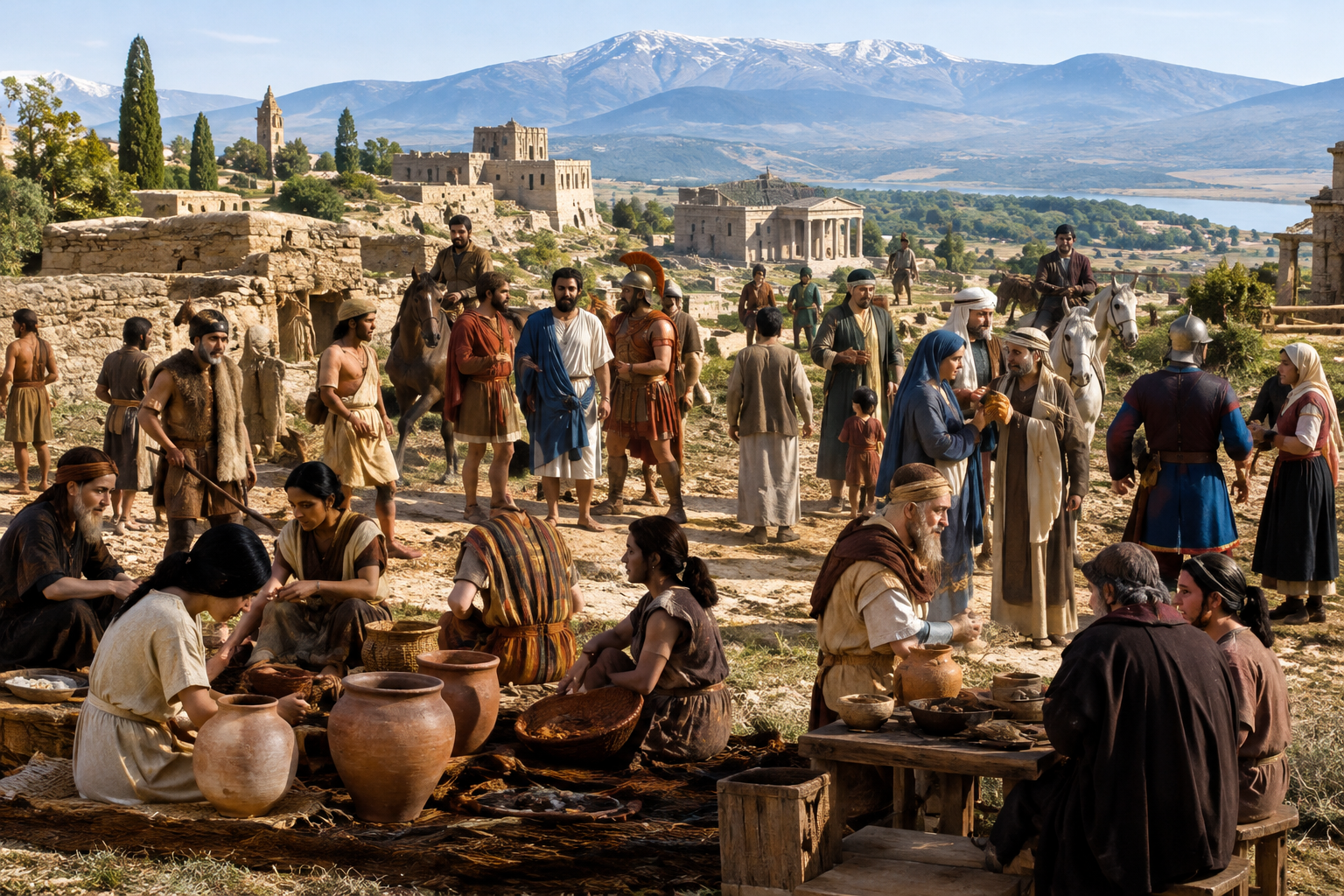
There is something arresting about haplogroup J2a1 because it appears, again and again, in places where settled life was being remade: early farming villages, Bronze Age corridors of trade, classical towns of Anatolia, Roman provinces, and even later medieval burials far from its older heartlands. It is not a badge of one people or one kingdom. Rather, it is one of those paternal lineages that helps show how men, families, and communities moved through the worlds of the Near East, the Mediterranean, and Europe over very long stretches of time.
As ever with Y-DNA, a note of caution matters. J2a1 traces only one direct paternal line, father to son to son, and does not represent a person's whole ancestry. Nor does sharing a broad haplogroup prove close kinship, noble descent, or belonging to a single ethnic group. But when ancient DNA places J2a1 in real archaeological settings, the result is wonderfully concrete: not an abstraction, but men buried at Catalhoyuk, Gordion, Megiddo, Cambridge, and elsewhere, each part of a much larger human story.
Within the wider Y-chromosome tree, J2 is broadly associated with lineages long present across the Near East and eastern Mediterranean, and J2a1 is one important branch within that wider cluster. For J2a1, the supplied ancient DNA points especially strongly toward an early presence in Neolithic societies stretching from Iran and Anatolia into the Caucasus and then into southeastern Europe. That does not mean every expansion from those regions was driven by this one lineage, but it does place J2a1 among the paternal lines involved in some of the oldest farming communities known to archaeology.
The sample trail opens impressively early. At Tepe Guran in Neolithic Iran, sample NEO816 from 6750 BC places this paternal lineage in the Zagros world of early village life. From Anatolia come three striking finds from Catalhoyuk: cch076 dated to 7000 BC, cch120 dated to 6500 BC, and cch508 dated to 5000 BC. That is not a fleeting appearance. It suggests continuity of related paternal branches across millennia at one of the most famous early settled sites on earth.
There is more. In the southern Caucasus, ARO011 from Arukhlo Shomutepe-Shulaveri in Georgia, dated to 5500 BC, shows J2a1 in another early farming horizon. Westward, the lineage appears in Neolithic Europe: I5207 from Asparn Schletz in Austria at 5150 BC, NEO143 from Gorzsa Cukormajor in Hungary at 4675 BC, and PIE044 from Giurgiu Pietrele Magura Gorgana in Romania at 4100 BC. Taken together, these samples fit a familiar archaeological picture: the spread of farming lifeways into Europe involved movement of people as well as ideas, and J2a1 was clearly part of that demographic process.
What happened next is particularly interesting, because J2a1 does not remain confined to an early farming zone. It turns up across the Bronze Age in places linked by exchange, mobility, and emerging regional powers. In the north Caucasus, the Maikop-related burials I6266 at 3435 BC and I6268 at 3600 BC from Novosvobodnaya Klady in Adygea, Russia, hint at paternal links running through one of the great cultural crossroads between steppe, Caucasus, and Near Eastern worlds.
Farther east, DA381 from Chalcolithic Geoksyur in Turkmenistan, dated to 3233 BC, reminds us that lineages connected with J2a1 also appear along routes reaching into Central Asia. In Anatolia itself, the line remains visible in samples such as IKI024 from Ikiztepe at 3300 BC, I7073 from Suluova at 2804 BC, and MA2212 from Ovaoren at 2625 BC. These are not identical societies, of course, but they show a persistent paternal presence in Anatolia over a very long period.
The Mediterranean record adds another layer. NEO828 from Bronze Age southern Italy, Gaudo, dated to 2796 BC, and the Croatian Cetina Valley individuals I19026 at 1800 BC and I19031 at 1700 BC, suggest that J2a1 lineages had become part of the human traffic of the Adriatic and central Mediterranean. The outlier burial I14499 from Velika Gruda in Montenegro, dated to 1350 BC, makes the same point in a slightly different way: paternal lines could travel, settle, and become locally unusual.
One of the most evocative Bronze Age appearances is I10359 from Canaanite Megiddo, dated to 1570 BC. That does not make J2a1 a uniquely "Canaanite" lineage any more than Catalhoyuk makes it uniquely Anatolian. But it does place it squarely in the interconnected eastern Mediterranean of cities, trade, diplomacy, and war.
Read South Caucasus DNA History
If the Neolithic gives J2a1 depth, Anatolia gives it remarkable continuity. At Gordion and nearby Galatian contexts, the lineage appears repeatedly: I4029 from Bronze Age Gordion Central Anatolia, dated to 660 BC; GOR001_L003, GOR001Y, and GOR001_L from Classical Age Anatolia Galatia Gordion, all dated to 165 BC; and BOG020 from Imperial Roman Era Anatolia Galatia Bogazkale at 225 AD. Add I16583 from Roman Era Apollonia Anatolia at 150 AD and I4532 from Byzantine Period Mardin in southeast Anatolia at 750 AD, and the impression is plain: this was one of the paternal lines woven into Anatolia's populations across successive political worlds.
There are also hints of wider movement beyond the eastern Mediterranean core. I35803 from Late Roman Spain, Cordoba Lucena Cortijo Basilica del Coracho, dated to 450 AD, and I3584 from Post-Roman Sierra de Alhama at 550 AD, show J2a1 in Iberia. GYS050 from Late Antique Pannonia in Hungary at 425 AD does the same for the Danube frontier. These are precisely the kinds of finds that make Roman and post-Roman history feel less tidy than schoolbook maps suggest. Empires moved soldiers, merchants, craftsmen, captives, clergy, and families; Y-DNA often catches the traces.
England too enters the picture. The Barnham Market burials in Norfolk - BMN012, BMN019, and BMN021, all dated to 600 AD - place this paternal line in Anglo-Saxon early medieval England. Later, medieval Cambridge offers ATP_PSN_306 and ATP_PSN_18, both from St Johns Hospital and dated to 1250 AD. No one should leap from that to a claim about "English J2a1 identity"; that would be absurdly simple. But it does show that by the Middle Ages, this paternal branch was part of the population history of Britain as well.
Discover Roman and Medieval Britain DNA
This is where castles and dynasties enter the story, though carefully. The supplied noble association is Scottish Royalty, centered on Dundonald Castle in South Ayrshire. The site itself has deep roots, beginning as a prehistoric fort and later serving as a royal place in the early medieval kingdom of Strathclyde. The great stone castle visible today was built in the late 14th century for Robert Stewart, later King Robert III of Scotland, and it became an important residence of the Stewart dynasty.
Dundonald is exactly the kind of place that reminds us how landscapes accumulate power. A hill used in prehistoric times becomes a royal site, then a dynastic castle, and later a ruin dense with memory. That does not prove any specific Stewart Y-DNA assignment from the information supplied here, nor does it mean that a bearer of J2a1 is genealogically tied to Robert Stewart. What it does provide is a historical frame: by the later Middle Ages, Britain contained many paternal lines with origins scattered across earlier prehistoric and historic migrations. A haplogroup like J2a1, documented in early and medieval England and more widely across Europe, belongs in that broader British story of population mixture and continuity.
In that sense, Dundonald Castle is less a genetic proof than a historical stage. It stands in a kingdom shaped by Brittonic, Gaelic, Norse, Norman, and wider European connections. Ancient DNA, written genealogy, and architecture each preserve different fragments of the past. Put together, they offer context rather than certainty - and often that is more interesting than a simplistic claim of descent.
Explore the Royal House of Stewart
J2a1 is historically compelling because it keeps turning up where human worlds were being connected: Neolithic farming communities in Iran and Anatolia, Caucasus networks, Bronze Age Mediterranean societies, classical and Roman Anatolia, Iberia, Hungary, and medieval Britain. The pattern does not support a fairy tale about one "J2a1 people." It supports something richer and more historically plausible: a durable paternal lineage moving through many societies, languages, and political orders.
For family historians, that is worth lingering over. A Y-DNA haplogroup can point to a deep paternal background, but it cannot by itself tell you whether your ancestors were Canaanite townsmen, Galatian villagers, Roman provincials, or Scottish nobles. Ancient DNA gives parallels, not certificates. Yet those parallels are extraordinary. To share a paternal branch with men from Catalhoyuk, Megiddo, Gordion, Norfolk, or Cambridge is to glimpse the scale of the human past in a very personal way.
If your Y-DNA belongs to J2a1, or to a neighboring branch, MyTrueAncestry can help you explore how your direct paternal line fits into this longer archaeological record. Uploading your DNA may reveal similarities to ancient individuals and historical populations discussed here, while remembering that genetic matches illuminate deep ancestry without automatically proving direct descent from any one ancient person, dynasty, or castle-owning family.






Comments