Haplogroup J1

– 6 min read


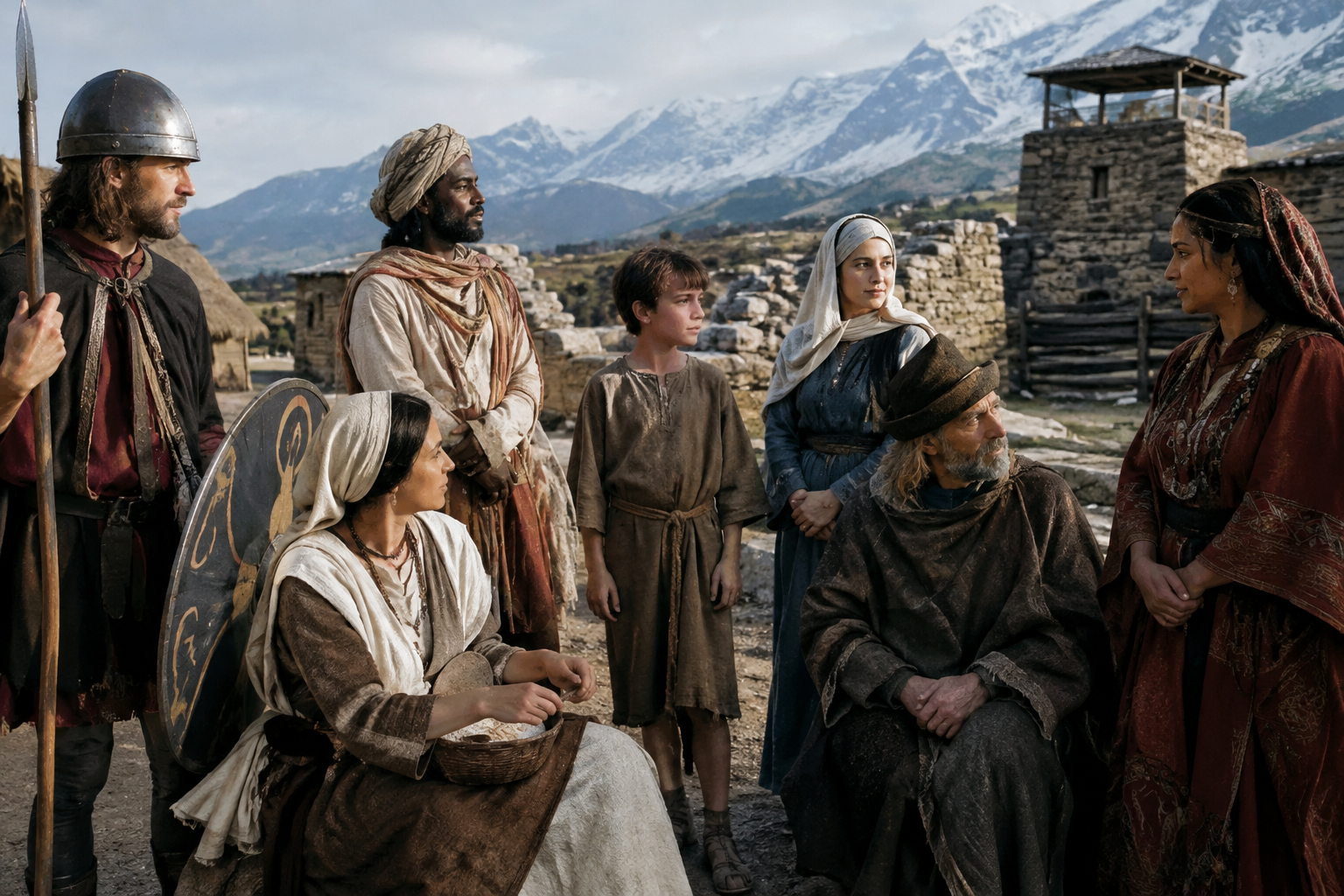
Haplogroup J1 is one of those Y-chromosome lineages that keeps turning up in places where historians already suspect long, complicated stories of movement, trade, settlement, and rule. In plain terms, a Y-DNA haplogroup traces one direct paternal line: father to son to son across many generations. It does not describe a person's whole ancestry, culture, language, or identity. But it can be a remarkably useful thread, especially when ancient DNA allows us to watch that thread appear in different regions over thousands of years.
For J1, the pattern is especially striking. The samples supplied here place it in prehistoric Iran, the Bronze Age Levant, Anatolia, the Aegean, the Caucasus, medieval Arabia, East Africa, and also, rather intriguingly, in parts of early medieval and medieval Europe. That does not mean one simple migration or one single people. Quite the opposite. J1 looks less like a marching army and more like a durable paternal lineage that became woven into many different societies across the Near East and beyond.
Within the wider Y-chromosome tree, J1 belongs to haplogroup J, a major West Eurasian paternal lineage often associated in broad terms with Southwest Asia. For J1 itself, scholars generally place its deeper background somewhere in that wider Near Eastern world, though the exact routes and timings of different branches remain matters of ongoing research rather than neat certainties.
The ancient evidence in this dataset begins very early. A Neolithic sample from Hajji Firuz in Iran, I2328, dated to 5950 BC, places J1 in one of the great early farming landscapes of the Zagros region. Another early Iranian case, sha004 from Shah Tepe, dated to 3250 BC, shows the lineage still present in northern Iran by the Early Bronze Age. Then there is I11480 from Shahr-e Sukhteh in southeast Iran, dated to 2850 BC, from the Helmand Civilization world - a reminder that J1 was not confined to one narrow district but was part of a much larger arc of early urban and proto-urban societies.
That eastern and southwestern Asian background helps explain why J1 later appears in so many settings tied to exchange networks: the Caucasus, Mesopotamia, Anatolia, the Levant, and maritime Mediterranean routes. It is the sort of haplogroup that makes sense in a world of caravan tracks, farming frontiers, ports, and imperial roads.
Explore Ancient Iran's Genetic Continuity
If you want to see J1 in the thick of Bronze Age history, the Levant is hard to ignore. The supplied samples from Megiddo are especially important: I4525 dated to 1550 BC, I10104 and I10268 both dated to 1439 BC, I2195 dated to 1440 BC, and I2190 dated to 1302 BC. There is also the outlier I10266 from 1725 BC. This is not a single stray burial. It suggests that J1 formed part of the paternal landscape of Late Bronze Age Canaanite society.
The same broad world appears again at Ashkelon, where ASH066_ASH_IA1 is dated to 1150 BC and identified as Philistine-period. That matters because the southern Levant in this period was a place of political collapse, migration, and cultural mixing. J1's presence here does not prove ethnic labels, but it shows continuity and interaction in precisely the kind of coastal crossroads archaeologists expect.
Move west and north, and J1 turns up in TIT025 from Titris Hoyuk in Anatolia, dated to 2240 BC, in BOG024 from Roman-era Galatia Bogazkale dated to 225 AD, and in I20231 from the Lydian Kingdom Samantas Necropolis Yatagan, dated to 615 BC. There are also Aegean examples: NST001 and NST012 from Nea Styra, Euboea, both dated to 3900 BC, KUK002 from Mycenaean Paros Island dated to 1600 BC, I6420_d from Mycenaean Lokris Proskynas dated to 1560 BC, and I17959 from Delphi dated to 650 BC.
What does that tell us? Not that "the Greeks were J1" or any such nonsense. Rather, it shows that eastern Mediterranean societies were genetically mixed in ways that match their archaeology. Seafaring, colonization, mercenary service, trade, and imperial entanglements all left traces.
Discover Prehistoric Aegean DNA
The Caucasus and nearby regions add another layer. We see J1 in zrj003 from Shamakhi, Azerbaijan dated to 275 AD, in I16553 from Bragdzor, Northern Armenia dated to 750 BC, and in I13949 and I13031 from Iron Age Armenian contexts dated to 663 BC and 840 BC. Again, the point is not to flatten these regions into one genetic bloc. The point is that J1 belongs firmly to this broader zone of long-term continuity and mobility.
Then comes Arabia and the Indian Ocean. I21111 from Soqotra Momi Zaflah, Yemen, dated to 900 AD, places J1 in the medieval Arab world. And several samples from Mtwapa on the Kenyan coast - I19386 dated to 1585 AD, and I19409, I23551, I23660 dated to 1600 AD - show the lineage in the Swahili coastal sphere shaped by trade across the Red Sea and Indian Ocean. That is a lovely corrective to narrow regional thinking. Paternal lines travel with merchants, sailors, settlers, soldiers, enslaved people, and families. History at sea is still history in DNA.
For many readers, the most surprising part of J1 is its appearance in European contexts. Yet late antique and medieval Europe was full of newcomers, borderland communities, and inherited Roman-era mobility. Samples such as GYS017 from Arrabona Szechenyi Square, Hungary dated to 425 AD, SZL033 from Savaria Szeleste Barbaricum dated to 525 AD, and RKF227, RKF230, and RKF220 from Rakoczifalva Szolnok dated to 625 AD, 650 AD, and 725 AD place J1 in the turbulent frontier world of Pannonia, Avars, Byzantines, and post-Roman communities.
There is more. In Italy, J1 appears in the South Tyrol cemetery at Malles Burgusio Santo Stefano: 2419 and 2424 dated to 450 AD, and 2423a, 2423b, 2423c, 2423d, and 2423 dated to 650 AD. In Germany it appears in DRH043 from Roman Deersheim, Saxony-Anhalt dated to 500 AD, Alh10 from Altheim, Bavaria dated to 475 AD, and G37 from Lauchheim Mittelhofen dated to 700 AD in a Merovingian context. There is also I13866 from the Late Medieval Ashkenazi Cemetery, Erfurt, dated to 1325 AD, and ST0475 from medieval Sint-Truiden dated to 900 AD.
This is not evidence for one single migration carrying J1 into Europe. It is evidence that Europe's past was more interconnected than nationalist history books once liked to admit.
Explore Post-Roman Central European DNA
The noble association supplied here points not to a medieval castle in Europe, but to one of the great royal complexes of Iran: Golestan Palace in Tehran. That is fitting for J1. If this haplogroup has one recurring historical theme, it is the old Near Eastern world of courts, cities, uplands, caravan routes, and imperial capitals.
Golestan Palace grew from a citadel first shaped under the Safavids and was rebuilt and expanded by the Qajar rulers after Tehran became the capital in the late eighteenth century. It became a ceremonial theater of monarchy, where shahs received envoys and later staged coronations. Much of the surviving complex belongs to the nineteenth century, especially the age of Naser al-Din Shah, whose additions brought together Persian architectural traditions, mirrored interiors, tilework, gardens, museums, and selective European influence.
Now, one must be careful. A historical association between Persian royalty and a haplogroup does not prove that every shah, prince, or cadet line carried J1, nor that a palace itself offers genetic proof of dynastic descent. But Golestan helps us think historically. Ancient DNA gives us burials and bones; palaces give us memory, performance, and power. Together they remind us that paternal lineages persisted not in abstraction but in households, courts, and political worlds.
It is also hard not to notice that some of the earliest J1 evidence in this dataset comes from Iran itself, from I2328 at Hajji Firuz and sha004 at Shah Tepe. Golestan Palace, though far later, stands in the same broad historical landscape where some of J1's documented ancient story was already unfolding millennia before the Qajars ever raised their mirrored halls.
Read More on Iranian Genetic Lineages
The sensible lesson of haplogroup J1 is not a romantic fantasy of one tribe conquering half the world. It is better than that. J1 shows how a paternal lineage can persist through radically different societies: Neolithic farmers in Iran, Bronze Age Canaanites, Anatolian and Aegean communities, Iron Age Caucasian populations, medieval Arabian islanders, Swahili coast townsmen, and post-Roman Europeans.
Ancient DNA is powerful precisely because it can test, complicate, or sometimes overturn the tidy stories we inherit. Written genealogy usually begins late and follows elites. Archaeogenetics reaches deeper and often finds a broader human cast. Shared J1 between distant individuals does not mean close kinship, still less direct descent from a royal line. But it does place those individuals on far-reaching historical maps of movement and continuity.
If your own Y-DNA belongs to J1, that may connect your direct paternal line to this very wide historical sphere. Not to one crown, one ethnicity, or one heroic ancestor, but to a deep and mobile human past stretching from early Iran and the Levant to medieval courts, ports, and frontier cemeteries.
MyTrueAncestry lets you compare your DNA with ancient individuals and historical populations, offering a fascinating way to place your family history in a much older frame. A match to ancient samples or a shared haplogroup like J1 can reveal meaningful historical context, even when it does not prove direct genealogical descent or membership in a noble dynasty.
Upload your DNA and see whether your ancestry connects with ancient farmers, Mediterranean traders, frontier communities, or royal landscapes like those discussed here.






Comments