Haplogroup I1a4a

– 6 min read


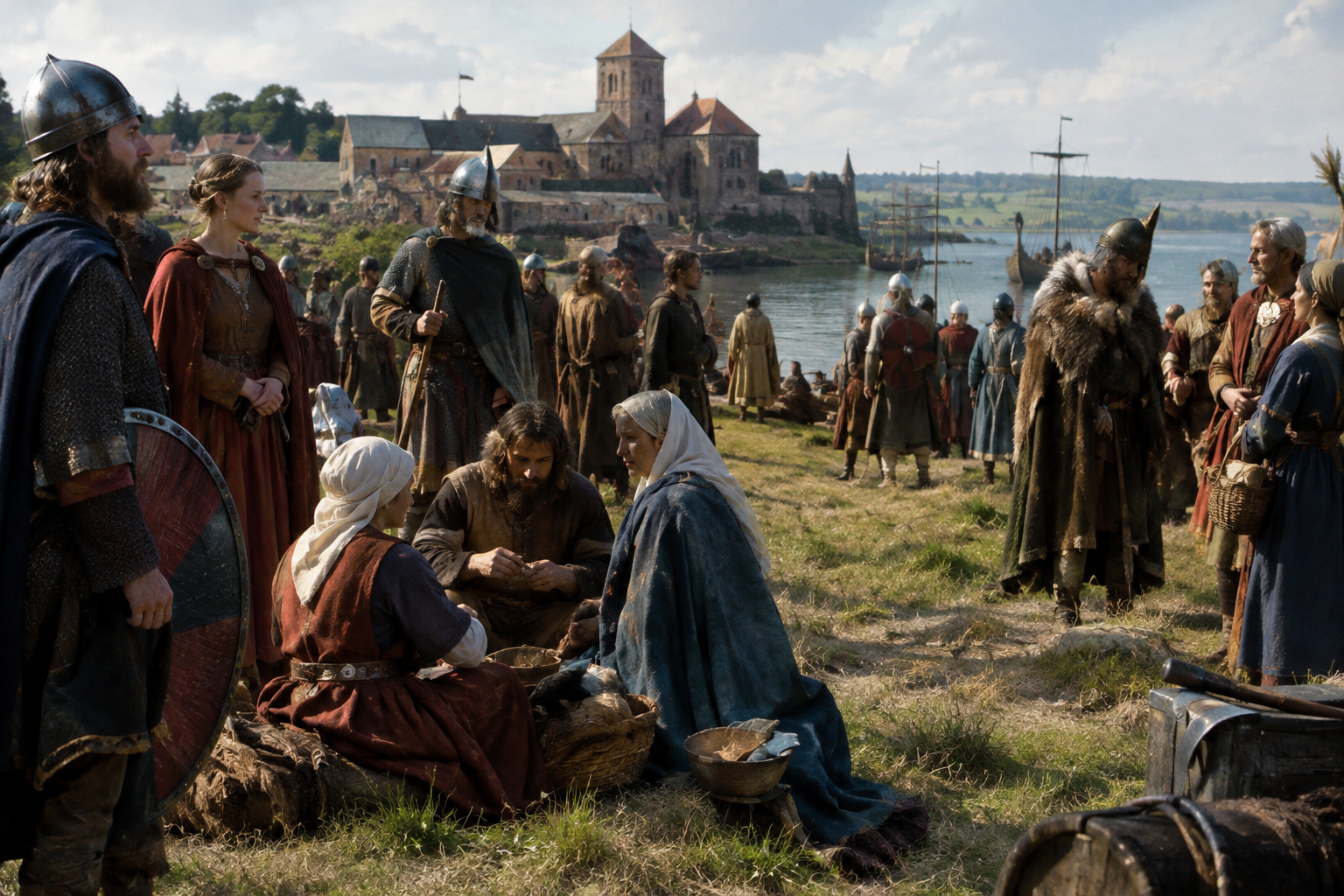
Some Y-chromosome lineages announce themselves with a fanfare of famous dynasties or textbook migrations. Haplogroup I1a4a is more interesting in a quieter, more archaeological way. Its story emerges not from one single kingdom or one neat ethnic label, but from a scatter of men buried across northern Europe and beyond: Bronze Age Scandinavians, Iron Age islanders, Viking Age Danes, early medieval Germans, and later individuals in England and Sweden. What makes it compelling is precisely that long continuity of paternal lines across very different historical worlds.
As always with Y-DNA, a note of proportion is needed. A Y-haplogroup traces just one line of descent: father to father to father. It does not describe a person's whole ancestry, culture, language, or identity. Still, paternal markers can be remarkably useful. They let us watch certain male lines appear, persist, and move across centuries in ways the written record alone could never show. For a subclade such as I1a4a, the safest historical setting is broadly northern European, with especially strong archaeological visibility in Scandinavia and the Baltic-facing world.
I1a4a sits within the wider I1 branch of the Y-chromosome tree, a lineage long associated in broad terms with northern Europe. But one must be careful here: the deep history of I1 is not automatically the exact history of every later twig on that branch. What the sample set for I1a4a does suggest, however, is that this particular paternal line was established in the Scandinavian world by the Bronze Age and remained visible there through the Iron Age, Viking Age, and even into later historical periods.
The earliest anchors are striking. At Ollsjo in Sweden, the Battle Axe period sample oll009 dated to 1840 BC gives us a very early Scandinavian glimpse. Not far behind come two Danish Bronze Age individuals: CGG106712 from Lolland Uglemose, dated to 1675 BC, and NEO590 from Sjaelland Magleo, dated to 1347 BC. These are not proofs that every later bearer of I1a4a descends from one continuous local dynasty. But taken together, they strongly place this paternal branch in southern Scandinavia long before the Viking ships, the sagas, or the medieval kingdoms.
That matters because it gives historical depth to the northern distribution. Rather than appearing suddenly in the Viking Age, this lineage seems already to belong to the older population history of Denmark and Sweden.
Explore Scandinavias Battle Axe DNA
By the Iron Age, the picture sharpens. Denmark is especially prominent. We find CGG106524 from Hestehavens mose in Jutland, dated to 237 BC. Then there is CGG106718, associated with the Danii Tribe at Sjaelland Kalundborg Simonsborg, dated to 175 AD, and CGG107392 from Asnos, dated to 188 AD. Another Scandinavian point comes from Sweden: CGG024145 from Pre-Vendel Oland Stoerlinge, also dated to 175 AD.
This is the sort of evidence archaeologists love because it is stubbornly unromantic. It does not tell us that these men thought of themselves as part of a single people in any modern sense. It tells us something better: that one paternal lineage kept turning up in the connected maritime zone of the Danish islands, Jutland, and southern Sweden over many centuries. That suggests either continuity, repeated local success, or both.
And then, as so often in ancient DNA, the map widens. In the Migration Period and early Middle Ages, related paternal lines appear beyond Scandinavia: OBM052 from Obermoellern in Germany, dated to 500 AD, and DRH024 from Deersheim, Saxony-Anhalt, also 500 AD, both tied here to the Thuringii Tribe. In Bavaria there is AED249, a Dark Ages Baiuvarii Tribe sample dated to 485 AD. In Hungary, A181017 from Gothic Kecskemet-Mindszenti Transtisza, dated to 450 AD, shows the same broad paternal signature in a very different political landscape.
One should not turn that into a simplistic tale of "the haplogroup of the Goths" or "the haplogroup of Germanic tribes." That would be poor history and worse genetics. But it is reasonable to say that I1a4a appears in the sort of northern and central European settings shaped by the mobility of Late Antique and early medieval populations.
Read About Gothic Genetic Diversity
If the Bronze and Iron Age material gives us depth, the Viking Age gives us movement. Denmark again provides several key individuals: VK367 from Bogovej Langeland, dated to 900 AD; VK316 from Hessum on Funen, dated to 950 AD; and CGG106776 from Bogovej, dated to 975 AD. These are exactly the sorts of contexts in which one would expect northern paternal lines to remain visible, embedded in the seaborne networks of the Viking world.
Then comes one of the most vivid samples in the whole set: VK144, identified as a Danish Viking Clan individual from the St. Brice Massacre in Oxford, dated to 1002 AD. Here the lineage is no longer just in Scandinavia; it is present in one of the best-known violent episodes of Anglo-Danish history. No, this does not make I1a4a "the Viking haplogroup" in any exclusive sense. But it does place this paternal line inside the documented North Sea world of raids, settlements, mercenary service, and political entanglement.
Even more expansive is VK409 from Staraya Ladoga, dated to 1000 AD. Staraya Ladoga was one of the great gateways between Scandinavia and the river routes of eastern Europe. A lineage seen in Bronze Age Denmark, Iron Age Oland, and Viking Age Ladoga tells us something important: northern paternal lines did not remain locked in place. They travelled with traders, settlers, warriors, and families along routes stretching from the Baltic to England and Rus.
The later sample kro008 from the Stora Kronan Shipwreck Battle of Oland, dated to 1676 AD, is a reminder that such lineages did not vanish when the medieval world ended. They continued into the early modern period, carried by sailors, soldiers, and ordinary men whose names are often lost while their Y-chromosomes endure.
Two later samples nicely complicate any attempt to confine I1a4a to a single region. ATP_PSN_351 from Medieval England Cambridge St Johns Hospital, dated to 1049 AD, shows the lineage in medieval England outside an explicitly Viking burial context. And VEM059 from Early Medieval Croatia Velim-Velistak, dated to 775 AD, places it in the eastern Adriatic sphere.
These finds do not mean that all these men were part of one coherent migratory event. Medieval Europe was full of movement: military service, trade, marriage, slavery, frontier settlement, and local continuity all overlapped. Ancient DNA helps us see that overlap. It can show that a paternal branch present in Denmark in the Bronze Age later appears in England, Germany, Hungary, Croatia, and the Baltic world. But it cannot, on its own, tell us the exact language a man spoke or the banner under which he fought.
Discover North Sea Migrations to Britain
What, then, of later noble families? Here the supplied historical material brings us to Clan Montrose and Clan Graham, both centered on Mugdock Castle. This is where one must keep a cool head. A historical association between a haplogroup and a clan tradition is not the same thing as proof that every Graham, every Montrose connection, or every branch of the family carried I1a4a. Noble lineages were complicated things, shaped by cadet branches, adoptions, non-paternal events, and the untidy realities of history.
Still, the setting is wonderfully evocative. Mugdock Castle, near Milngavie in East Dunbartonshire and described also in the Stirlingshire context, began as a 14th century stronghold of the powerful Graham family. Over time it grew from fortress to more elaborate residence, with later rebuilding in the 16th century. In the 17th century it became entangled in the civil wars through James Graham, the famous Marquis of Montrose. Later, like so many great aristocratic seats, it declined as newer houses proved more comfortable. Fire, war, and neglect turned it into the ruin that survives today within Mugdock Country Park.
There is a nice historical irony here. Ancient DNA gives us paternal lines from men buried in bogs, cemeteries, tribal landscapes, and massacre pits; castles preserve the memory of named families who appear much later in written record. The two are different kinds of evidence. Genetics tracks biological lineages, often without names. Castles and chronicles preserve names, titles, ambitions, and architecture, often without genetics. Put together, they make the past look fuller.
So for a lineage like I1a4a, Mugdock is best understood not as proof of descent from some Bronze Age Dane or Viking from Oxford, but as part of the later historical geography in which northern European paternal lines could persist, reappear, and become attached to medieval lordship and memory.
The real lesson of I1a4a is not that it belonged to one tribe, one nation, or one noble house. It is that some paternal lines can be followed, however intermittently, from the Bronze Age Scandinavian world into Iron Age Denmark and Sweden, through the migrations of Late Antiquity, into Viking mobility, and onward into medieval and early modern Europe. That is a remarkable thing.
And it is also a useful corrective to the old habit of drawing hard lines between prehistory and history. The men represented by oll009, CGG106712, NEO590, VK144, or ATP_PSN_351 were not living in separate, sealed chapters. They were part of a long human continuum of settlement, movement, conflict, and family descent. Y-DNA cannot tell the whole story, but it can show that the paternal past is often deeper, messier, and more geographically connected than surnames alone suggest.
If your own Y-DNA points toward a lineage like I1a4a, the exciting part is not claiming a Viking warrior or a Scottish noble as a proven ancestor. It is discovering that your direct paternal line belongs to the same broad historical landscape that produced Bronze Age Scandinavians, Viking Age seafarers, medieval townsmen, and the later families whose ruined castles still dominate the map.
Upload your DNA to MyTrueAncestry to explore whether your results show similarities to ancient individuals such as these and to place your paternal line in its wider historical setting. The connections can be illuminating even when they do not prove direct descent from a particular ancient person or noble house.






Comments