Haplogroup I1a1b1a

– 6 min read


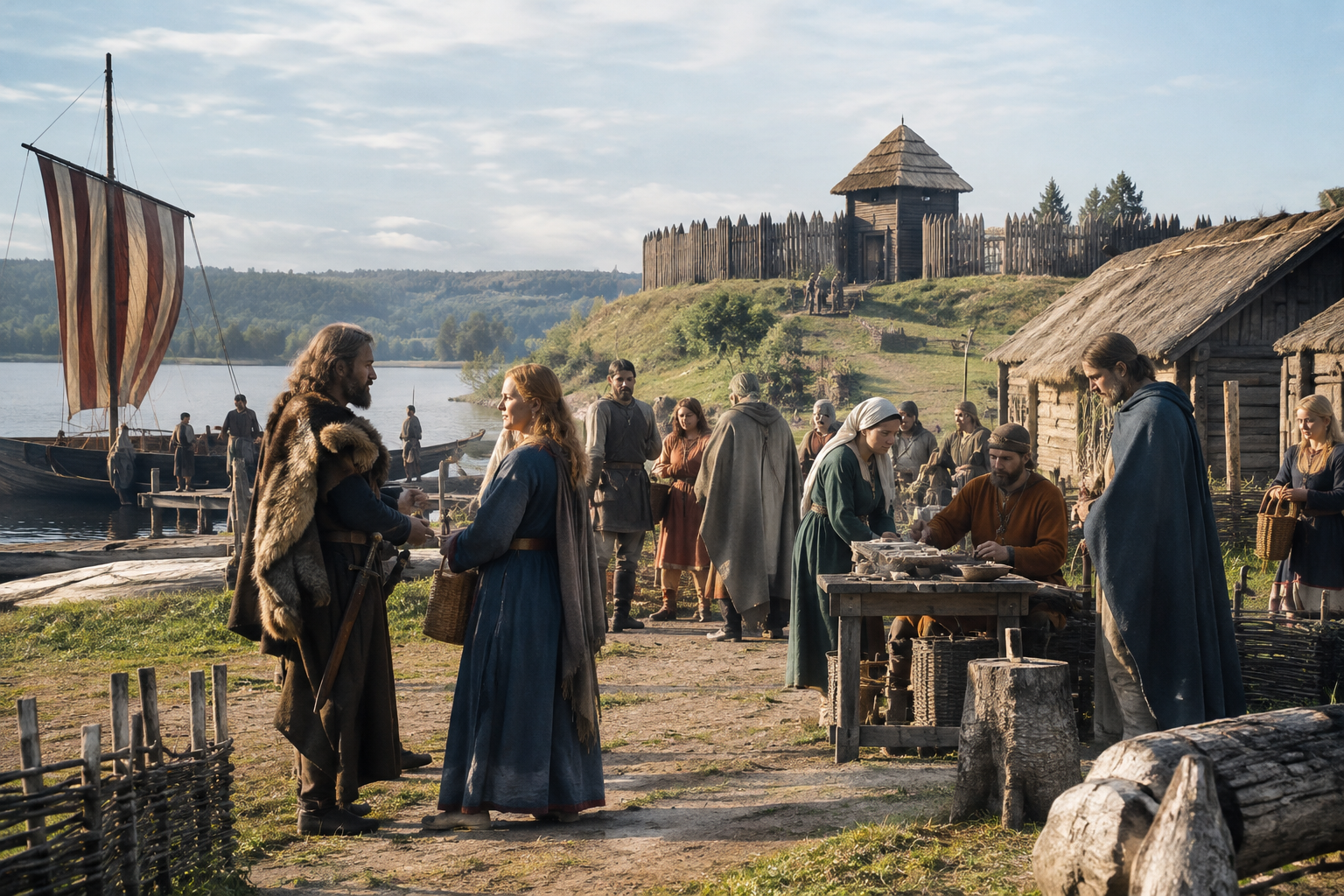
Some Y-chromosome lineages announce themselves with a neat national label. Haplogroup I1a1b1a does not. What makes it interesting is precisely that it refuses to sit still. In the ancient DNA record supplied here, it appears in places that pull us from Iron Age Prague to post-Roman Pannonia, from Merovingian Bavaria to Viking and medieval Scandinavia, and onward into Britain, Poland, Germany, Denmark, and even the Baltic-Rus world. This is not the story of a single people marching in lockstep. It is the story of a paternal line turning up again and again in the busy northern half of Europe.
That is worth pausing over. A Y-DNA haplogroup traces one direct paternal line only: father to father to father across the centuries. It does not represent a person's whole ancestry, culture, language, or identity. But in archaeology, that narrowness is also its strength. It lets us watch one thread of male-line descent appear in graves, settlements, ship burials, towns, and frontier zones. For a subclade such as I1a1b1a, the safest approach is to place it within the wider history of haplogroup I1, often associated in broad terms with northern Europe, while being careful not to project every feature of the larger branch onto this more specific lineage.
The sample spread suggests that I1a1b1a belonged to a paternal world shaped by mobility across the North European plain, the Baltic, and the North Sea. There is an early and striking appearance in Neolithic Sweden Albacksbacken Maglarp Year:1800 BC ID:CGG105926. One sample never proves a whole population history, but it reminds us that lineages later common in historical northern Europe can have deep roots in Scandinavia or nearby regions long before the Viking Age made that world famous.
After that, the trail becomes much clearer in the Iron Age and early medieval periods. We find Danii Tribe Denmark Northwest Sjaelland Asnaes Year:175 AD ID:CGG107443, Iron Age Pommerania Gdansk Wielbark Year:200 AD ID:PCA0480, and Iron Age Czech Prague Year:100 BC ID:2338b. These are not all one culture and not one kingdom. Rather, they sit across the corridor linking southern Scandinavia, the Baltic coast, and central Europe. That matters because this is exactly the sort of landscape where trade, warfare, marriage, and migration repeatedly shuffled male lines across political boundaries.
By late antiquity and the early Middle Ages, the map becomes even more revealing. We meet this lineage in the churn of the post-Roman world: Post Roman Empire Pannonia Hungary Balatonszemes Year:475 AD ID:Bal_111, Bal_111m, and Bal_111x; Longobard Period Pannonia Savaria Szeleste Barbaricum Hungary Year:525 AD ID:SZL026; Migration Period Hungary Rakoczifalva Year:650 AD ID:RKF183; and Dark Ages Italy Torino Lavazza Year:550 AD ID:To_Lav_T2US16. This is a world of collapsing Roman administration, incoming and reorganizing military groups, and local communities adapting fast. The same paternal branch appearing here does not prove a single tribal identity, but it does show that this lineage was present in the human networks connecting the Carpathian Basin, the Danube frontier, and northern Italy.
One of the pleasures of ancient DNA is that it restores geography to genetics. These men were not abstract markers on a chart. They lived in real settlements and were buried in landscapes we can still map.
Take Pre-Vendel Age Oland Sandby Borg Sweden Year:475 AD ID:snb012. Sandby Borg is famous as a fortified ringfort on Oland, a place bound up with violence and upheaval. Then there are the dramatic Vendel Age Saaremaa finds: Salme II-III Year:725 AD ID:VK495, Salme II-J Year:725 AD ID:VK549, Salme II XXVIII Year:725 AD ID:VK511, and Salme I Year:725 AD ID:VK507. These burials, associated with armed seaborne groups in the eastern Baltic, fit a period before the classic Viking Age but already full of maritime ambition. They show the northern world in motion, and I1a1b1a appears right there among it.
Then the Viking Age itself brings a small constellation of samples: Viking Age Denmark Trekroner-Grydehoj Year:793 AD ID:CGG106841, Early Viking Age Hundstrup Sealand Denmark Year:680 AD ID:VK296, Viking Age Rantzausminde Grav Funen Denmark Year:875 AD ID:VK315, Viking Age Fjalkinge Sweden Year:975 AD ID:fjk534, Viking Age Sweden Uppland Alsike Year:975 AD ID:als007, Viking Age Skara Varnhem Sweden Year:1050 AD ID:VK404, and VK407. Add Viking Age Gnezdovo Russia Year:950 AD ID:VK223, and suddenly the lineage stretches from Denmark and Sweden deep into the trade and warrior routes leading east toward the river systems of Rus.
That eastern appearance is especially suggestive. It does not make I1a1b1a a "Viking haplogroup" in any simple ethnic sense, but it shows the lineage moving within the same broad maritime and commercial sphere that linked Scandinavia to the Baltic and beyond.
There is also continuity after the Viking Age. In urban and medieval settings we find Medieval Sigtuna Sweden Year:1100 AD ID:mbs072, Piast Dynasty Lubusz-Greater Poland Border Santok Lad Year:1100 AD ID:PCA0389, and Medieval Jutland Denmark Vor Frue Kirkegard Aalborg Year:1400 AD ID:CGG100498. Even Stora Kronan Shipwreck Battle of Oland Sweden Year:1676 AD ID:kro016 shows that this paternal line remained part of Scandinavian populations into the early modern era. Not every branch stayed local, and not every carrier shared the same identity, but the pattern is hard to miss: this is a northern European lineage with a long historical footprint.
The British samples are modest but important. Kingdom of Mercia England Wolverton Buckinghamshire Year:635 AD ID:I16509 and Kingdom of Dumnonia Britain Cornwall Widemouth Bay Year:700 AD ID:I16383 place the lineage in early medieval England and the southwest during a period when Britain was anything but isolated. The North Sea was not a barrier. It was a road. Men, goods, mercenaries, brides, and ideas passed constantly between Britain and the continent, and later between Britain and Scandinavia.
The continental material supports that same impression. Merovingian Period Bavaria Altheim Germany Year:600 AD ID:Alh_236 and Alh_141, Carolingian Drantum Lower Saxony Germany Year:750 AD ID:DRU011, and Saxon Lower Saxony Germany Dunum Year:840 AD ID:DUN005 put I1a1b1a into the Frankish and Saxon worlds as well. If one wanted a neat ethnic label, the evidence resists it. Better to say that this haplogroup turns up repeatedly in regions that were central to Germanic-speaking, Baltic-facing, and North Sea-connected populations across the first millennium AD.
This is where the story becomes especially atmospheric. The supplied noble association is Clan Mowat, linked to Freswick Castle on the far north coast of Caithness. And what a setting it is: not a cosy inland manor, but a windswept coastal seat in a region tied for centuries to the sea lanes of the North Atlantic.
Freswick Castle itself seems to have developed from an earlier stronghold into a later medieval tower house, eventually associated with the Sinclair family, major northern lords. By the modern period it had fallen into ruin, leaving only a fragment of what was once a more complex residence. But the site matters for more than masonry. Nearby excavations at Freswick Links have uncovered a notable Norse settlement with houses, trade goods, and evidence for a community connected far beyond Caithness.
That is precisely the sort of place where a lineage like I1a1b1a makes historical sense as context. Not because a ruin can prove a haplogroup, and not because a clan tradition guarantees a specific Y-line for every branch of a family. It cannot and does not. But Freswick sits within a region deeply shaped by Norse settlement, Scottish lordship, and long contact across the northern seas. In other words, it belongs to the same wider historical zone in which this haplogroup repeatedly appears in the ancient DNA record.
The Mowat connection should therefore be read carefully: as a historically evocative regional association, not as proof that every Mowat male carried I1a1b1a. Still, for readers interested in how paternal lineages, clan history, and coastal strongholds sometimes intersect, Freswick is an irresistible case. A ruined tower above a Norse-linked shore tells us something written pedigrees often do not: medieval families inherited landscapes already crowded with older histories.
So what does haplogroup I1a1b1a reveal? Above all, it shows how one paternal lineage can move through many different historical settings without belonging exclusively to any single one of them. In the evidence here, it appears in Neolithic Sweden, Iron Age central and northern Europe, the post-Roman Danube world, Merovingian and Saxon territories, Viking Age Scandinavia and the Baltic, medieval Poland and Denmark, and early medieval Britain.
That long arc is a useful reminder that ancient DNA works best when paired with archaeology and history. Genetics can show that paternal lines persisted, spread, or reappeared across centuries. Archaeology tells us whether those men lived in forts, farming communities, ports, churchyards, or ship-linked warrior groups. Written history adds kings, clans, and castles. Put together, they do not produce a fairy tale of direct descent from every ancient man who shares a haplogroup. What they do produce is something better: a grounded sense of where your deep paternal line may have been part of the human story.
If your own Y-DNA belongs to I1a1b1a, MyTrueAncestry offers a chance to explore those connections for yourself, from Scandinavian burials to North Sea worlds and medieval frontiers. Ancient DNA matches do not prove that you descend from a particular noble family or from any one excavated individual. But they can place your paternal line in the company of real people from the past, and that is often far more interesting.






Comments