Haplogroup E1b1b1b2a1a

– 6 min read


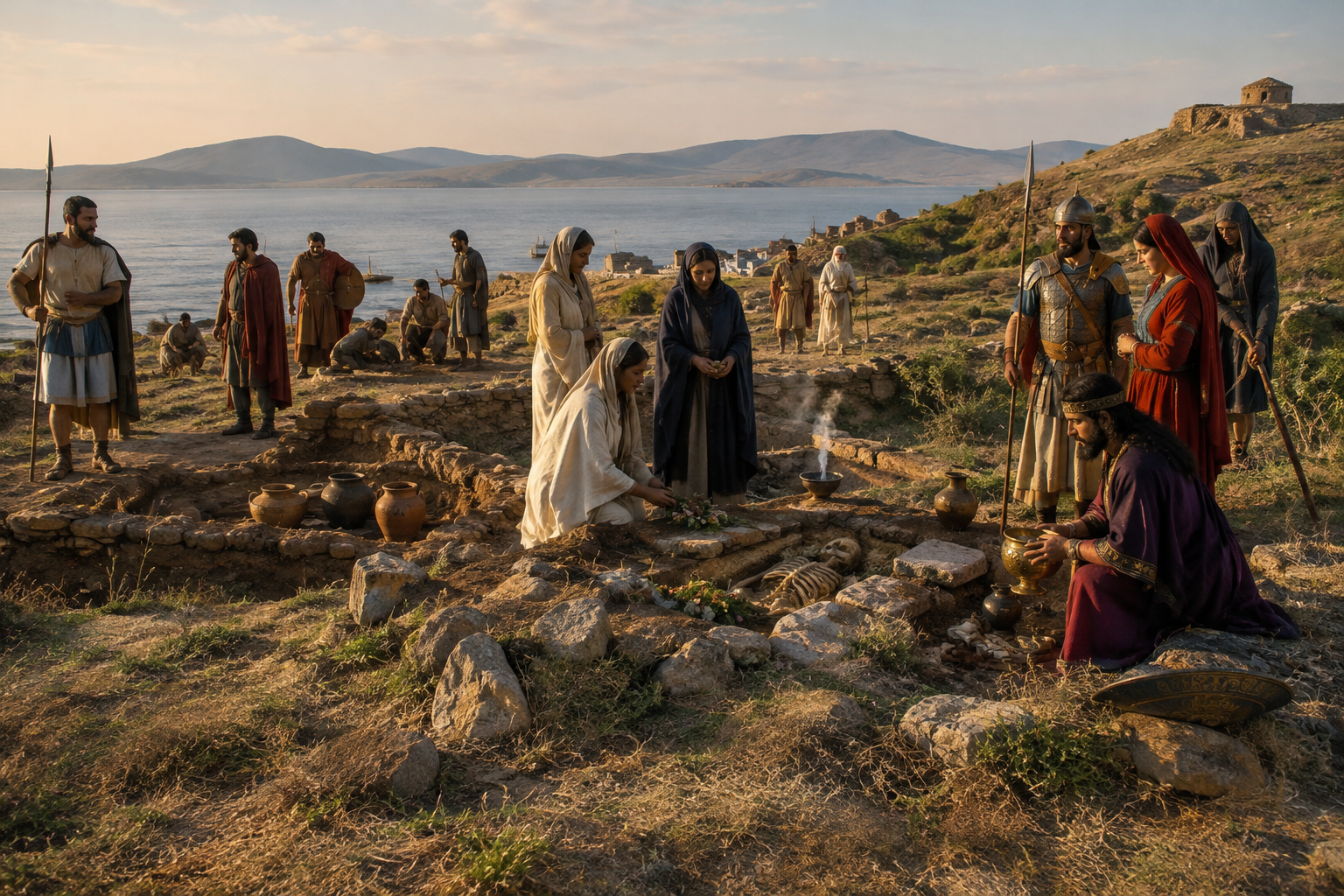
Some Y-chromosome lineages seem to sit still in the historical imagination. Others keep turning up in places that make us rethink the map. Haplogroup E1b1b1b2a1a belongs to the second category. It is a paternal line nested within the wider E1b1b family, a major branch of the Y-chromosome tree with deep importance in the history of Africa, the Mediterranean, and western Asia. But this particular subclade is interesting not because it can be tied neatly to one people or one kingdom. Quite the opposite. Its ancient appearances suggest movement, survival, and reappearance across a remarkably wide arc of the ancient world.
That is worth saying carefully. Y-DNA tracks one direct paternal line only: father to father to father. It does not represent a person's whole ancestry, culture, language, or identity. Still, when ancient DNA places a paternal lineage in excavated graves from Syria, Canaan, Armenia, Roman Serbia, Sicily, Sardinia, and beyond, it gives us something wonderfully concrete: not a myth of origins, but a set of real men buried in real landscapes, each leaving a clue about how male lineages moved through history.
For a subclade as specific as E1b1b1b2a1a, caution is essential. We should not simply lift the entire history of broad E1b1b and paste it onto this narrower branch. What the sample list does allow us to say is that this lineage, or very close related branches, was present early in the eastern Mediterranean and adjacent Near Eastern world.
One of the oldest supplied anchors is ETM010, from Middle Bronze Age Ebla, Tell Mardikh, Syria, dated to 2600 BC. Ebla was no obscure village. It was one of the great urban centers of ancient Syria, plugged into long-distance exchange and diplomacy. A paternal lineage found there belonged to a world of palace archives, trade caravans, and political experiment.
Then there are the elite burials from Late Bronze Age Canaanite Megiddo: I10769 and I10770, both dated to 1500 BC. Megiddo, perched over the Jezreel Valley, controlled routes between Egypt, the Levant, and inland Asia. If you were looking for a place where lineages could gather, mix, endure, and move on, Megiddo is exactly the sort of place you would expect.
Together with I4614 from Early Bronze Age Southeast Anatolia, Tatika, dated to 2100 BC, these finds point toward an eastern Mediterranean and Near Eastern setting in which this paternal branch was already established in antiquity. That does not prove a single homeland in the modern nationalist sense. But it does place the story in a corridor running through Syria, the Levant, and Anatolia, long before Rome, Byzantium, or medieval lordship appeared on the scene.
Explore South Caucasus DNA History
If Syria and Canaan show early presence, Armenia shows persistence. Several supplied samples come from the Armenian highlands and nearby regions: RISE423 from Late Bronze Age Armenia, Nerkin-Getashen, Gegharkunik Province, Martuni, dated to 1309 BC; I15732 from Pre-Urartian Late Bronze Age Armenia, Nerkin-Getashen, Gegharkunuk, dated to 1368 BC; and R11675 from Bronze Age Armenia, Beniamin, dated to 1420 BC.
This is striking. We are not looking at a single stray individual but at repeated appearances in the South Caucasus across centuries. Add I20444 from Parthian Empire Armenia, Sarukhan, dated to 75 BC, and the picture becomes richer still. The paternal line was not confined to one brief prehistoric episode. It was present in a region that saw the rise and fall of local polities, the shadow of Assyria, the formation of Urartu nearby, Persian imperial power, and later Hellenistic and Parthian entanglements.
The sample NEV030 from Aramaean Anatolia, Nevali Cori, dated to 615 BC, adds another useful reminder. Ancient western Asia was not made up of sealed ethnic boxes. Aramaean, Anatolian, Levantine, and Caucasian zones were connected by war, trade, migration, deportation, and marriage. A Y-lineage could persist locally in one valley, appear in an elite burial in another, and later turn up hundreds of miles away without needing a heroic migration tale attached to it.
That, in a way, is the historian's joy here. The evidence does not flatter simple origin stories. It gives us something better: a messier, more human past.
Follow the DNA Route from Anatolia to Rome
The Mediterranean, of course, is not a barrier in this story. It is the road. Two especially evocative samples are I21968 from Hellenic-Carthaginian Sicily, Italy, Marsala, dated to 550 BC, and I24556 from Carthaginian Italy, Sicily, Birgi, dated to 542 BC. Here the paternal line appears in a classic contact zone where Phoenician-Punic, Greek, and indigenous Sicilian worlds overlapped, fought, traded, and borrowed from one another.
This matters because Sicily was one of antiquity's great human junctions. A lineage present in Punic Sicily need not be labeled narrowly "Phoenician" or "Carthaginian" in some exclusive sense. What it certainly shows is that this paternal heritage had become part of the western Mediterranean by the first millennium BC.
Then we reach the Roman frontier and the great imperial shuffle of people. At Viminacium in Serbia, two Late Roman burials carry the line: I15502 from the Pirivoj Necropolis, dated to 225 AD, and I15526 from the Vise Grobalja Necropolis, dated to 200 AD. Viminacium was a legionary center and provincial capital on the Danube, precisely the sort of place where soldiers, merchants, settlers, administrators, and their families from many regions of the empire came together.
And the story does not stop when Rome weakens. MFC017, from the Post Roman Period Pannonia, Arrabona, Menfocsanak Barbaricum, Hungary, dated to 550 AD, suggests that paternal lines seen in imperial settings could remain in the Carpathian Basin into the post-Roman centuries. That is not proof of uninterrupted father-to-son continuity from one named individual to another. But it is good evidence that the lineage belonged to the population mix of the late antique and early medieval Danubian world.
Read About Post-Roman Hungary DNA
Other supplied samples show just how far such paternal branches could travel, or how widely related branches could be distributed. I12221 from Medieval La Palma, Sardinia, dated to 941 AD, places the lineage in an island long shaped by Roman, Byzantine, and Mediterranean traffic. Sardinia often preserves old genetic layers rather well, but it was never isolated from the sea around it.
At the more unexpected end of the list sits I3346, identified as Skeleton Lake Sindhi Worshipper, dated to 830 AD. Even allowing for all the caution such a label requires, it is a reminder that the historical reach of some paternal branches extends far beyond the tidy regional narratives we prefer to tell. Likewise ALN008 from the Iron Age Alai Nura Burial, dated to 300 AD, hints at links or distributions stretching into Inner Asia. These are not reasons to overstate one unified migration from the Levant to Central Asia or India. They are reasons to remember that ancient and medieval Eurasia was linked by many routes, not just one.
If there is a lesson here, it is that E1b1b1b2a1a seems to belong to worlds of connection: urban Bronze Age polities, maritime exchange, imperial armies, and post-imperial frontier societies.
The supplied field for associated noble families and castles is empty, and that absence is important in itself. It means we should resist the temptation to bolt this haplogroup onto some alluring medieval pedigree. No castle can certify a chromosome. No coat of arms can prove a paternal subclade. And no reader should be told that sharing a broad Y-line with an ancient burial or later dynasty makes him a descendant of that house.
Still, the historical bridge between ancient DNA and later noble society remains a fascinating one. The same regions that produce these ancient samples, Armenia, Sicily, Serbia, Hungary, Sardinia, are landscapes where medieval lordship, fortification, and dynastic politics later flourished. Ancient DNA gives us a much older layer beneath those castles and chronicles: the people already living, arriving, mixing, and leaving descendants long before heraldry and written genealogies took over the record.
That is why noble history and archaeogenetics complement each other so well when handled properly. Written genealogy usually starts late and favors elites. Ancient DNA starts earlier and often catches everyone else: soldiers on frontiers, men in provincial cemeteries, high-status burials in Bronze Age citadels, and island communities whose names never made it into royal chronicles.
Discover Medieval Sicily's Genetic Diversity
So what does haplogroup E1b1b1b2a1a reveal? Not a single tribe, not a simple ethnicity, and certainly not a guaranteed noble pedigree. What it reveals is a paternal history with deep roots in the Near East and eastern Mediterranean, repeated appearances in the South Caucasus, a clear foothold in Punic and Hellenic Sicily, and a presence in the mobile, mixed populations of the Roman and post-Roman Danube.
That makes it historically interesting in exactly the right way. It reminds us that paternal lineages can survive conquests, language shifts, imperial collapses, and religious change. It also reminds us that ancient DNA does not flatten history into bloodlines. Rather, it complicates history, and in doing so makes it more believable.
For MyTrueAncestry users, that is the real excitement. A haplogroup like E1b1b1b2a1a does not hand you a ready-made identity. It opens a set of historical questions. Was your direct paternal line part of the old eastern Mediterranean world? Did related branches move with merchants and mariners? Did they appear in Roman military corridors or endure in the Caucasus over many centuries? Ancient DNA cannot always answer those questions in a genealogically exact way, but it can show the sort of world your paternal line once inhabited.
If you want to explore whether your own DNA shows connections to ancient individuals such as ETM010 from Ebla, the Megiddo elite burials I10769 and I10770, the Armenian samples RISE423 and I15732, or the Roman-era men of Viminacium like I15502 and I15526, MyTrueAncestry can help place your results in that wider historical setting. Those matches do not prove direct descent from any one ancient person or membership in a later noble family, but they can offer a vivid new perspective on your deep ancestry.






Comments