Haplogroup E1b1b1b1a1

– 6 min read


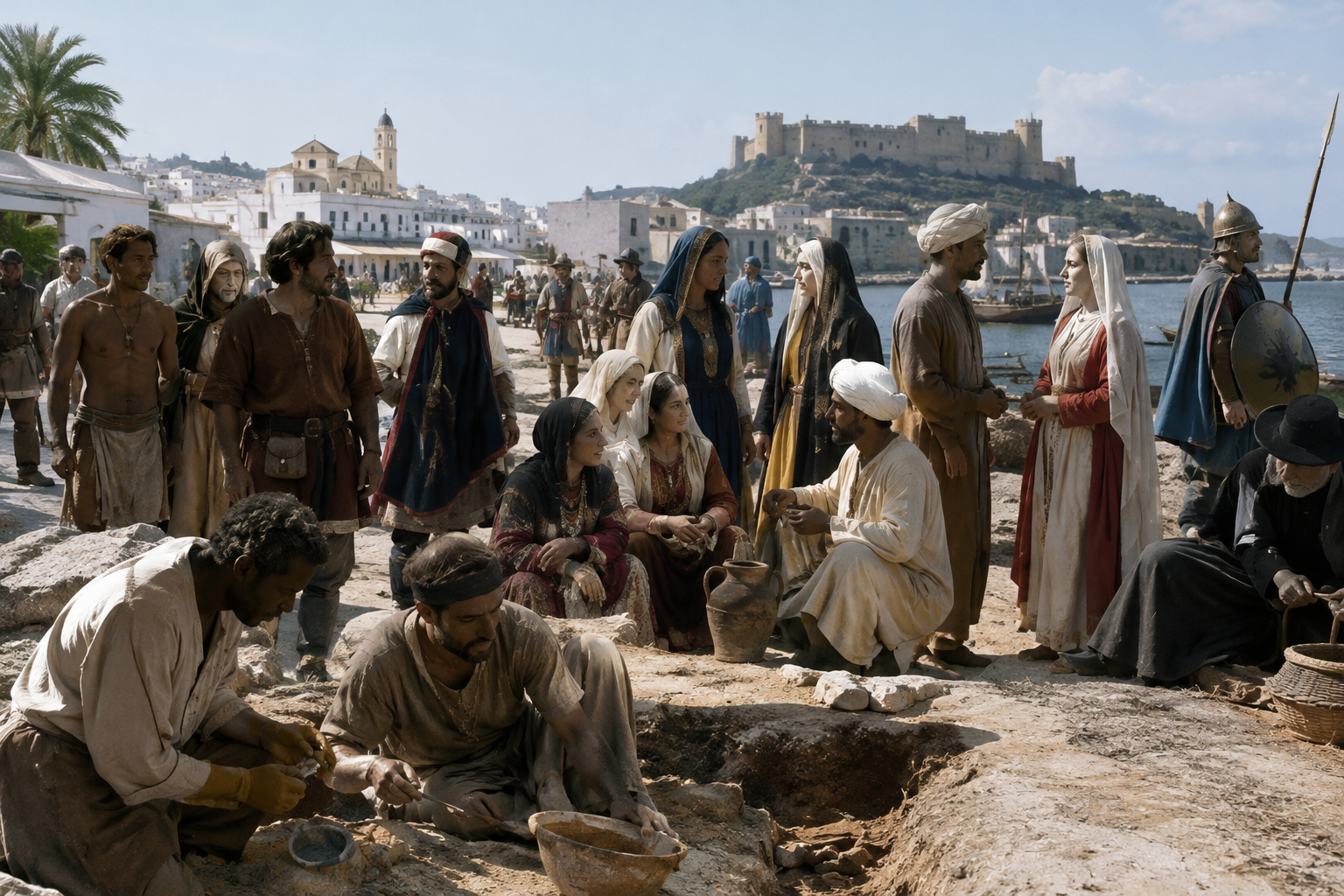
Some Y-chromosome lineages are famous because they dominate modern maps. Others are historically interesting for a different reason: they keep turning up in places where worlds met. Haplogroup E1b1b1b1a1 belongs to that second category. In the ancient DNA record supplied here, it appears not in a single tidy homeland story, but across Sicily, Islamic Iberia, the Canary Islands, Portugal, North Africa, and even frontier Germany. That distribution does not make it mysterious so much as unmistakably historical. It looks like a lineage carried through ports, garrisons, islands, conquests, trade routes, and communities formed between Africa and Europe.
As always with Y-DNA, we are talking about one very particular line of descent: father to father to father. It is powerful evidence for paternal ancestry, but it is not a person's whole ancestry, nor a shortcut to ethnicity, language, or identity. And with a lineage this specific, caution matters. The deeper history of broader E1b1b branches is better known than the story of this exact downstream subclade, so the responsible approach is to use the ancient samples as anchor points and place them within wider, well-established patterns of Mediterranean and North African movement.
Within the wider Y-chromosome tree, E1b1b is one of the major paternal lineages long associated with parts of North Africa, the Mediterranean, and the Near East. Its many branches have been involved in different population histories, so one should not simply pour the entire prehistory of E1b1b into the narrower cup of E1b1b1b1a1. Still, the branch's appearance in the material here strongly suggests a story bound up with the long contact zone between North Africa and southern Europe.
That contact zone was never a hard border. Roman imperial rule, Phoenician and Punic networks before it, and later Islamic expansion and medieval commerce all moved men, families, captives, soldiers, scholars, and laborers across the sea. When a paternal lineage appears in Algeria, Sicily, Ibiza, Valencia, Portugal, and the Canary Islands, the sensible explanation is not a single migration event but repeated episodes of movement and settlement across centuries.
Explore North Africa's Genetic History
The most striking thing about the sample set is how maritime it feels. Sicily alone gives several useful windows. GABN5b, from a Medieval Sicily Palermo La Gancia Islamic Burial dated to 828 AD, sits at the beginning of the Islamic period on the island. Palermo in this era was becoming one of the great cities of the central Mediterranean. A lineage like this in such a setting fits a world of military movement, migration, and new urban communities rather than any simple idea of isolated local descent.
Then there is GABN1b, a Medieval Sicily Palermo La Gancia Burial from 1125 AD, and SGBN3, from a Medieval Sicily Segesta Muslim Grave dated to 1200 AD. Together they remind us that Sicily under Muslim and then Norman rule did not abruptly replace one population with another. It remained socially mixed and regionally connected. Paternal lines could persist through political change even while religion, language, and government shifted overhead.
The Iberian evidence is just as revealing. Three individuals from Medieval Ibiza Al-Andalus, ldo118, ldo130, and ldo140, all dated to 950 AD, place this lineage in a Balearic island society tied to al-Andalus and the wider western Mediterranean. Add to them MS060 from Medieval Islamic Spain, Valencian Community, Segorbe, dated to 1150 AD, plus I12644 and I12649 from the Taifa of Valencia around 1200 AD, and a pattern emerges: this was not a one-off arrival but part of the male-line diversity present in Islamic and post-Roman Iberian settings.
I7500, described as Carthago-Iberian-Mehrebi, Cordoba Caliphate, 950 AD, is especially suggestive because even its label points to mixed historical worlds: Iberian, Maghrebi, and caliphal. It captures the point rather neatly. Haplogroups do not belong to civilizations; people do. And medieval Cordoba was precisely the sort of place where paternal lines from several shores of the Mediterranean could meet.
Discover Medieval Islamic Ibiza DNA
Two samples from the Canary Islands are among the most historically evocative in the list. gun011X, from Guanche Tenerife, Canary Islands, dated to 800 AD, and CAN.023, from Late Guanche Gran Canaria Lomo Galeon, dated to 1250 AD, place this paternal line among the Indigenous populations of the islands before or around the period of European conquest. That matters because the Guanche populations are often discussed in relation to North African origins. These samples help anchor that discussion in specific paternal evidence without pretending that one haplogroup alone explains Guanche identity.
Put beside the Roman-era North African sample R10770 from Necropolis Orientale, Sitifis, Algeria, dated to 210 AD, the picture becomes sharper. Here we have the same general paternal branch represented in both mainland North Africa and the island populations off the Atlantic coast. That does not prove a direct line from one burial to another, of course, but it does support the broader historical view that some paternal ancestries found in the Canaries were part of a North African world.
The western edge of Iberia adds yet another chapter. LP117_10, from Medieval Kingdom of Portugal, Santarem Rua dos Barcos, dated to 1300 AD, and LP116_10, from Kingdom of Portugal, Aveiro Travanca, dated to 1750 AD, show that such lineages remained present into later Portuguese history. In a peninsula shaped by Roman rule, Islamic polities, Christian kingdoms, enslavement, trade, and maritime expansion, that continuity is not surprising. But it is still useful to see it in actual dated individuals rather than in vague historical generalities.
Read the Genetic History of Portugal
Not every sample here belongs to the warm-water Mediterranean. STRAZ_I_37, from the Late Roman Frontier at Straubing Azlburg, Germany, dated to 400 AD, is a useful reminder that the Roman world moved people far beyond their ancestral landscapes. A paternal lineage more at home in Mediterranean and North African contexts appearing on the German frontier is exactly the sort of thing the empire made possible, through soldiers, camp followers, merchants, and imperial administration.
Later still, ELW036, a Post Medieval Plague Victim from Ellwangen, Germany, dated to 1550 AD, shows the same branch in central Europe in the early modern period. Again, one should resist over-reading a single sample. But together with the Roman frontier evidence, it shows that this paternal line was not confined to one cultural sphere. It could surface in very different social settings, from Islamic burial grounds to plague pits.
Another telling sample is I3807, from Post-Reconquista Granada, dated to 1550 AD. If any city embodies the layered history of this haplogroup's sample set, it is Granada: Islamic kingdom, conquered Christian city, and a place where ancestry did not obediently rearrange itself to match new rulers. Paternal lines often outlast dynasties, and ancient DNA is particularly good at catching that fact.
The supplied noble context takes us far from Palermo and Granada to Angus in Scotland, where Redhouse Castle is associated here with Clan Laing. The building began as a late medieval tower house, probably built in the 1500s by the Scrymgeour family, then passed through several owners as political fortunes shifted. It was altered and enlarged over time, but by the 1700s it had ceased to be a major residence and gradually fell into ruin. Today it survives as a roofless shell near the coast.
That may seem a world away from E1b1b1b1a1, but in fact it is a good lesson in how genetics and history should be combined. Castles preserve memory unevenly. They remember owners, alliances, and feuds better than they remember the deep paternal diversity of the people who moved through them. A clan association in a modern DNA context can be intriguing, but it is not proof that every historical Laing, Scrymgeour, retainer, or tenant shared one Y-chromosome line. Nor does a shared haplogroup between living testers and medieval or ancient individuals prove a direct documented descent.
What Redhouse Castle does offer is a fitting historical backdrop: a reminder that lineages continue while political structures decay. Tower houses become ruins. Families rise, fragment, and sell. Yet paternal lines may persist quietly through all of that, sometimes resurfacing not in charters or heraldry but in a laboratory result.
If there is a lesson in E1b1b1b1a1, it is that paternal ancestry can illuminate historical geography in wonderfully concrete ways. This branch appears in Roman Algeria, in Guanche burials of the Canary Islands, in Islamic and later medieval Sicily, across al-Andalus and Valencia, in Portugal, and at moments even in Germany. That is not evidence for one heroic founding ancestor roaming half the map. It is evidence for centuries of movement across connected worlds.
It also shows why ancient DNA matters. Written genealogy usually begins late and favors elites. Ancient DNA restores ordinary men as historical actors: someone buried in Palermo in 828 AD, someone in Segorbe in 1150 AD, someone in Granada in 1550 AD, someone on Tenerife in 800 AD. They are not merely data points. They are the people who make broad historical processes real.
If you want to explore how your own paternal ancestry may connect with ancient populations like these, MyTrueAncestry can help you compare your DNA with archaeological samples from across the ancient world. Those matches can open remarkable historical perspectives, even when they do not prove direct descent from a particular ancient individual or noble house.






Comments