Haplogroup E1b1b1a1b2a

– 6 min read


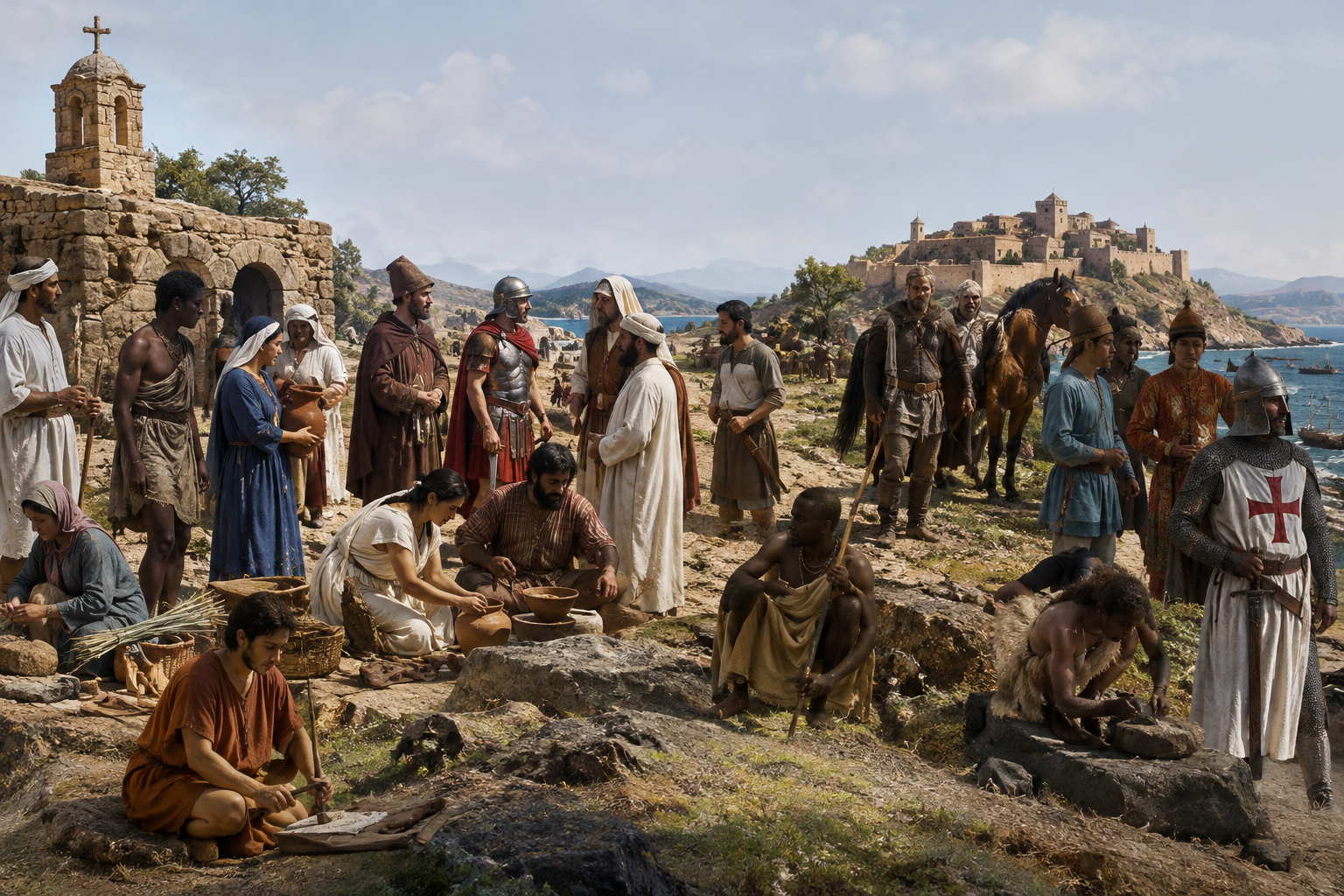
Some Y-chromosome lineages seem to sit neatly inside one historical box. E1b1b1a1b2a does not. It appears instead in a world of ports, garrisons, courts, monasteries, burial grounds, and long-distance movement stretching from the Nile and the Levant to the western Mediterranean, the Balkans, Britain, and even far beyond. That makes it historically interesting at once: not because one narrow story explains it, but because it keeps turning up where people, goods, and empires met.
As always with Y-DNA, a caution is essential. A haplogroup tracks one direct paternal line only: father to father to father. It does not describe a person's whole ancestry, identity, language, or culture. And with a specific branch like E1b1b1a1b2a, we need to be especially careful not to dump the entire history of broader E1b1b or E-M35 straight onto a much narrower twig of the tree. Still, ancient DNA gives us something precious: not myth, not family legend, but real men from real graves, placed in time and landscape.
The wider E1b1b family is one of the great paternal lineages of Africa and the Mediterranean world, with major importance in northeast Africa, North Africa, and parts of the Near East and southern Europe. Within that broader setting, E1b1b1a1b2a belongs to a branch whose historical appearances in the supplied ancient DNA point above all to a corridor linking Egypt, the Levant, the Mediterranean coastlands, and later the mobile societies of late antiquity and the Middle Ages.
That matters because the Mediterranean was never a tidy set of sealed civilizations. It was a sea of ferries, grain fleets, pilgrim traffic, mercenaries, tax officials, monks, traders, sailors, captives, and aristocrats. A paternal lineage could persist locally in one valley for centuries and also turn up, through migration or admixture, in a distant port city or frontier community. The ancient DNA supplied here fits precisely that messy, human picture.
Explore North Africa's Genetic History
Some of the most suggestive evidence comes from the eastern Mediterranean. Two Phoenician-period individuals from Achzib on the coastal Israel-Acre region, both dated to 650 BC, carry this lineage: I22260 and I22253. Achzib was part of a maritime world tied to Phoenician commerce and colonization. These men do not prove that E1b1b1a1b2a was "the Phoenician haplogroup" - no sensible geneticist would say such a thing - but they do place this paternal line within the Levantine coastal sphere at a time when eastern Mediterranean seafaring linked cities from the Levant to Cyprus, North Africa, Sardinia, and Iberia.
That wider web appears again further west. In Punic contexts we find I22122 from Carthaginian Sardinia, Tharros, dated 472 BC, and I18199 from Carthaginian Spain at Almera, Cuevas del Almazora, Villaricos, dated 276 BC. Here the historical setting is unmistakable: western Mediterranean settlements shaped by Carthaginian expansion, trade, and local mixing. A Y-line found in both Levantine and Punic contexts is exactly the sort of result that reminds us how thoroughly connected the first-millennium-BC Mediterranean had become.
Then there is DEM3245, from Elite Tomb I in the Royal Tombs of Aigai, Macedonia, dated 400 BC. Aigai is one of those places where archaeology and political history collide with full force. The royal burial ground of the Macedonian kingdom is not a casual context. Yet even here caution is needed. Shared haplogroups do not make a man "Macedonian" in some pure biological sense, nor do they tie him genealogically to later dynasties without very specific evidence. What the sample does show is that this paternal branch was present in elite circles in the northern Greek world as well.
Late antiquity and the early medieval centuries widen the map further. In Egypt, C5_2287 from Coptic Period Egypt, Thebes, dated 518 AD, places the lineage squarely in the old heartland of Upper Egypt. In Lebanon, Byzantine-era Chhim gives us R9818 dated 577 AD and R9823 dated 650 AD. In the Alps, 1895_1 from Dark Ages Italy, South Tyrol, Malles Burgusio Santo Stefano, dated 450 AD, shows the line in a region where Roman, post-Roman, and transalpine worlds overlapped.
And then, perhaps most strikingly for readers who imagine ancient paternal lines as immobile things, there is BMN006 from Anglo Saxon Early Medieval England, Norfolk Barnham Market, dated 600 AD. A lineage with eastern Mediterranean and northeast African associations appearing in early medieval England is not a paradox. It is a reminder that the Roman and post-Roman worlds moved people astonishing distances. The same lesson appears in R3664 from Migration Period Sipar, Croatia, dated 740 AD.
The African side of the story remains important too. I6139 from Kulubnarti Early Makurian Nubia, dated 750 AD, and I19132 from Kulubnarti Makurian Nubia, dated 810 AD, show the branch in medieval Nubia, south of Egypt along the Nile. Still deeper African context may be glimpsed in I13980, listed as Neolithic Tanzania Cushitic, dated 600 BC, and I8808 from Kenya Jawuoyo Rockshelter South-East African Hunter Gatherer, dated 250 AD. These samples should not be forced into a simplistic single-route migration tale, but they do underline the wider African background of the lineage's history.
If we laid these samples on a map, the point would not be a triumphant arrow saying "the haplogroup went from A to B to C." Human history is not that obliging. Instead we would see clusters around exactly the places where ancient historians would expect mobility: Nile settlements, Levantine coastlines, Punic colonies, Balkan crossroads, Alpine corridors, and imperial provinces.
One outlier in the list, BUR002 from the Late Xiongnu Empire in Mongolia, dated 100 AD, is particularly intriguing because it lies far outside the main Mediterranean-Afroasiatic zone suggested by the other samples. That is not evidence for a neat grand migration from Egypt to Mongolia or the reverse. More likely it reminds us that steppe empires, war, enslavement, trade, and long-range exchange could move individuals and lineages in unexpected ways. The ancient world was full of such surprises.
The same can be said of SI-38, the Crusader Knight Georgian / Lebanon, dated 1250 AD. In crusader-period Lebanon, identities were layered and complicated: western Europeans, local Christians, Armenians, Syrians, Arabs, and Caucasian connections all crowded the same political and military stage. A paternal lineage found there tells us less about a single ethnic label than about the remarkable density of contact in the medieval eastern Mediterranean.
Explore Ancient DNA of the Mongolian Steppe
The supplied noble-and-castle context is not a medieval castle at all, but something older and grander: Ancient Egypt's Valley of the Kings, on the west bank of the Nile near ancient Thebes. It was the principal royal burial ground of Egypt's New Kingdom from about 1539 to 1075 BCE, where pharaohs including Tutankhamun, Seti I, and Ramesses II were laid in rock-cut tombs beneath the cliffs and the peak of al Qurn.
This matters here because one of our key samples, C5_2287, comes from Thebes in 518 AD, many centuries after the great age of the pharaohs. By then the Valley of the Kings had already lived several afterlives. Tombs had been robbed in antiquity; royal mummies had been gathered and reburied for protection; Greek and Roman visitors had scratched graffiti into the site; later explorers and archaeologists turned the valley into one of the most famous landscapes in world archaeology, especially after Howard Carter's discovery of Tutankhamun's tomb in 1922.
So while we must not pretend that a Coptic-period man from Thebes was a direct descendant of New Kingdom pharaohs, he did live in a landscape saturated with royal memory. Thebes is one of those places where genetics and history meet on unequal but fascinating terms. DNA can identify a paternal line in a later inhabitant. Archaeology preserves the monumental setting in which that line persisted. Written history tells us how the same valley was reused, reinterpreted, visited, looted, and rediscovered across millennia.
That is, in its own way, rather moving. A Y-lineage such as E1b1b1a1b2a does not hand us a roll call of kings. What it offers is something subtler: evidence that men carrying related paternal signatures were present in the same broad regions that produced some of the ancient world's most enduring courts, temples, and burial landscapes.
Read More on Ancient Egypt and DNA
E1b1b1a1b2a is historically revealing because it refuses to stay in one compartment. The ancient samples provided here place it in Levantine coastal settlements, Punic western colonies, Macedonia, Coptic Egypt, Byzantine Lebanon, Nubia, Alpine Italy, Anglo-Saxon England, crusader-period Lebanon, and later even colonial Maryland in the sample I15315 from Historic St. Mary City Chapel Field Cemetery, dated 1667 AD. That final appearance is a useful reminder that early modern Atlantic worlds inherited lineages from much older Mediterranean and African histories.
None of this proves direct descent from any famous tomb occupant, noble lineage, or ruling house. It does something more historically honest. It shows how one paternal branch can be tracked through the real churn of human history: settlement and continuity in some places, mobility and mixture in others, survival across changing empires almost everywhere.
For MyTrueAncestry users, that is the real excitement. Your Y-DNA haplogroup is not your whole story, but it can open one unusually sharp window into the male line of the past. Sometimes that window looks onto a Phoenician port, sometimes a Nubian cemetery, sometimes a medieval frontier, and sometimes a landscape as famous as Thebes and the Valley of the Kings.
If you want to explore whether your DNA shows similarities to ancient individuals, historical populations, and the deep paternal histories discussed here, MyTrueAncestry can help you place those results in archaeological context. The matches may be illuminating without proving direct descent from any specific ancient person or noble family, and that is precisely what makes them so valuable.






Comments