Haplogroup E1b1b1

– 7 min read


Some Y-chromosome lineages seem to belong to a single neat historical chapter. E1b1b1 does not. It turns up early in the Near East, appears in Neolithic farming contexts, shows itself around the Mediterranean, surfaces in Roman and post-Roman Europe, and is still found in medieval and early modern burials from places as far apart as England, Iberia, Nubia, and coastal Kenya. If you want a paternal lineage that reminds us how connected the old world could be, this is a good place to begin.
That needs one important qualification from the start. A Y-DNA haplogroup traces only one direct paternal line: father to father to father. It does not summarize a person's whole ancestry, culture, language, or identity. Still, when ancient DNA repeatedly places a lineage in strikingly different times and landscapes, it gives us a valuable way of tracking long-term male-line continuity, movement, and mixture. E1b1b1 is historically interesting precisely because it refuses to stay in one box.
E1b1b1 belongs within the broader E haplogroup family, a major branch of the human Y-chromosome tree with deep roots outside northern Europe. In historical and archaeogenetic discussion, E1b1b1 is often associated with lineages that became important in parts of the Near East, North Africa, the Balkans, the Mediterranean, and later many regions touched by mobility across sea and land. Exactly how particular downstream branches spread remains a matter for detailed subclade work, but the broad pattern is clear enough: this is a paternal lineage with a long history in the southern and eastern reaches of the western Eurasian world.
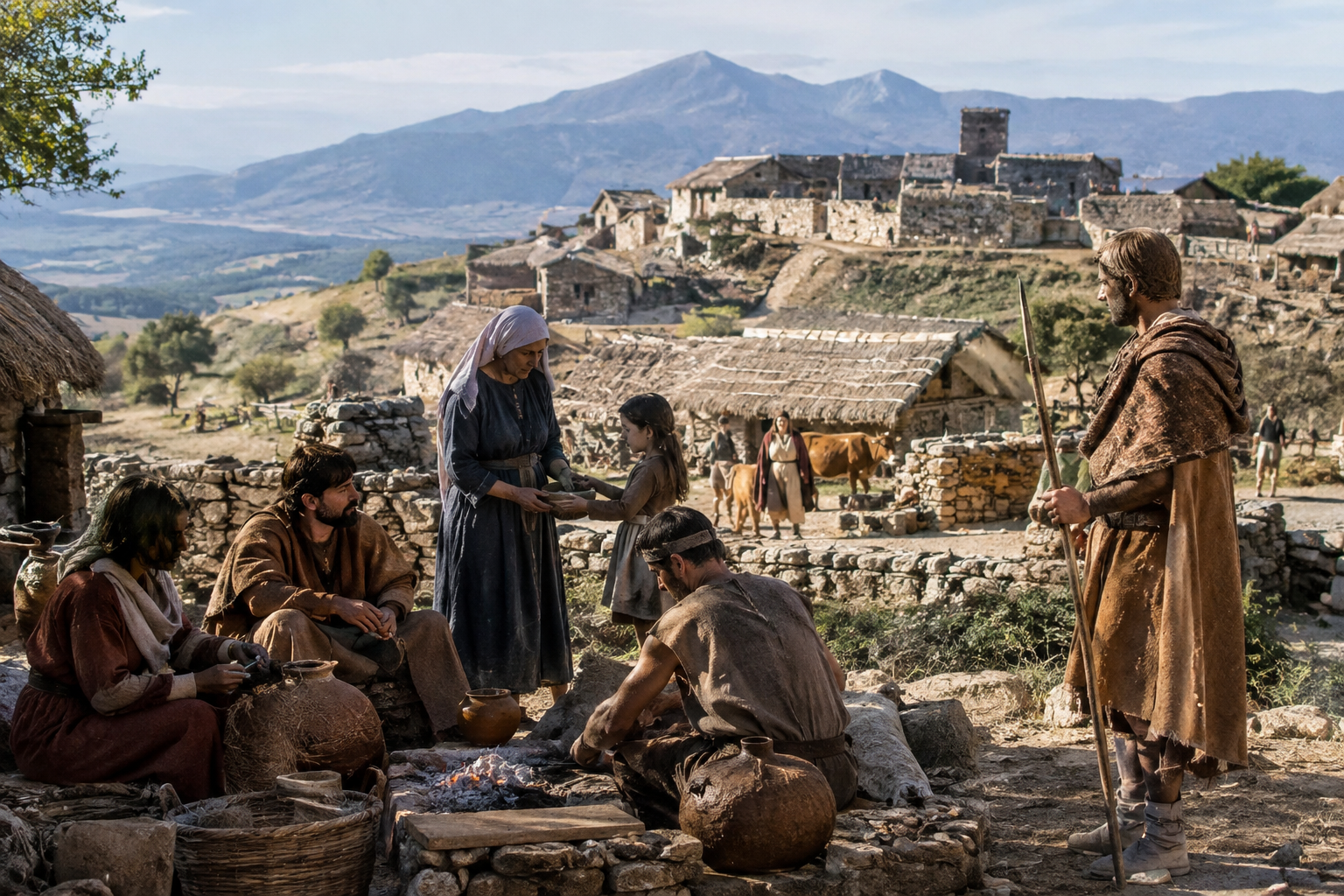
One of the most arresting signs of that early history comes from Neolithic Jordan. At Ain Ghazal and nearby contexts around Amman and Sahab, the samples I1414 (8100 BC), I1415 (7900 BC), and I1710 (7522 BC) place E1b1b1 in one of the great early farming societies of the Levant. Ain Ghazal was not some minor village tucked away from history. It was part of the world that saw the rise of large settled communities, plastered houses, elaborate ritual life, and the social experiments that came with agriculture. In other words, this haplogroup is present not at the edge of the Neolithic story, but close to one of its formative centers.
Another Levantine marker, I1171 from Peqi'in Cave in the Chalcolithic Levant, dated to 3900 BC, suggests that related paternal lines remained part of the region's population landscape long after the first farming transition. That does not mean a single unbroken village pedigree for millennia. It does mean that E1b1b1 fits comfortably into the long male-line history of the Levant and its neighboring worlds.
Readers interested in how farming populations helped reshape ancient Eurasia may enjoy this wider overview:
Explore the Neolithic Expansion
If the Levant gives us E1b1b1 near the beginning of settled life, the later samples show just how far such paternal lines could travel or persist. In the central Mediterranean, I22118 from Hellenic-Carthago Italy Sardinia Tharros, dated to 639 BC, sits in a world of Phoenician and wider Mediterranean exchange. Then I18202 from Punic Spain Almera Cuevas del Almazora Villaricos, dated to 280 BC, places the lineage in Iberia during the Punic period. Neither sample by itself proves a simple migration route. But taken together, they fit a historical landscape in which sailors, merchants, settlers, soldiers, and local communities were constantly interacting across the sea.
Roman evidence adds another layer. I3691, the Roman Pompeii Vesuvius victim from the House of the Golden Bracelet, dated to 79 AD, offers a famous human snapshot from an Italian town abruptly sealed by disaster. E1b1b1 here is a reminder that the Roman world was genetically varied at the household level, not just in frontier garrisons and ports. Farther east, I4664 from Imperial Roman Serbia Lepenski Vir, dated to 225 AD, and I20391 from Imperial Roman Spain Girona Sarria de Ter Pla de lHorta, dated to 350 AD, show the haplogroup in very different corners of imperial territory.
What is so striking about E1b1b1 in these Roman and pre-Roman contexts is not some romantic fantasy of a single dynasty striding across history. It is something more interesting: this paternal lineage appears wherever the Mediterranean's old networks were thickest - Levant, Sardinia, Iberia, Italy, and the Balkans. That is exactly the sort of pattern ancient DNA is good at revealing.
For more on this western Mediterranean setting, this article is an excellent companion read:
The post-Roman samples show that E1b1b1 did not vanish with the empire. In Hungary, GYS014 and GYS039 from Late Antique Pannonia Arrabona Szechenyi Square, both dated to 425 AD, and SZL102 from Post Roman Period Pannonia Savaria Szeleste Barbaricum, dated to 525 AD, place the haplogroup in a region famous for political churn. This was a corridor of soldiers, federates, migrants, local provincials, and newcomers. A paternal lineage like E1b1b1 appearing here fits the complicated human traffic of the Danube basin.
Italy offers another revealing cluster. The Dark Ages Italy South Tyrol Malles Burgusio Santo Stefano samples 2069, 2420_17, and 2429_136, all dated to 450 AD, together with COL_130 from Lombard Collegno Northern Italy, dated to 580 AD, suggest that E1b1b1 was present in communities living through the breakdown of Roman rule and the rise of new early medieval polities. Again, caution matters: a haplogroup is not an ethnicity. But these burials are a useful corrective to any notion that the early medieval West was made up of neatly separated "Roman" and "barbarian" bloodlines.
The same breadth continues east and north. I19490 and I19487 from Thracian Bulgaria, both dated to 800 BC, remind us that Balkan contexts matter for this lineage too. PCA0558 from Medieval Piast Era Poland Silesia Milicz, dated to 1100 AD, shows E1b1b1 well into medieval central Europe. And in England, ATP_PSN_933 from Medieval England Cherry Hinton, dated to 1055 AD, ATP_PSN_703 from Late Medieval England All Saints, dated to 1150 AD, ATP_PSN_438 from Medieval England Cambridge St Johns Hospital, dated to 1200 AD, and ATP_PSN_508 and ATP_PSN_515 from Medieval England Augustinian Friars, both dated to 1290 AD, show the lineage in the British Isles across several medieval settings.
That English cluster is particularly valuable because it reminds us of something often forgotten in popular ancestry talk: medieval England was not genetically uniform, and paternal lines with longer southern or Mediterranean histories could be thoroughly part of later English populations.
Readers interested in how those mixed post-Roman and medieval populations formed may want to continue here:
Discover Roman and Medieval Britain DNA
E1b1b1's story is not only European or Levantine. I19143 from Kulubnarti Makurian Nubia, dated to 825 AD, places the lineage in medieval Nubia. On the East African coast, I0595 from Early Swahili Period Kenya Panga ya Saidi Kilifi, dated to 1543 AD, and I19388 and I19423 from Medieval Coastal Kenya Mtwapa, dated to 1585 AD and 1600 AD, show it in the Swahili world, one of the great commercial societies of the Indian Ocean.
Iberia, meanwhile, gives us a remarkable long view: I3579 from Late-Roman Era Montefrio Granada, dated to 500 AD; MS060 from Medieval Islamic Spain Valencian Community Segorbe, dated to 1150 AD; and I3807 from Post-Reconquista Granada, dated to 1550 AD. Few lineages could ask for a better lesson in historical layering. Roman Iberia, Islamic Iberia, and post-Reconquista Iberia were not biologically sealed off from one another. They were successive political orders inhabited by people whose paternal lines often had deeper and more complicated roots.
If that Iberian and North African dimension interests you, this related article is very much to the point:
Trace Iberian and North African Connections
In this case, the supplied noble family and castle field is empty, which is itself worth saying plainly. That means we should not invent a chivalric pedigree for E1b1b1, attach it to an alluring castle on a hill, or pretend that an ancient Y-line automatically leads to a medieval lordly house. Genetics is most interesting when it is honest about what it can and cannot do.
What we can say is that the medieval regions where E1b1b1 appears - England, Poland, Hungary, Italy, Iberia - were precisely the regions where noble families, monasteries, castles, market towns, and royal administrations were consolidating power. If later noble houses in such places are associated with this haplogroup in other contexts, that would still need to be demonstrated family by family, line by line, and ideally with documented or tested paternal evidence. A broad haplogroup match alone is not proof of descent from any specific dynasty.
That is not a disappointment. It is a better way of doing history. Castles and noble genealogies belong to the written record. Haplogroups belong to the deeper and narrower history of paternal lines. Occasionally they intersect; often they simply illuminate the same landscape from different angles.
So what sort of lineage is E1b1b1? Not a badge of one nation, one tribe, or one "race." It is a paternal branch that appears early in the Levantine Neolithic, remains visible in later Near Eastern contexts, and turns up repeatedly in Mediterranean, Balkan, central European, African, and medieval settings. The samples from Ain Ghazal, Peqi'in Cave, Tharros, Villaricos, Pompeii, Pannonia, Lombard Italy, medieval England, Nubia, and coastal Kenya are not one family album. They are something better: a series of firmly dated glimpses showing where related male lines appear across real historical worlds.
That is the value of archaeogenetics. It does not replace archaeology or written history. It adds another witness. Sometimes that witness confirms what we suspected about migration and mixture. Sometimes it unsettles tidy stories. E1b1b1 does both.
If your own Y-DNA falls within E1b1b1, MyTrueAncestry can help place that paternal line beside ancient individuals from some of the most important chapters in human history, from the first farming communities of Jordan to medieval cemeteries in England and the cosmopolitan ports of the Swahili coast. Those matches do not prove direct descent from a named ancient person or a noble family, but they can offer a vivid and surprisingly personal perspective on the long history of your paternal line.






Comments