Foreign Founders: Genetic Genealogy of the Medieval Piast Dynasty and Its Links to Other European Royal Houses

– 7 min read


The Piast Dynasty: Genetic Origins and Royal Lineages
The article takes readers deep into cathedral crypts and royal chapels across Poland to ask a deceptively simple question: who, in biological terms, were the Piasts? By focusing on the paternal line – the Y chromosome – it uncovers a striking result: most securely identified male Piasts belong to a rare lineage today linked not with Slavic heartlands, but with north‑western Europe.
The investigation began not in a laboratory, but in churches. The team sifted through more than 340 places traditionally connected with the dynasty and found that almost all were empty memorials. Only eight sites across Poland held human remains that might really belong to the Piast family.
The cathedral at Płock emerges in the article as a kind of Polish Saint‑Denis: the main burial ground for the dynasty. In its royal chapel and the crypt below, archaeologists in the 1970s had gathered bones into 18 labelled containers – each bearing the name of a Piast prince or duke. Earlier grave disturbances, smashed coffins and mixed bones meant that none of these labels could be trusted.
When the authors reopened the containers in 2019, they took multiple samples from each set of bones and used radiocarbon dating to anchor them in time. The dates matched the broad period when Płock functioned as a royal burying place in the 12th–14th centuries. They did not, however, always match the name on the container – clear evidence that at some point the dead had been shuffled and re‑shuffled.
Out of this confusion, 17 distinct skeletons with good DNA emerged, representing a run of Piast generations in Płock and, later, Warsaw. The article follows them one by one, assigning them temporary laboratory labels and then matching them back to named individuals in the historical record wherever possible.
In Warsaw's Cathedral of St John the Baptist, the story is more intimate and more secure. Two 16th‑century graves, first opened in the 1950s, belonged to the last Masovian Piasts: brothers Stanisław and Janusz III, who both died in their mid‑twenties. When the team returned to these graves in 2016, the bones were still in place, the burials undisturbed.
Radiocarbon dates, skeletal age estimates and DNA all agree that these two young men are who tradition says they are. Nearby, a stone sarcophagus bearing two names held more bones, partly mixed. One skeleton, on radiocarbon and anthropological grounds, fits Bolesław IV, who died in 1454 aged about 33. No convincing remains of Janusz I were found in the excavation.
Using genome‑wide data, the article reconstructs a chain of kinship between the skeletons and weaves it carefully into the known Piast family tree. Radiocarbon dates, estimated age at death, biological sex, and the pattern of close genetic relationships are placed alongside medieval chronicles and charters to create a comprehensive picture of dynastic succession.
In Płock, one skeleton matches perfectly the expected profile of Duke Konrad I Mazowiecki, who died in 1247: his lifetime, his age at death, and his position in the family network. Another fits Bolesław II of Masovia, who died in 1313, with related skeletons emerging as his son Wacław and grandson Bolesław III. The kinship links echo precisely the documentary genealogy recorded in medieval sources.
The article also highlights a curious case involving a skeleton that is genetically a second‑degree relative of Bolesław II, but whose Y‑chromosome does not match the usual Piast pattern. This dissonance can be explained once maternal ancestry is taken seriously – the genes that make him a "Piast" seem to come through the female line rather than the supposed father in the male line, reminding us that dynastic diagrams and biological reality do not always line up neatly.
The real shock comes when the article turns to the Y chromosome – the part of the genetic code passed from father to son. If a dynasty truly traces its male line from a single founding ancestor, most of its men should share the same Y‑chromosome lineage.
Among the ten individuals that the study identifies as Piasts with high confidence, seven do indeed share the same paternal signature. Their Y chromosomes fall into a branch of a broader Western European male line, often lumped under the label R1b. By combining data from several Piast males, the team can pin this down more finely to a very narrow twig on the genetic family tree, called BY3549.
Today this Y‑chromosome line is rare in Europe, and especially rare in Central and Eastern Europe. Ancient DNA makes the picture even more intriguing. Before and during the rise of the Piast state, the same Y‑line appears only in three men from the far west and north‑west: one from Iron Age France around 650 BC, another from Roman Netherlands in the 2nd century AD, and a third from Viking‑age England in the late 9th to 10th centuries.
None of the more than 150 early medieval male skeletons from the area of modern Poland that the authors had studied previously carried this lineage. It does not look like a typical local line that simply rose to power. Instead, the Piast Y‑chromosome appears to have arrived from outside, probably from the west or north‑west, well before it took root in Masovia and Greater Poland.
This is why the article bluntly states that the Piasts were "non‑local" in biological terms. Their male‑line ancestry, as far as can be traced, ties them more closely to western and north‑western European populations than to the surrounding Slavic groups that dominated the region in earlier centuries.
The narrative does not stop at the genetic label. The article places this rare Y‑line in its political and archaeological context. From the later 10th century onwards, the first named Piast ruler, Mieszko I, and his son Bolesław I Chrobry appear as major players in the politics of the Holy Roman Empire. Written sources show Mieszko I intervening in imperial succession struggles, Bolesław I fighting and negotiating with Emperor Henry II over Lusatia and Meissen, and Mieszko's daughter marrying into the royal houses of Sweden, Denmark and England.
The genetic evidence of a western‑leaning Y‑chromosome line sits very comfortably beside this historical picture of a dynasty at home in the world of the Empire, the Baltic seaways and even the North Sea. It also dovetails with archaeological evidence that the early Piast economy leaned heavily on long‑distance trade, including the trade in enslaved people – a field in which Scandinavians and other northern groups were notorious specialists throughout the medieval period.
The article does not simply declare the Piasts to be Vikings or Franks – those would be anachronistic labels for a small, mobile founding group whose precise origins remain to be worked out. What it does show, through the rare Y‑chromosome line R1b‑BY3549 and its ancient western parallels, is that the men at the core of the dynasty were not drawn from the bulk of the local male population. They were outsiders who, within a few generations, married into local families, anchored themselves in places like Płock and Gniezno, and left their marker in the crypts of cathedrals across Poland.
Several named Piasts emerge in the article as clear bearers of this non‑local Y‑chromosome line. Konrad I of Masovia, the duke who invited the Teutonic Knights into Prussia, carries the distinctive genetic signature. So do Bolesław II of Masovia and his descendants Wacław and Bolesław III, forming a clear patrilineal chain across multiple generations. The last Masovian princes, Stanisław and Janusz III, buried in Warsaw Cathedral, also bear the same rare western lineage, connecting them directly to their ancestors in Płock despite the centuries between them.
Taking these men together, the article can confidently assign the R1b‑BY3549 line to a chain of at least 13 Piast generations, including kings buried in Wawel whom the team did not sample directly, but whose place within the uninterrupted male line is clear from the genealogy. This creates an unprecedented genetic portrait of a medieval European dynasty spanning several centuries of rule.
The article's exploration is not purely technical. It feeds into a broader picture of royal mobility and intermarriage that characterized medieval European politics. One particularly elegant example involves the connection between Polish and Hungarian royal houses through shared maternal lineages that can now be traced in the DNA of excavated remains.
In Székesfehérvár, in modern Hungary, the tomb of King Béla III and his queen Anna of Antioch was opened and analysed in recent years. The article draws on those earlier studies and compares them with its own results. An unidentified Árpád male, buried near Béla III, shares a specific mitochondrial lineage with Konrad I – a pattern best explained if this man is Béla's father, King Géza II, whose mother Helena of Serbia was also the grandmother of Konrad I's mother. The Piast and Árpád lines thus intersect in the bones themselves.
Another thread runs through Silesia and Bohemia. Anna of Bohemia, wife of the Piast ruler Henry II the Pious, was a granddaughter in the female line of Anna of Antioch and Béla III. Her grave in Wrocław was opened, and her mitochondrial DNA matches that of Anna of Antioch exactly. The Piast skeletons, Árpád skeletons and Přemyslid consorts thus form a network that can be read both in chronicles and in sequences of DNA.
Grave goods in these Piast burials are, by medieval standards, often modest – many of the high medieval bones come from disturbed royal burials where metal fittings and ornaments have long since been robbed or reordered. Yet the settings speak loudly enough: stone sarcophagi carved with princely names, royal chapels repurposed as collective ossuaries, and cathedrals whose crypts became crowded with generations of one ruling house. In these spaces, the rare western lineage wrapped itself in Polish political and religious identity.
 Michal Zenczak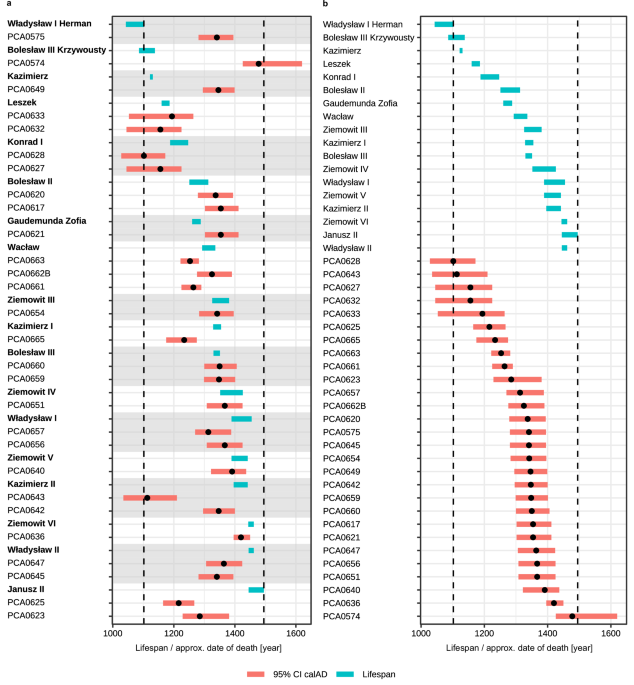
Comments