Ancient DNA reveals Yakut origins and resilience under Russian conquest
– 7 min read


Yakut Origins and Long-Term Continuity in Eastern Siberia
The article opens in the vast, frozen landscapes of Yakutia, where winter can plunge below –60°C and rivers like the Lena, Yana and Indigirka carve through the permafrost. In this setting, archaeologists working with the French–Russian Mission in Eastern Siberia have uncovered a chain of frozen graves that reads like a family saga stretching back 500 years. Ancient DNA pulled from petrous bones, teeth and even lung tissue allows the authors to follow the rise of the Yakut people, from obscure beginnings to their role as key players in the Russian Empire's fur frontier.
Deep beneath the modern city of Yakutsk, one grave stands out: an Iron Age man, known in the study as Mokp, buried around 280 BCE. His genetic signature connects him to earlier Siberian groups, especially the Nganasan and Neolithic-to-Iron Age inhabitants of Yakutia. In other words, he represents a very old, local layer of population in the region long before the Yakuts, as we know them today, took shape.
Mokp's DNA shows ancestral components that later become diluted in the Yakuts. His genome is like a fossil imprint of pre-Yakut Yakutia, allowing the authors to track how much of this older Siberian world survives inside later burials.
From the fifteenth century onward, the graves change. Bodies are wrapped in exquisite furs and cloth, buried with saddles, cauldrons, knives and the carved wooden cups called chorons, used to drink fermented mare's milk. These are the ancestors of today's Yakuts.
When the authors place their genomes on a broad genetic map alongside thousands of modern and ancient people, all Yakuts from about 1500 CE onwards form a tight, homogeneous cluster. They sit near modern Yakuts, Evenks and Buryats, but the pattern is clear: by the time we can see them archaeologically, Yakuts already form a distinctive population that has changed very little down to the present day.
To work out how this population formed, the team tests different ancestry models. Two key ingredients emerge: a local Siberian component similar to the Iron Age man Mokp and to earlier Yakutia groups, and a southern, Trans-Baikal component, related to medieval and late medieval populations around Lake Baikal and Mongolia.
Genetic dating methods suggest that these two groups mixed sometime between about 1100 and 1250 CE. Almost immediately afterwards, around 1210–1400 CE, a small founding community – a few hundred individuals at most – expanded to become the Yakut people. This timing neatly echoes Yakut oral traditions that speak of an origin linked to the movements of peoples during the rise of the Great Mongol Empire.
The graves of this early period include individuals like Atlasovka, a woman buried in the late fifteenth or early sixteenth century. Her DNA places her close to the base of many later kinship ties reconstructed in the study, making her a plausible ancestor for several later families. She stands at the hinge between a freshly formed Yakut community and its rapid spread across northeastern Siberia.
The archaeological record of these early Yakuts is remarkable. Bodies are frozen in situ, their clothing, hair, and even eyelashes preserved. Alongside them lie heavy copper and iron cauldrons filled with horse meat offerings, carved wooden spoons and chorons for drinking fermented mare's milk, mammoth ivory combs and tobacco pipes, iron stirrups and bridles with jangling bells, and ornate saddles covered with metal plates.
These grave goods underline a society whose survival and status were tied to horses and cattle, not reindeer, setting them apart from their neighbours. DNA shows that under the furs and leather, the people in these tombs carried much the same genetic mix as modern Yakuts: a blend of older Yakutian ancestry and that later Baikal–Mongol influx.
The crucial question is what happens when Russia arrives. From 1632, Cossack detachments, fur traders and Orthodox priests push into Yakutia. They build forts, levy fur tribute and introduce new crops, vodka and diseases.
The authors sequence genomes from 122 individuals buried between about 1500 and 1922 CE, covering four archaeological stages that track deepening Russian influence, from pre-conquest Yakut society to the age of mass Christianization. For each stage, they check whether people become more "European" genetically over time.
The answer is striking: there is almost no broad genetic shift. With a handful of exceptions, all Yakut burials from stage 1 to stage 4 share the same underlying ancestry pattern as modern Yakuts. Statistical tests show no consistent increase in western European or Russian genetic contribution as time passes.
The few exceptions are all the more revealing. One woman, labelled Omouk1 and buried in stage 4, stands apart genetically. Her ancestry is closer to Evenk groups from the Russian Far East. The very word "omuk" in Yakut means "Tungus" or "stranger", and her grave goods speak of reindeer herding traditions more typical of Evenks than of horse-breeding Yakuts. She is a cultural and genetic outsider buried within Yakut territory.
A small number of other individuals – such as Omouk3, Khoumakhtaakh, and Haras – show slightly raised levels of western Eurasian ancestry. Genetic modelling suggests that some of this "European-like" influence arrived even before the Russians, probably via long-standing contacts with already mixed populations around the Baikal region. For others, admixture dates overlap with the seventeenth- and eighteenth-century Russian expansion. Yet these traces remain rare and do not reshape the main Yakut gene pool.
The overall picture given by the article is of a people whose genetic identity remains remarkably stable across four centuries of colonial pressure. However many crosses, cauldrons or coins enter the graves, the genomes beneath them look strikingly similar.
The frozen graves also reveal how Yakut communities structured themselves in space. Kinship analysis shows numerous families spread across the burial grounds. First- and second-degree relatives lie together or in nearby tombs, but never across the distant regions of Central Yakutia, Vilyuy, Verkhoyansk (Yana) and Indigirka.
At Oulakh, for example, three adult men buried only a few metres apart turn out to be all close kin. At AtDaban, a father and adult son share a grave, a vivid echo of patrilineal clan traditions described in Yakut ethnography. At the site called Arbre Chamanique ("Shamanic Tree"), a grandmother lies with her daughter and two grandchildren, all likely victims of a sudden smallpox outbreak that swept away whole households.
When the authors look at more distant genetic links – identity-by-descent segments that show how much genome is shared – they find that people buried in the same region are consistently more related to each other than to those from other river basins. There are almost no close relatives spanning regions. This suggests that most marriages, and therefore most children, were born within regional networks rather than across the entire Yakut territory.
Archaeologists had previously emphasised how similar grave goods and clothing were across Yakutia, arguing for large-scale movements of people between regions. The DNA tells a subtler story: material culture travelled fast, but people, on the whole, did not. The Yakut world looks less like a swirling mass of migrants and more like a patchwork of relatively stable regional communities, bound to the land of their fathers and grandfathers.
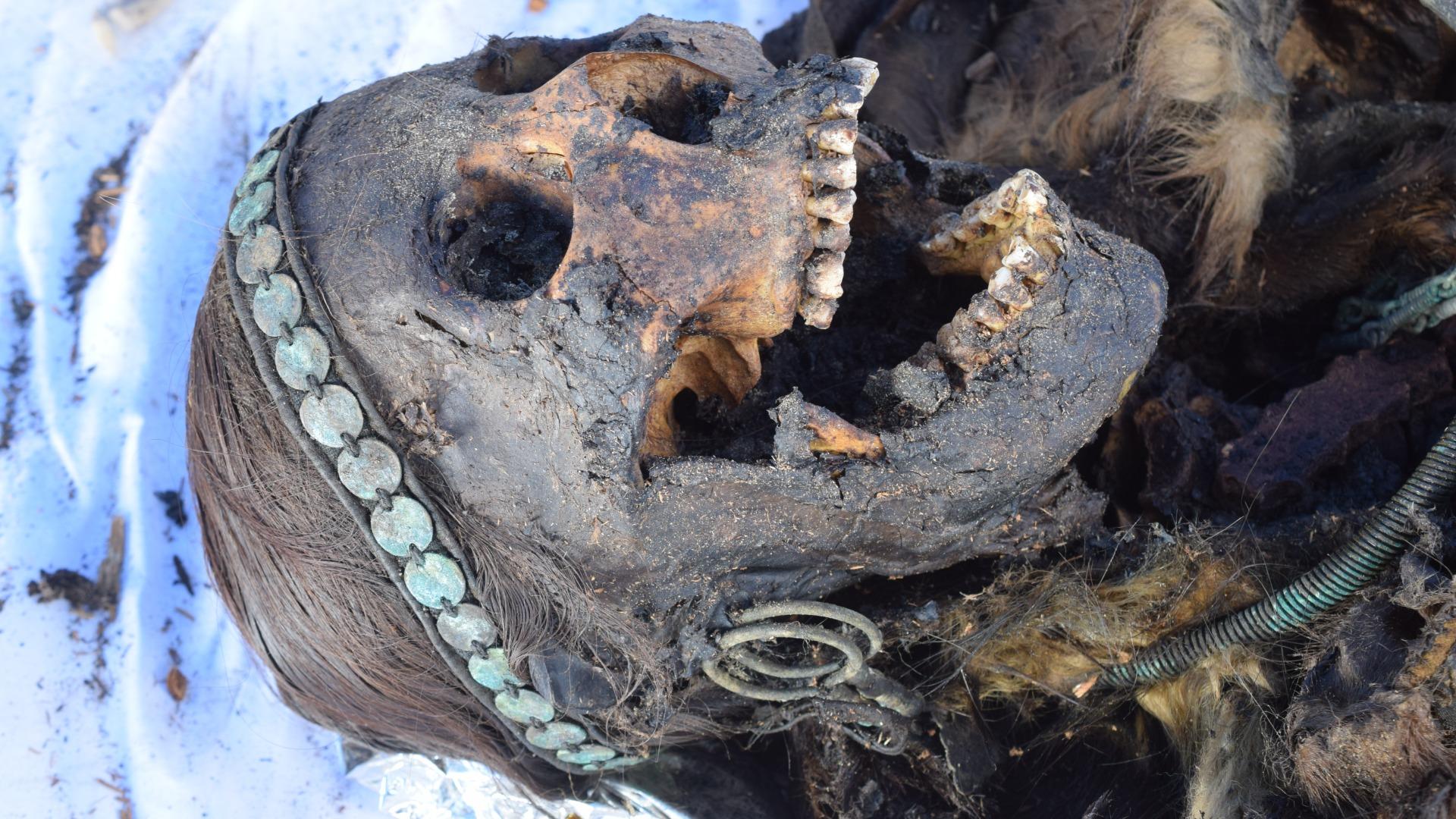
Among the burials, some individuals are linked directly to known historical families. One woman in particular, UsSergue1, is buried with an impressive array of goods: a wood comb, a fur hat adorned with a bronze solar disk, a choron placed between coffin and chest, stirrups, bridles, bells and a richly decorated saddle. Her skull is still crowned with jewellery. Archaeologically, she is clearly of high status.
Genetically, she is the most inbred Yakut in the study, the child of second-degree relatives. Yet her pedigree shows that she is the great-granddaughter of AtDaban6, a woman married to Bozekov, the most powerful clan leader of the late seventeenth and early eighteenth centuries. She is, in other words, a late descendant of the fur-trade elite.
She dies at the moment when Christian influence is tightening its grip on Yakut society, and her grave is one of the last to display classic shamanic artefacts. The article suggests that she may embody a final attempt by an old clan to maintain its ancestral spiritual and material world in the face of a new order.
Other graves also tie into shamanic traditions. Individuals at the Arbre Chamanique site bear ritual objects and show evidence of having died during a smallpox epidemic. Yet when the authors map shamanic burials against their genetic kinship network, they find no single "shaman clan". Shamanism appears across different families, not locked inside one bloodline.
The permafrost preserved not only human bodies but also microscopic traces of disease and everyday life. In three individuals from Central Yakutia, the authors identified DNA from the smallpox virus. Two of them had enough viral DNA preserved in lung and bone to allow partial reconstruction of the virus genome.
When these Yakut smallpox strains are set alongside other ancient and twentieth-century smallpox genomes, they do not nest neatly within the main twentieth-century clusters responsible for worldwide outbreaks. Instead, they form a distinct branch, suggesting that by about 1650 a particular lineage of smallpox was circulating in Yakutia that was different from those documented in Europe.
The article also examines ancient oral microbiomes from dental calculus deposits. From 78 calculus samples and 55 teeth, the authors reconstructed 74 ancient oral microbiomes. Despite four centuries that saw the arrival of tobacco, vodka and cereal crops, the underlying structure of the Yakut oral microbiome barely changed. The oral communities of a sixteenth-century horse breeder and an early twentieth-century Christian convert look, microbially speaking, almost the same.
Taken together, the ancient individuals in this article trace a clear arc. A deep local population, glimpsed in the Iron Age Mokp burial, is joined by migrants from the Baikal region around the time of Mongol expansion. A small founding community forms, probably in the thirteenth and fourteenth centuries, and then flourishes, spreading across the river basins of Yakutia.
Frozen graves from 1500 to 1922 CE, filled with cauldrons of horse meat, mammoth ivory combs, wooden saddles and, later, Orthodox crosses, show that despite disease, trade and imperial rule, the Yakut genetic inheritance remained remarkably constant. The article's ancient DNA work does not overturn Yakut oral traditions; it gives them a molecular backbone, confirming that the Yakut story is one of fusion between old Yakutia and newcomers from the south, followed by centuries of continuity in one of the harshest inhabited regions on Earth.
Original source: https://www.nature.com/articles/s41586-025-09856-5
Comments