Tracing Leonardo: DNA Signals from da Vinci–Linked Artifacts
– 5 min read



Biological Signatures on Leonardo-Linked Objects
This comprehensive study explores how traces of life – from plants and animals to microbes and humans – still cling to Renaissance drawings and centuries-old letters. By taking the gentlest possible swabs from the surfaces of artworks and documents connected with Leonardo da Vinci and his family, researchers demonstrate that every object carries a quiet biological record of its own history. These objects function as archaeological sites in miniature, where every surface fiber can hold the remains of past environments and people.
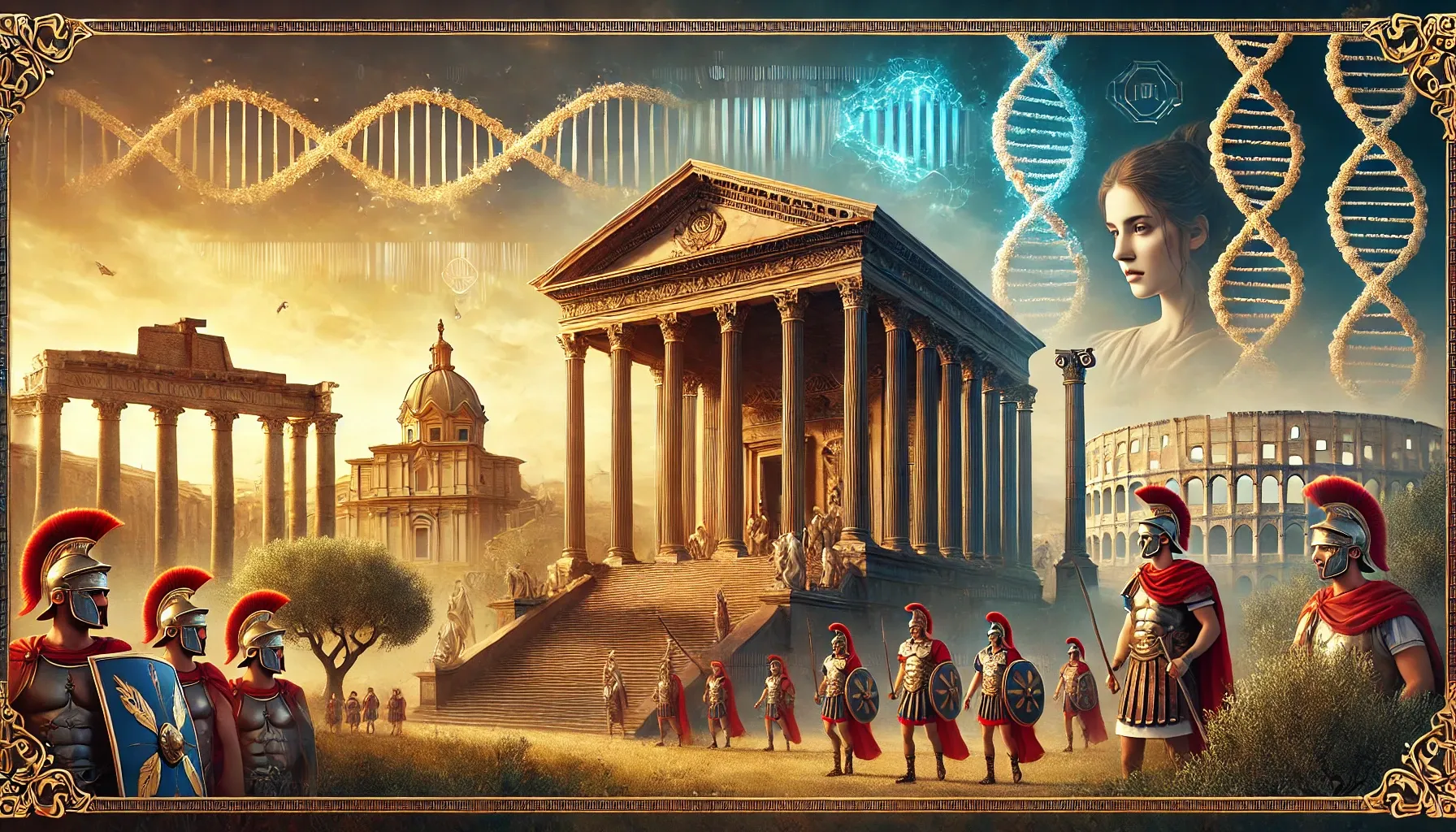
Advances in archaeogenetics have made it possible to trace our DNA back thousands of years, linking us to cultures long lost to time. You can see where your lineage fits in this vast human map at MyTrueAncestry.com.
At the center of this investigation stands a small but celebrated drawing, the red-chalk "Holy Child", attributed to Leonardo da Vinci and dated to around 1472–1476. Drawn on laid paper, only a hand's span in size, it was handled, framed, and admired over more than five centuries. The research team also sampled letters written by Frosino di Ser Giovanni da Vinci, Leonardo's ancestor, preserved in the Fondo Datini at the Archivio di Stato di Prato, alongside comparative drawings by Filippino Lippi, Andrea Sacchi, and Charles J. Flipart.
These objects span several centuries and cities – Florence, Rome, Paris, Barcelona, and Prato – and have lived many lives: created in workshops, transported, stored in archives, passed through collections. The study treats them almost as archaeological sites in miniature, where every surface fiber can hold the remains of past environments and people. Each chosen area on the artwork or manuscript is very lightly rubbed with a sterile swab, sometimes slightly moistened first, and then immediately followed by a second, dry swab.
When researchers sequenced the DNA from each swab, they found a rich mixture of plant material on the artworks. Among the most striking discoveries were sequences matching Italian ryegrass, one of the classic European grasses, and millet, one of the earliest domesticated crops known from ancient Eurasia. More specifically Tuscan were the willows – species of Salix – that line riverbanks such as those of the Arno. In fifteenth-century Florence, willows were not merely scenery: their wood and withies were turned into baskets, bindings, scaffolding, and charcoal for the workshops of painters and metalworkers.
The "Holy Child" showed a particularly intriguing hint of citrus DNA, especially sweet orange. Here, the biological trace echoes the social world. In fifteenth-century Tuscany, the Medici family – great patrons of Leonardo's generation – cultivated exotic gardens filled with prized citrus trees. For them, citrus was a badge of wealth, global connections and scientific curiosity. Leonardo is known to have spent time in the Medici garden at San Marco in Florence, a place where art, botany, and humanist learning mingled.
While the study is careful not to claim a direct connection, the presence of citrus on a Leonardo-attributed drawing fits remarkably well with this broader historical setting of gardens, patrons, and experimental horticulture. Plant DNA can reach an object through many routes: from the paper and sizes used in its making, from air and dust in workshops and storerooms, from resins and varnishes, or simply from pollen drifting through open windows.
Animal traces also emerged from the swabs. DNA fragments from pigs (Sus scrofa) and dogs (Canis lupus familiaris) were especially common. These could arise from anything from historical parchment and glues to more modern contamination from dust, leather bindings, or storage materials. More telling, perhaps, are the hints of animals that formed part of the economic fabric of Renaissance Italy.
The study identifies fragments of DNA from Chlamydia abortus, a pathogen of sheep and goats. Tuscany, like much of central Italy, relied heavily on sheep husbandry, particularly for wool. Wool fed the great textile industries that helped make Florence rich. It is therefore entirely plausible that documents and artworks would, over years of travel and storage, accumulate microscopic traces of the flocks that underpinned the region's wealth.
The fungal DNA paints a picture of the long lives of these objects in cupboards, cellars, libraries, and private collections. The researchers find evidence of common storage fungi and environmental species that speak to centuries of archival conditions. One of the archival letters produced an especially intriguing, though tentative, signal: sequences that looked like they might belong to Plasmodium, the parasite responsible for malaria.
Malaria was endemic in parts of Italy during the Renaissance, including low-lying and marshy areas of Tuscany, and there is independent evidence of malarial infection in some members of the Medici family. The study treats this finding with great caution – the data are sparse and could reflect laboratory noise – but even the possibility reminds us that these letters traveled through a landscape where fever and marsh were part of daily life.
The bacterial component of the biological signature is dominated by everyday companions of human skin, such as Cutibacterium acnes, and by various environmental species. These are the microscopic ghosts of artists, scribes, collectors, archivists, conservators, and modern researchers. Alongside them are bacteriophages (viruses that infect bacteria) and human papillomaviruses, which again underline the close and constant contact between people and objects.
No single bacterium or virus can be taken as definitive evidence for a specific event. Instead, the study shows that each object has its own recognizable pattern – a "composite biome" – that reflects a lifetime of surfaces, storage conditions and human touch. When compared across objects, these patterns are different enough that the artworks and letters can be separated from one another in statistical space, as if each drawing and document sits in its own tiny microbial niche.
Beyond plants and microbes, the researchers also attempted to detect traces of the men who wrote, drew and handled these objects. They focused on the Y chromosome, which is passed from father to son and can be grouped into large "branches" or haplogroups with characteristic distributions across regions and populations.
From the "Holy Child", from letters written by Leonardo's ancestor Frosino, and from comparison drawings and controls, the team collected and sequenced traces of human DNA. As expected for surfaces that have been touched by many people over centuries, the human DNA was extremely sparse and mixed. Yet, in a subset of samples, enough Y-chromosomal fragments remained to attempt a cautious reconstruction.
The most interesting pattern appears in the objects associated with Leonardo da Vinci's family. Multiple independent swabs from Leonardo-associated items – the drawing and his ancestor's letters – repeatedly point to a broader paternal group within the E1b1/E1b1b lineage, a major Mediterranean cluster common today around the Mediterranean shores, in parts of Italy and southern Europe, and in North Africa and the Levant.
Some control samples – modern male volunteers and other artworks – carried different Y lineages typical of Europe and the Near East. One male control also belonged to the broader E1b1b group, but to a distinct sub-branch. The repeated appearance of related E1b1/E1b1b signals specifically on the Leonardo-linked objects raises the tantalizing possibility that the biological traces of a da Vinci paternal line may still linger on these surfaces.
Source: https://www.biorxiv.org/content/10.64898/2026.01.06.697880v1
Discover how your DNA connects to ancient civilizations at www.mytrueancestry.com.
Comments