Haplogroup R1b1a1b1a1a1c2b2a1b1b1a1

– 6 min read


Some Y-DNA lineages are historically interesting because they turn up in famous places. Others are interesting because they appear in awkward, revealing corners of the past: a bog in Jutland filled with the dead of conflict, a Viking Age burial on Oland, a medieval church setting in Belgium where one man could still be marked as an outsider. Haplogroup R1b1a1b1a1a1c2b2a1b1b1a1 belongs to that second category. It is a very specific paternal branch, and that specificity matters, because the narrower the branch, the more careful we must be about the claims we make for it.
Y-DNA haplogroups trace a direct paternal line: father to father to father across the centuries. They do not describe a person's whole ancestry, culture, language, or identity. In a broad sense, this lineage sits inside the vast R1b family, one of the major Y-chromosome groupings in western Eurasia. But a deep subclade like this one should not simply be handed the entire biography of R1b as though nothing changed along the way. What ancient DNA can do, however, is show us where closely related paternal lines appear in time and space, and that begins to sketch a historical geography stretching across northwestern Europe.
When we deal with a lineage as specific as R1b1a1b1a1a1c2b2a1b1b1a1, the sensible starting point is not to pretend certainty we do not have. The wider R1b tree has a long history in Europe, and many of its branches became prominent in different regions and periods. Yet the story of this exact subclade is not automatically the story of all Bronze Age steppe expansions, all Celtic-speaking peoples, or all later northwestern Europeans. The evidence supplied here instead points us toward something more grounded: a branch visible in ancient individuals from Denmark, Sweden, and Belgium, and therefore one that sits plausibly within the world of North Sea and adjacent continental mobility.
That matters because the North Sea was never a barrier in the simple sense. It was a highway, a recruiting ground, a raiding zone, a trading corridor, and sometimes a grave. Paternal lineages moved through it with men who fought, married, settled, migrated, and were buried far from where their grandfathers had lived. If you want a broader framework for the deep prehistoric backdrop behind such European paternal histories, MyTrueAncestry readers may also enjoy this overview of the continent's early farming expansion.
Explore Europe's Neolithic Expansion
The first supplied sample is CGG019209, described as Jute Early Roman Era Denmark Jutland Bog War Alken Enge Year:88 AD. Alken Enge is one of those sites that remind us how brutal Iron Age and Roman-era northern Europe could be. Human remains deposited in wetlands are not tidy genealogical documents; they are evidence of organized violence, disposal, ritual, or all three together. A lineage appearing here places this paternal branch, or a very close one, in Jutland during the early Roman era. That does not make the man "a Jute" in some modern ethnic shorthand just because the sample label uses the word. But it does root the haplogroup in the social world of southern Scandinavia at a time when local communities were entangled with wider northern European currents.
The second sample, VK444, comes from Viking Age Oland Island Sweden Year:847 AD. Oland in the Viking Age was no backwater. It sat in a maritime zone tied to Baltic exchange, Scandinavian politics, and long-distance travel. A paternal line found there in the ninth century suggests continuity or reappearance within a Scandinavian setting several centuries after the Alken Enge individual. Again, this is not proof that CGG019209 and VK444 belonged to the same immediate family line in any genealogical sense. What it does show is that related paternal ancestry could persist in the wider northern sphere across a very long span of time.
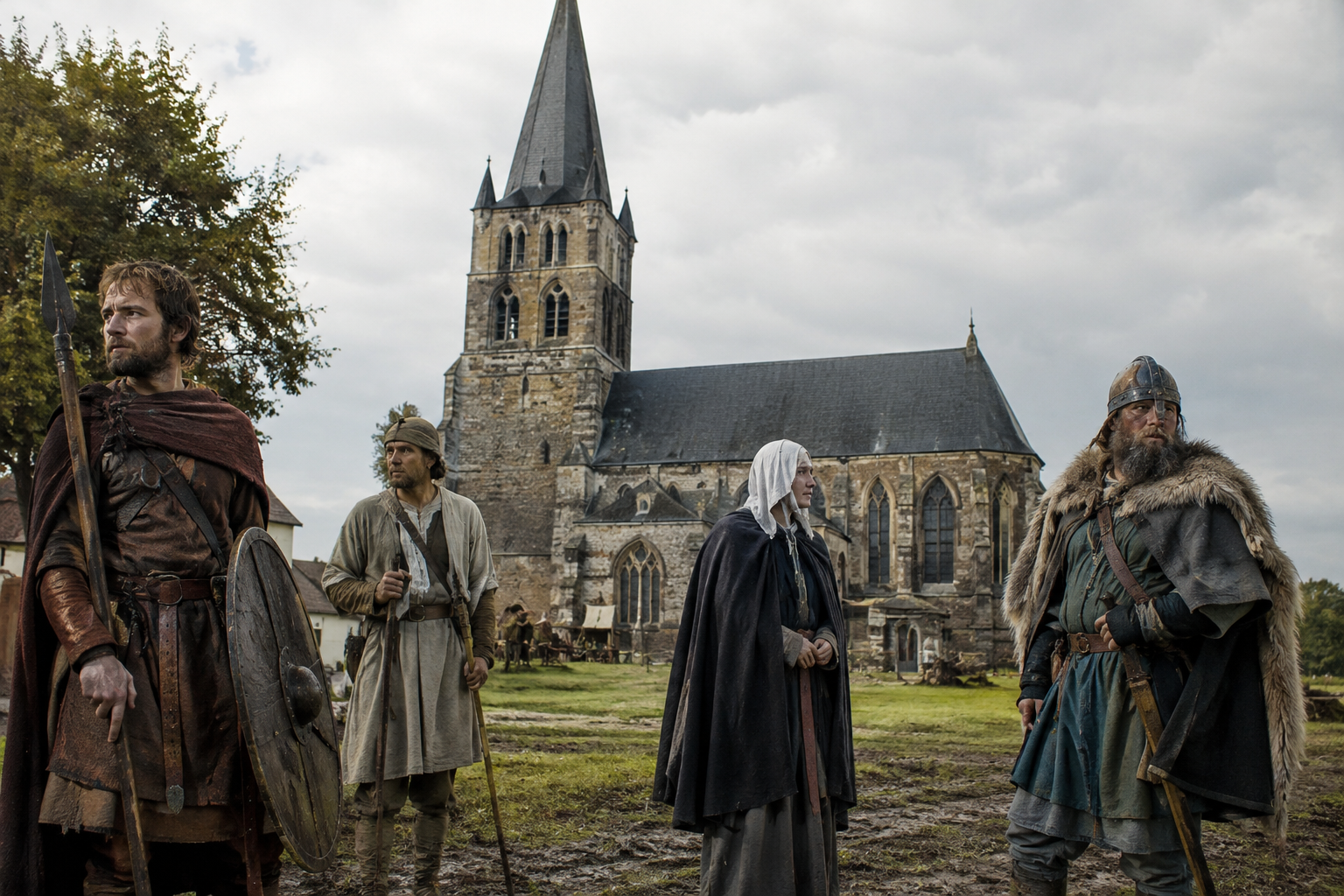
The third sample, ST1186, is recorded as Medieval Belgium Outsider Sint-Truiden Onze-Lieve-Vrouwekerk Year:900 AD. That word "outsider" is especially tantalizing. Medieval towns and ecclesiastical centers were full of movement: clerics, craftsmen, traders, retainers, pilgrims, displaced people, and ambitious newcomers. Sint-Truiden sat in a region deeply shaped by Carolingian and post-Carolingian politics, monastic institutions, and urban development. A paternal lineage linked to an "outsider" there is a neat reminder that the medieval Low Countries were not genetically static villages frozen in amber. They were connected landscapes.
Readers interested in that exact region and context should have a look at MyTrueAncestry's piece on medieval Sint-Truiden, which explores how genetics can illuminate an urbanizing medieval community.
Explore Medieval Sint-Truiden DNA
Put those three samples together and a pattern begins to emerge, if modestly. This haplogroup's documented ancient appearances cluster around the northern European seaways and adjacent mainland. Jutland, Oland, and Sint-Truiden belong to different political worlds, but they are not unrelated worlds. By the first millennium AD they were linked by trade, warfare, mercenary service, migration, and the creation of new Christian and aristocratic orders.
That is where ancient DNA is at its most interesting. It does not tell us that one neat ethnic group marched from point A to point B carrying a label on its forehead. Instead, it shows paternal lineages recurring within historically connected zones. In this case, that zone stretches from Denmark to Sweden to the Low Countries, precisely the kind of network from which later medieval North Sea societies emerged. If you want to think more about that maritime corridor, the MyTrueAncestry article on North Sea migration offers a useful companion.
It is also worth stressing what this does not prove. It does not prove a direct line from a Viking Age man on Oland to a medieval noble house in Scotland. It does not prove that every later bearer of a similar Y-line was Scandinavian, nor that every historically Scandinavian family carried this branch. Genetics gives us distribution and relatedness, not a ready-made saga.
That caution is especially important when we turn to later noble families. The supplied associations point to Clan Scott and Clan Shaw, not as proven genetic certainties for every documented male in those families, but as historically meaningful contexts in which this haplogroup is of interest.
For Clan Scott, the landscape is Dalkeith Palace in Midlothian. The site had an earlier medieval castle tied to the Douglas family before passing to the Crown after the fall of the Black Douglases in the fifteenth century. In the early eighteenth century, the older fortress gave way to the grand palace created for the Duke of Buccleuch, with architecture inspired by the great classical houses of Europe. That progression is almost a little essay in Scottish history: fortress, forfeiture, royal politics, aristocratic magnificence, and finally modern reuse as part of a university campus. It is not "genetic proof" of anything, but it is an extraordinarily good reminder that paternal lines, if they endured locally, passed through changing social worlds far more complicated than a clan tartan on a postcard.
Clan Shaw's associated stronghold, Dounreay Castle in Caithness, tells a different northern story. Probably built in the 1500s for the Sinclair family, it stood in a region shaped by Norse influence, clan rivalry, and coastal exchange. By the modern era the tower had fallen into ruin, and in the twentieth century the surrounding area was transformed by the Dounreay nuclear establishment. Few images better capture the sheer oddity of historical continuity: a late medieval ruin surviving beside one of Britain's most striking industrial landscapes. For a haplogroup with ancient appearances in Scandinavia and the North Sea zone, Caithness is historically resonant ground, though resonance is not the same thing as proof.
Readers who want to dig further into these family settings can continue with MyTrueAncestry's clan features on the Scotts and the Shaws.
The great value of a lineage like R1b1a1b1a1a1c2b2a1b1b1a1 is not that it hands us a fairy tale of direct descent from warriors, Vikings, or nobles. The value is subtler and better. It shows how one paternal branch can appear in very different settings: a violent bog deposit in Roman-era Jutland, a Viking Age burial on Oland, and a medieval individual in Belgium described as an outsider. That is a history of movement, survival, and regional connection.
For Scotland, the noble and architectural associations add another layer. Places such as Dalkeith and Dounreay preserve the memory of the societies in which later paternal lines were recorded, contested, and remembered. Castles do not carry DNA, but they do preserve the political geography within which men carrying particular Y-lines lived, married, served, fought, and founded later families.
If you are interested in how Scandinavian and Viking Age genetics illuminate these later worlds, one more MyTrueAncestry article is especially relevant here.
So the lesson of this haplogroup is not a boast but an invitation to think historically. A Y-chromosome branch can connect northern Europe across centuries, yet every appearance belongs to a different human story. Ancient DNA gives us the skeleton of that story. Archaeology, castles, and historical records put clothes back on the bones.
If this lineage has sparked your curiosity, MyTrueAncestry can help you explore whether your DNA shows links to ancient individuals, archaeological cultures, and historic populations like those discussed here. Those matches can offer remarkable clues about deep ancestry, even when they do not prove direct descent from a particular ancient person, clan, or noble family.






Comments