Haplogroup I1a5a

– 7 min read


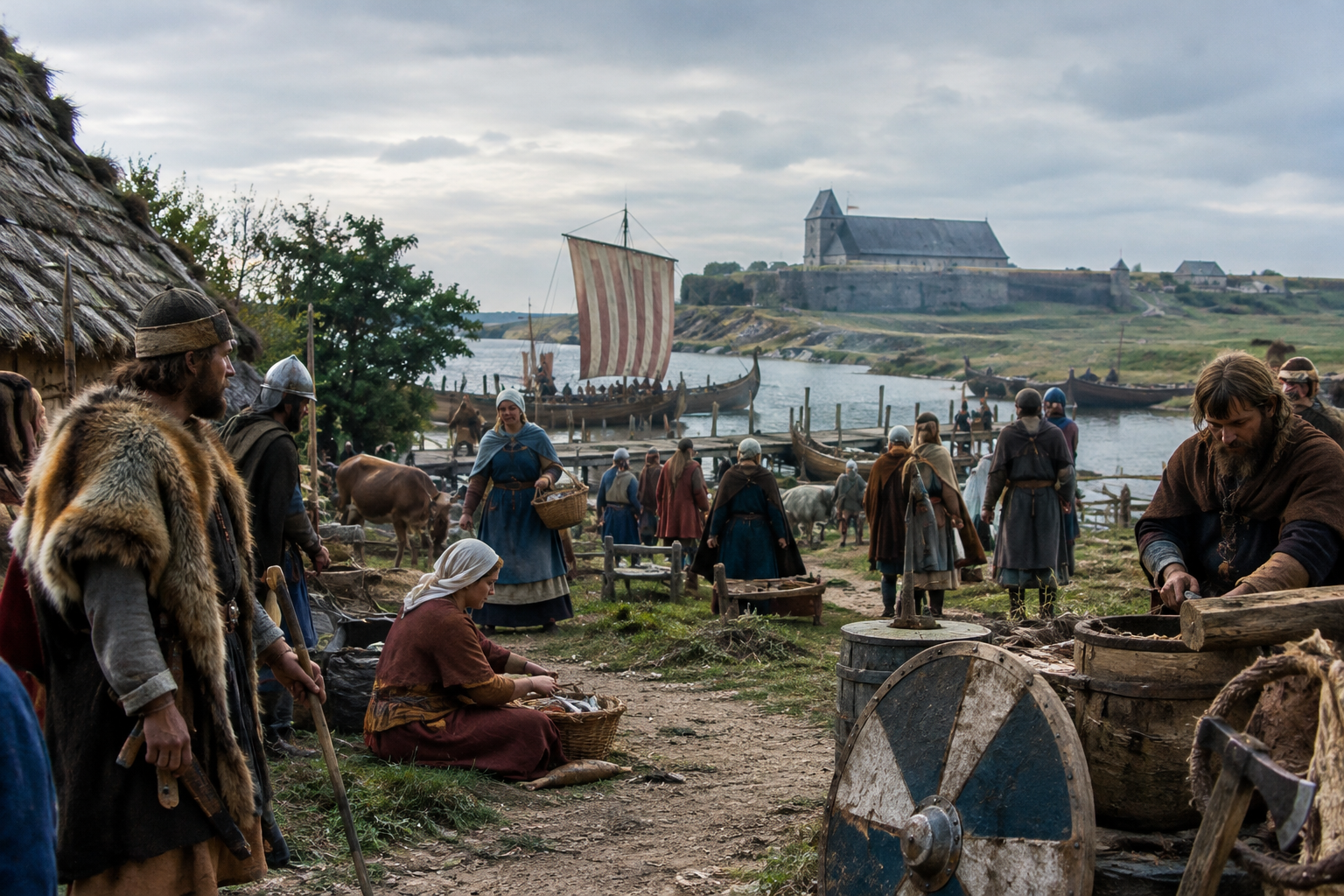
Some Y-chromosome lineages announce themselves with imperial fanfare. Others are more intriguing because they appear, quietly but persistently, across the cold shores and inland corridors of northern Europe, then turn up again in Viking-age movement, early medieval societies, and later historical landscapes. Haplogroup I1a5a belongs to that second category. It matters not because it can be made to explain everything, but because it offers a narrow paternal thread running through a very wide historical canvas.
As always, a caution is essential at the start. A Y-DNA haplogroup traces one direct paternal line only: father to father to father. It does not represent a person's complete ancestry, culture, language, or identity. Nor does sharing a haplogroup prove close kinship with an ancient individual or a noble family. What it can do, however, is illuminate long-term patterns in male-line ancestry, settlement, and movement. In the case of I1a5a, the supplied ancient DNA points strongly toward a northern European and especially Scandinavian story, with later appearances stretching into Britain, central Europe, the Baltic world, and even the Norse Atlantic.
I1a5a is a subclade within the wider Y-DNA haplogroup I1, a lineage long associated in broad terms with northern Europe. For a branch as specific as I1a5a, it is important not to lazily assign it the entire history of all I1 men across millennia. Still, the evidence supplied here suggests that this particular paternal line was present in Scandinavia from at least the Bronze Age onward and remained visible there through the Iron Age and Viking Age.
The earliest samples in this set are striking. CGG106712, from Early Nordic Bronze Age Denmark at Lolland Uglemose, dated to 1675 BC, and NEO590, from Nordic Bronze Age Denmark at Sjaelland Magleo, dated to 1347 BC, place this paternal line in southern Scandinavia deep in prehistory. So too does oll009, the Ollsjo Battleaxe Sweden sample dated to 1840 BC. One should not flatten these into a single simplistic migration tale, but together they suggest that lineages related to I1a5a were already part of the human landscape around the Baltic in the Bronze Age.
That matters because Scandinavia was not some frozen cul-de-sac. It was a zone of exchange, maritime travel, local continuity, and repeated reshaping. A lineage appearing in Bronze Age Denmark and Sweden, then reappearing in later Iron Age and Viking contexts, gives us a plausible picture of endurance in the north rather than a brief genetic cameo.
Explore Scandinavias Bronze Age Roots
By the Iron Age, the pattern becomes denser. We see CGG106524 from Iron Age Denmark, Jutland Hestehavens mose, dated to 237 BC; CGG106718 from the Danii Tribe at Sjaelland Kalundborg Simonsborg, dated to 175 AD; CGG107392 from Iron Age Denmark Asnos, dated to 188 AD; CGG024145 from Pre-Vendel Sweden at Oland Stoerlinge, dated to 175 AD; and CGG106822 from a Nordic Tribe context at Sjaelland Denmark Bredebjerggord 8, dated to 350 AD.
This is not one family marching through time. It is something more interesting: a paternal signature recurring across different Scandinavian settings over many centuries. The appearance in both Denmark and Sweden suggests that I1a5a, or closely related paternal lines within this branch, belonged to the interconnected world of the western Baltic and Kattegat, where seaways mattered as much as frontiers on land.
The Danii reference in CGG106718 is especially evocative. It places the lineage within a context associated with the peoples later linked to the Danes, though one must not leap from one Y-line to a whole ethnic identity. Ancient DNA is often most useful when it pricks the bubble of neat labels. What it shows here is that a male line associated with later Scandinavian populations was already present in the region's Iron Age communities.
And then the story spills outward. Samples such as OBM052 from the Thuringii Tribe in Germany Obermoellern, dated to 500 AD, and DRH024 from Deersheim, Saxony-Anhalt, also dated to 500 AD, suggest that this northern paternal branch was not confined to Scandinavia. The same is true of AED249, a Dark Ages Baiuvarii Tribe sample from Bavaria dated to 485 AD. These finds fit well with the broader movement and mixing of the Migration Period, when northern and central Europe saw shifting confederations, military retinues, resettlements, and local integration.
Explore Post-Roman Central Europe
If the Bronze and Iron Age evidence shows persistence, the Viking Age evidence shows range. The supplied list includes VK367 from Viking Age Bogovej Langeland Denmark, dated to 900 AD; VK316 from Viking Age Hessum Funen Denmark, dated to 950 AD; CGG106776 from Viking Age Denmark Bogovej, dated to 975 AD; and VK420 from Viking Age Hedmark Norway, dated to 950 AD. These are exactly the kinds of contexts in which one would expect Scandinavian paternal lines to appear, and they reinforce the northern core of the haplogroup's history.
But Viking mobility was never just about Scandinavia itself. VK144, identified as a Danish Viking Clan sample from the St. Brice Massacre Oxford, dated to 1002 AD, places the lineage in one of the most dramatic episodes of Anglo-Scandinavian history. Here the genetic evidence does not merely point to movement; it sits within a documented moment of violence in England involving people of Scandinavian background.
Another remarkable sample is VK409 from Viking Age Staraya Ladoga, dated to 1000 AD. Staraya Ladoga was a key node in the eastern Viking world, linking the Baltic to the river routes of eastern Europe. This sample hints that men from this paternal branch participated not only in western sea-raiding and settlement, but also in the eastward networks of trade, warfare, and political formation.
Then there is VK190 from the Post Viking Era Greenland Western Settlement, dated to 1404 AD. A Y-line that appears in Bronze Age southern Scandinavia and later in Greenland is, frankly, irresistible. Not because it proves an unbroken dynasty of named men, but because it vividly illustrates the geographic reach of Scandinavian expansion. A paternal lineage rooted in the Baltic north was carried across the North Atlantic into one of medieval Europe's most marginal settlements.
The British evidence in this set does not begin and end with Vikings. ATP_PSN_351, from Medieval England Cambridge St Johns Hospital, dated to 1049 AD, shows the lineage in medieval England in a very different setting: not a battlefield or a ship burial, but an institutional urban environment. That is rather useful, because it reminds us that paternal lineages do not belong only to warriors, chiefs, or saga protagonists. They also belonged to ordinary or semi-ordinary men living in towns, hospitals, parishes, and working communities.
Elsewhere on the continent, the line appears in contexts that speak to the complexity of late antiquity and the early Middle Ages. A181017 from Gothic Kecskemet-Mindszenti Transtisza Hungary, dated to 450 AD, and VEM059 from Early Medieval Croatia Velim-Velistak, dated to 775 AD, show that this paternal branch had spread well beyond its Scandinavian heartland. That does not make I1a5a a "Gothic haplogroup" or a "Croatian haplogroup." It means that men carrying this line were part of the fluid population movements that shaped Europe after Rome.
Even the much later kro008, from the Stora Kronan Shipwreck Battle of Oland Sweden, dated to 1676 AD, has a certain grim charm. It shows the survival of this paternal line in Sweden into the early modern military world. The same Y-chromosome branch seen in Bronze Age burials and Viking contexts turns up in the crew of a seventeenth-century warship. It is a reminder that haplogroups are not episodes. They are long continuities, though never simple ones.
The later historical association supplied here brings us to Clan MacCrimmon and Dunvegan Castle on the Isle of Skye. This is a splendid place to think about the difference between genetic history and historical memory. Dunvegan Castle, the oldest continuously inhabited castle in Scotland, has been the seat of the chiefs of Clan MacLeod for around 800 years. Beginning as a fortified rock above Loch Dunvegan in the thirteenth century, it developed into a great house shaped by additions, rebuilding, and the long afterlife of Highland tradition.
The castle's story mixes power, warfare, hospitality, and cherished objects such as the Fairy Flag and the Dunvegan Cup. In other words, it preserves exactly the sort of noble and clan memory that written history loves: seats, symbols, alliances, prestige. The MacCrimmons, famed in Highland tradition and associated with the MacLeods, belong to that world of hereditary service, lordship, and local reputation.
What genetics can do here is more modest, but still illuminating. A haplogroup association does not prove that every historical MacCrimmon man carried I1a5a, nor that a Bronze Age or Viking-age carrier of this line was an ancestor of the clan. That would be fantasy dressed as science. What we can say is that the long presence of I1-related paternal lines around the North Sea and in Britain gives meaningful context for later Scottish and insular histories. The world of Skye did not arise in isolation. It sat at the edge of Gaelic, Norse, and later Scottish political worlds, precisely the sort of contact zone where northern paternal lineages might have deep historical roots.
Dunvegan itself is valuable not as genetic proof but as a physical archive of regional continuity. Its stones, additions, and survivals preserve the memory of families whose identities were shaped by medieval lordship, sea routes, and layered ancestry. That is where castle history and DNA history can genuinely meet: not in crude claims of descent, but in showing how long-settled regions carry both biological and cultural continuities across centuries.
Taken together, the evidence for I1a5a suggests a paternal lineage strongly tied to Scandinavia from the Bronze Age onward, later visible in Iron Age Denmark and Sweden, present in Migration Period central Europe, active in Viking-age expansion, and still detectable in medieval Britain, the Norse Atlantic, and early modern Sweden. That is a substantial historical footprint.
It also offers a useful lesson in method. Ancient DNA does not replace archaeology, and neither replaces written history. But together they allow us to ask better questions. A castle like Dunvegan preserves the memory of later families. Ancient samples such as CGG106712, NEO590, VK144, and VK190 preserve something different: glimpses of real men who lived in very different worlds, yet belonged to paternal lines that could endure for thousands of years.
If your own Y-DNA falls within I1a5a, that does not make you a Viking, a Thuringian, or a MacCrimmon. It does mean that one narrow branch of your ancestry belongs to a lineage with a documented past in the northern European world. And that, frankly, is interesting enough without embroidery.
If you want to explore how your DNA compares with ancient individuals, historical populations, and the deeper paternal story behind your results, MyTrueAncestry can help place your ancestry in a much wider historical setting. Those comparisons may reveal fascinating connections to ancient peoples and regions, while not proving direct descent from any specific ancient individual or noble family.






Comments